





























António Campinos says Europe has “more or less lost” the global AI race, but can still be a major player in the next tech revolution if it focuses on bringing down barriers within the EU single market.
The President of the Munich-based European Patent Office (EPO) has said that the European Union should focus on further integrating its single market if it is to win the global race in emerging technologies and grow market-leading enterprises.
 ADVERTISEMENT
ADVERTISEMENT
ADVERTISEMENT
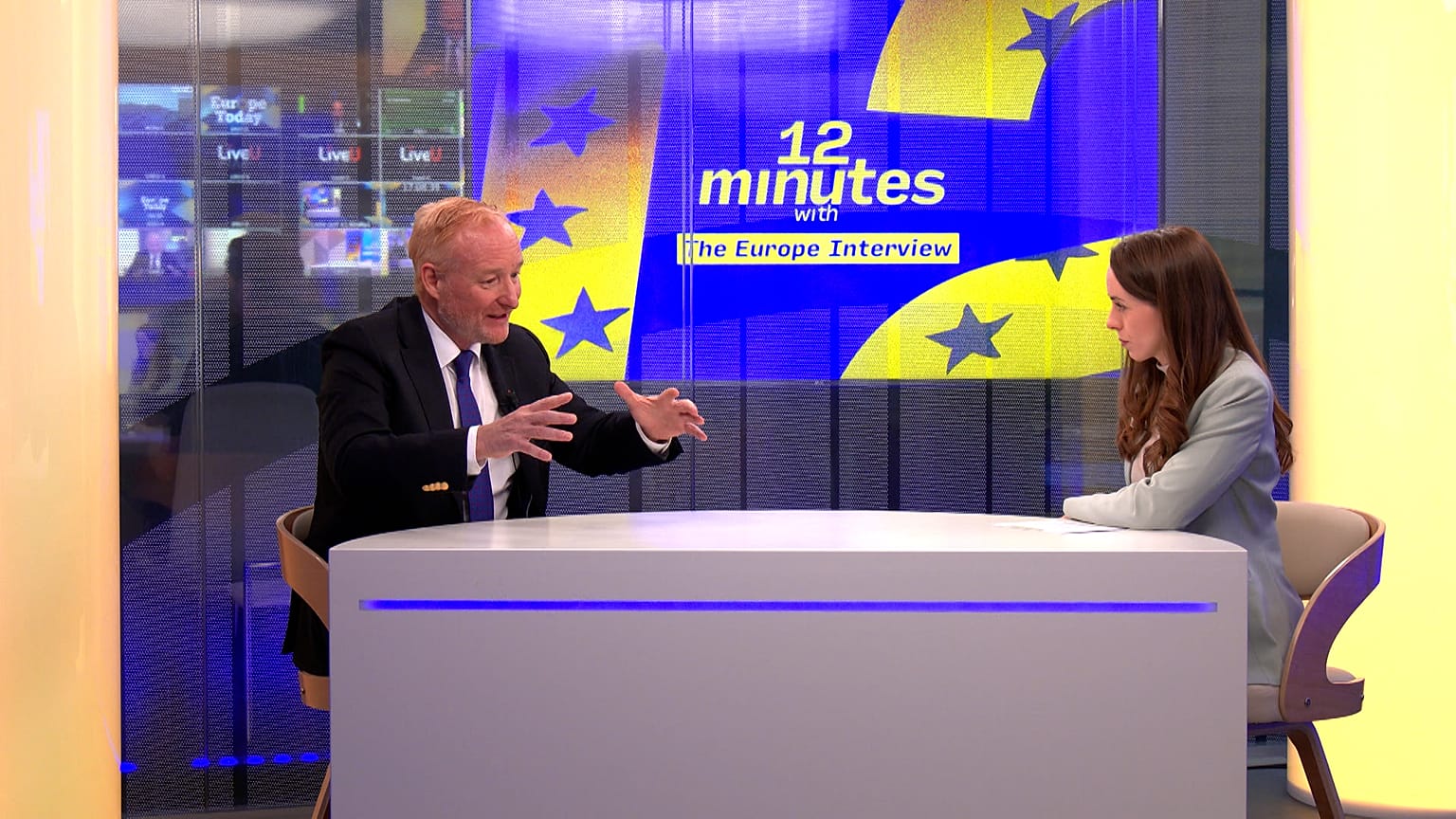
Speaking on Euronews’ 12 Minutes With, Campinos acknowledged that Europe has “more or less lost” the global race to dominate in the cloud and Artificial Intelligence (AI), but that there are “technological battles where we (Europe) can bring incremental improvements”.
The Munich-based institution he leads examines as many as 200,000 patent bids every year, allowing inventors and companies to obtain patent protection in up to 46 countries with a single application.
“The next big revolution I see is quantum technology. We're still in the phase in between fundamental research and development research, but we're coming rather close to the market. And typically, that's where Europe loses the battle of competitiveness, of innovation,” Campinos explained.
While Europe is considered a global powerhouse for innovation and research, startups face challenges when commercialising their inventions. “We have a problem of scale and of attracting sufficient funds in order to bring ideas from the lab to the market,” Campinos said.
“So that's why we need to focus. And to focus, we really need to defragment the internal market,” he added, saying Europe should integrate its stock markets to allow start-ups operating in these emerging sectors to scale up and become “global players”.
In February, the EU’s 27 leaders gathered for a retreat in the Belgian countryside – together with former Italian premiers Mario Draghi and Enrico Letta – to brainstorm new ways of reviving the bloc's stagnant economy and abolishing regulatory barriers.
Draghi and Letta are authors of two landmark 2024 reports on how to restore the EU’s competitive edge faced with fierce global competition, which call for deepening the integration of the bloc in areas such as energy, capital, telecommunications, and innovation.
While the diagnosis is well-known, progress in implementing the reforms has stalled.
The European Commission last week unveiled proposals for a new, EU-wide company regime known as EU Inc, which allows anyone to register a company online in 48 hours, for less than €100, and follow one set of rules throughout the bloc.
Campinos hailed EU Inc as a major step in helping startups and companies scale up across the Union, but said more needs to be done to further “defragment” the internal market.
“We really need to remove as many bureaucratic barriers as we can in order to free a little bit of space for macro entities, for research centres, for universities to bring as many ideas from the lab to the market,” Campinos said. He added that failing to do so represents a non-tariff barrier of around 40% to 60% for goods and 100% to 110% for services, and a lost GDP generation of up to €700 billion.
Campinos believes adapting the EU’s competition rules to a global market and integrating the bloc’s stock exchanges could create more certainty and opportunity for startups to scale up.
“We need to look into it because in the past 50 years, we didn't generate a $100 billion company or a trillion-dollar company, which is basically the value of many US and Chinese companies,” he added.
French President Emmanuel Macron recently set a June deadline for a new “agenda” on the EU’s economic revival, set to include the so-called Savings and Investments Union, which would streamline EU capital markets into a single pool of financial securities.
A sense of impatience for change is pushing a group of EU governments willing to integrate further to consider doing so without the participation of all 27 member countries, a prospect which could set a new precedent for the way the Union works.