




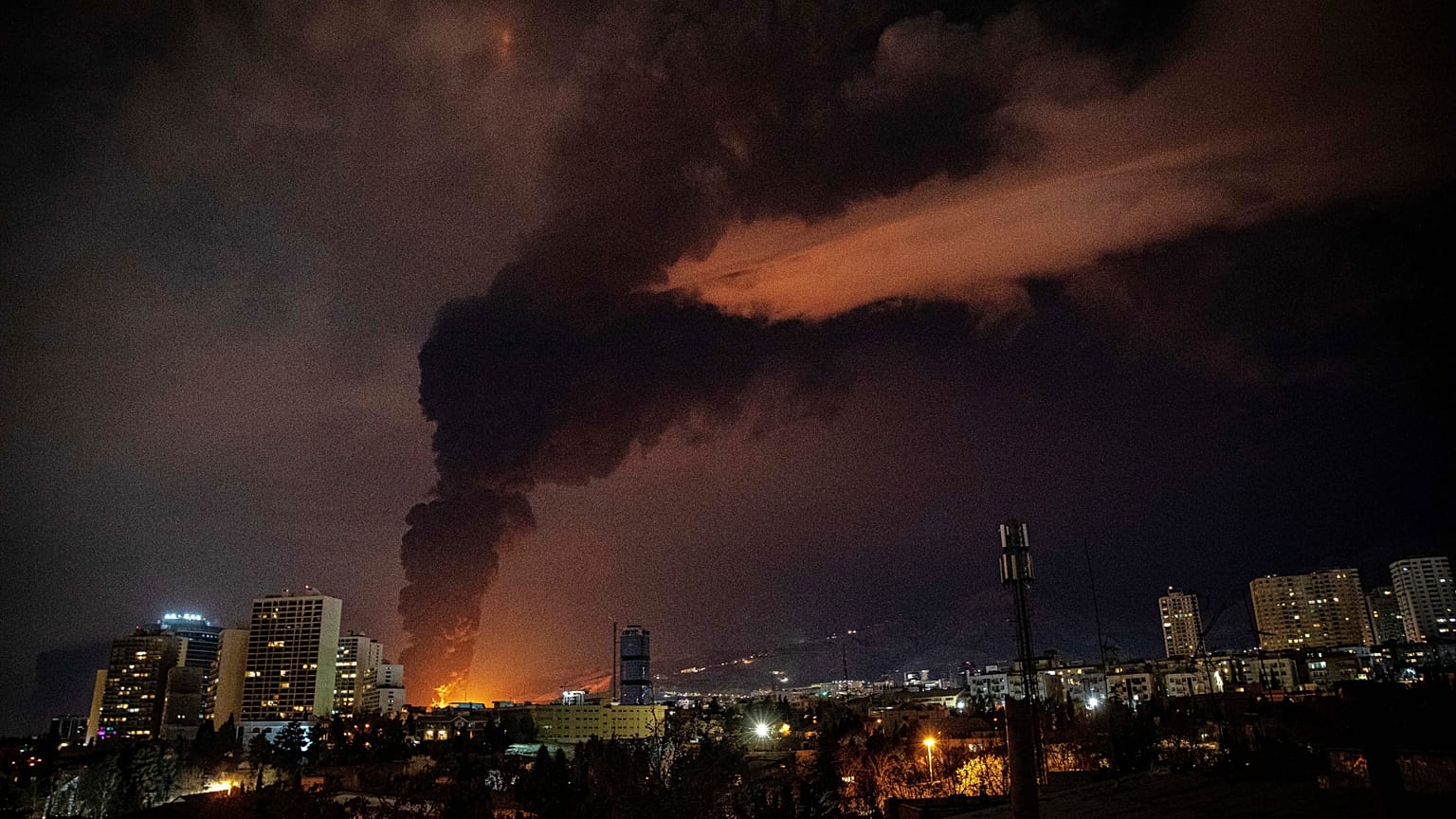













The United States and Iran are at war, and the European Union is increasingly affected by this rapidly escalating regional conflict.
Expanding quickly into a multi-front regional, the clashes have shattered global energy security, with fighting spreading from the Persian Gulf to NATO-linked territory.
 ADVERTISEMENT
ADVERTISEMENT
ADVERTISEMENT
After the launch of Operation Epic Fury on 28 February 2026 - a coordinated U.S.-Israeli operation targeting senior Iranian leaders, including Supreme Leader Ali Khamenei- Iran responded with large waves of ballistic missiles and drones. The fighting has already spread beyond Iran and Israel: strikes hit U.S. military assets and civilian infrastructure in Bahrain, the United Arab Emirates, and Qatar, and even reached the base of Akrotiri in Cyprus.
For Brussels, the crisis is no longer just a distant foreign policy issue but a potential threat to EU stability. The closure of the Strait of Hormuz disrupted global energy markets and pushed European natural gas prices up by almost 40%, as shipments of liquefied natural gas (LNG) from Qatar stopped.
The European Union Agency for Asylum (EUAA) is preparing for a humanitarian crisis. Officials warn that if large numbers of people were forced to flee Iran’s population of around 90 million, Europe could face the biggest refugee influx in decades.
In response, the EU has activated several civil protection tools to coordinate emergency assistance and strengthen defences against possible cyberattacks. The rapid escalation has also revealed weaknesses in the bloc’s preparedness: it still lacks a unified military rapid-response force, and gas storage levels are lower than in previous years (around 46 billion cubic metres compared with 77 billion cubic metres in 2024), leaving member states trying to address structural vulnerabilities.
All DGs on deck
In the latest Preparedness Union Strategy (published March 2025), the EU defines preparedness not just as a reactive capacity, but as a proactive, structural "mindset" to anticipate, prevent, and respond to cross-border threats.
In this case, the threats consist of energy instability, an impending refugee crisis, hybrid and cyber threats, transatlantic rifts, like the US’s possible trade retaliation against Spain, and security gaps. To face this, the bloc splits responsibilities between several Directorate-Generals (DG) - government departments or ministries.
DG ECHO coordinates humanitarian assistance through the EU Civil Protection Mechanism, including emergency aid and relief supplies. DG HOME focuses on internal security and border management, preparing for large migration flows and protecting critical infrastructure. DG CNCT oversees cyber resilience, implementing the Cyber Solidarity Act to help countries respond to cyberattacks on essential services. Meanwhile, DG DEFIS leads efforts to strengthen Europe’s defence industry, boosting military production and securing supply chains for defence equipment.
EU citizens have options
EU citizens fall back on several mechanisms in the event of conflicts, natural disasters or civil unrest beyond the Union’s borders.
European consulates and embassies are citizens’ first contact point. Under the Council Directive (EU) 2015/637, EU citizens abroad have the right to diplomatic and consular protection, and any member states’ representation must offer relief, evacuation and repatriation aid regardless of the EU nationality.
National governments remain in charge of repatriation operations. Yet, as stated by the Commission on 2 March in response to the situation in the Middle East, Europe supports “Member States' evacuation and repatriation efforts, including through the EU Civil Protection Mechanism and the Emergency Response Coordination Centre (UCPM), working closely with EU Delegations”.
This is the EU’s main evacuation tool. Through the ERCC, a 24/7 emergency hub, the UCPM co-finances and facilitates evacuations and aid delivery and coordinates the EU’s overall response. The EU organised the largest repatriation operations with 400 flights for 1000.000 Europeans during the pandemic and 98 flights for 3.000 citizens during the 2023 Afghanistan-withdrawal.
Hadja Lahbib, Commissioner for Equality, Preparedness and Crisis Management, recently announced that two flights under the UCPM have successfully brought back 356 Europeans from the Middle East. Beyond this, the EU also supported several member states in repatriating over 4.100 EU citizens. Efforts continue as the conflict unfolds.
“The EU has your back. That is our message to the thousands of European citizens stranded in the Middle East. We are sparing no effort to get our people home safe and sound. Since day one of the escalation in the Middle East, the EU has been fully mobilised through our Civil Protection Mechanism, organising more than 40 flights and bringing over 4,000 Europeans home safely. For the first time, rescEU planes are now flying EU citizens out of the region", Lahbib told Euronews.
"On the humanitarian front, Europe continues to carry the torch of humanity. The EU is the world’s largest humanitarian donor, with nearly €2 billion in humanitarian funding this year alone. With more than 100,000 people displaced in Lebanon, the EU has activated its new Middle East emergency fund to deliver lifesaving medicine, shelter, and urgent supplies", she added.
In the event of airspace closure or attacks, the UCPM foresees overland routes and hubs, for example in Jordan and Egypt. With its real-time satellites mapping, the Copernicus Emergency Management Service assesses impacted areas and identifies safe evacuation routes. The UCPM also activates on-the-ground emergency responses, such as search and rescue teams, and in-kind assistance aid.
With its 143 EU Delegations, the European External Action Service (EEAS) is not a “direct rescue player”, but it supports national repatriation and evacuation efforts by facilitating cooperation between embassies and the UCPM. In practice, delegations accelerate repatriation air and road journeys.
Additional response coordination comes from the Integrated Political Crisis Response (IPCR). By pooling together EU institutions and member states’ representatives, the mechanism supports the European Council’s presidency to identify gaps and share information to better align the EU’s overall response.
Conflicts and unrests abroad often trigger internal security threats, especially if some member states get militarily involved in external crises. As society's high digitalisation level increases vulnerability to foreign interference, the EU Cybersecurity Strategy reinforces the bloc’s operational ability to fend off, deter and address cyber threats.
The EU’s ProtectEU cooperates with Europol in countering spillovers in the EU, including terrorist and cyber-attacks, and building resilience through new information-sharing methods. The Commission levelled up the cooperation with Europol and the member states following ongoing unrests in the Middle East.
According to a representative of the Directorate-General for Communications Networks, Content and Technology (DG CONNECT), cyberattacks are brutal because they are thoroughly planned, remain undetected and manage to exploit systems’ vulnerability using AI.
Cooperation and information sharing between member states on cyber incidents on critical infrastructures is also essential for scaling up preparedness and reducing exposure to cyber-attacks, the representative said.
The representative also added that AI-driven disinformation campaigns linked to ongoing conflicts can heavily affect the EU’s internal security. As AI enables cheap production of deep-fakes, foreign actors can leverage AI to inflame tensions within the EU.
In case of conventional military attacks on Europe, the EU’s Mutual Defence Clause (Article 42(7) TEU) and Solidarity Clause (Article 222 TFEU) ask member states for military cooperation and overall joint action.
The 2025 Preparedness Union Strategy enhances Europe’s internal security by strengthening preparedness and reactiveness to emerging threats. Key objectives range from boosting foresight and anticipation capabilities, safeguarding vital societal functions, promoting citizens’ preparedness, to enhancing civil-military cooperation.
RescEU, a reserve of emergency equipment under the UCPM created during the pandemic, assists citizens with medical specialist teams, field hospitals, and firefighting planes, among others. Under this reserve, the EU Stockpiling Strategy guarantees Europeans essential goods in the event of a crisis.
Yet real operational reality looks different. The EU supports and coordinates crisis management while national governments remain in control. Different national systems, procedures, and priorities create an additional layer of complexity, often slowing down internal and external emergency response coordination.
Financial protection
Over on the financial side – at risk as oil prices rise and the energy market becomes extremely volatile – the EU has developed a host of tools meant to cushion the impact of these types of crises.
The first layer is monetary and financial stabilisation led by the European Central Bank (ECB). In the event of severe shock, the ECB can inject liquidity into the system through targeted lending operations and swap lines with other major central banks, ensuring banks continue to access funding even if markets become volatile. If needed, it can also intervene through asset purchases or other monetary tools to stabilise borrowing conditions.
Meanwhile, the euro area’s crisis fund, the European Stability Mechanism (ESM), can offer emergency loans or precautionary credit lines to governments facing sudden financing pressures, helping them maintain public spending and avoid destabilising debt crises.
There are fiscal rules and EU-level borrowing instruments that allow governments to spend more during emergencies. Under the Stability and Growth Pact, the EU can activate the “general escape clause”, suspending deficit limits so member states can run larger deficits without breaching fiscal rules.
It can also raise money collectively on financial markets, as it did during the COVID-19 pandemic with the SURE programme, which issued common EU bonds to finance wage-support schemes and prevent mass unemployment.
The EU budget itself can be redirected for financial relief. In a crisis, the EC and member states can reprogram existing funding streams to support emergency priorities such as humanitarian assistance, reconstruction, or refugee support.
Instruments like the CARE and RESTORE regulations have previously allowed governments to reallocate billions of euros from long-term development programmes to crisis management. And Article 122 of the EU treaties allows the Council to approve extraordinary financial support measures or new emergency funds when member states face severe economic difficulties, for quick mobilisation of resources - like, for example, a historic influx of Iranian refugees.
The Banking Union also includes a Single Resolution Fund, financed by banks themselves, to manage the orderly resolution of failing banks and prevent wider contagion. National deposit guarantee schemes insure bank deposits up to €100,000, helping to maintain public confidence in the banking system.
Institutions such as the European Investment Bank can provide credit lines, guarantees, and export financing to support companies and maintain trade flows during economic shocks.
In case of energy shocks
Another pressing financial issue is the severe disruption in the global supply of oil and natural gas. For this, the EU established legislation that requires member states to hold strategic oil reserves equivalent to around 90 days of imports. These would be released in coordination with international partners to stabilise supply and limit price spikes.
The EU has also established joint gas purchasing platforms that allow countries to pool demand and negotiate contracts collectively, reducing competition between member states and lowering costs. Emergency regulations can also impose temporary revenue caps or windfall taxes on energy companies, redirecting excess profits to funds used to subsidise household energy bills.