




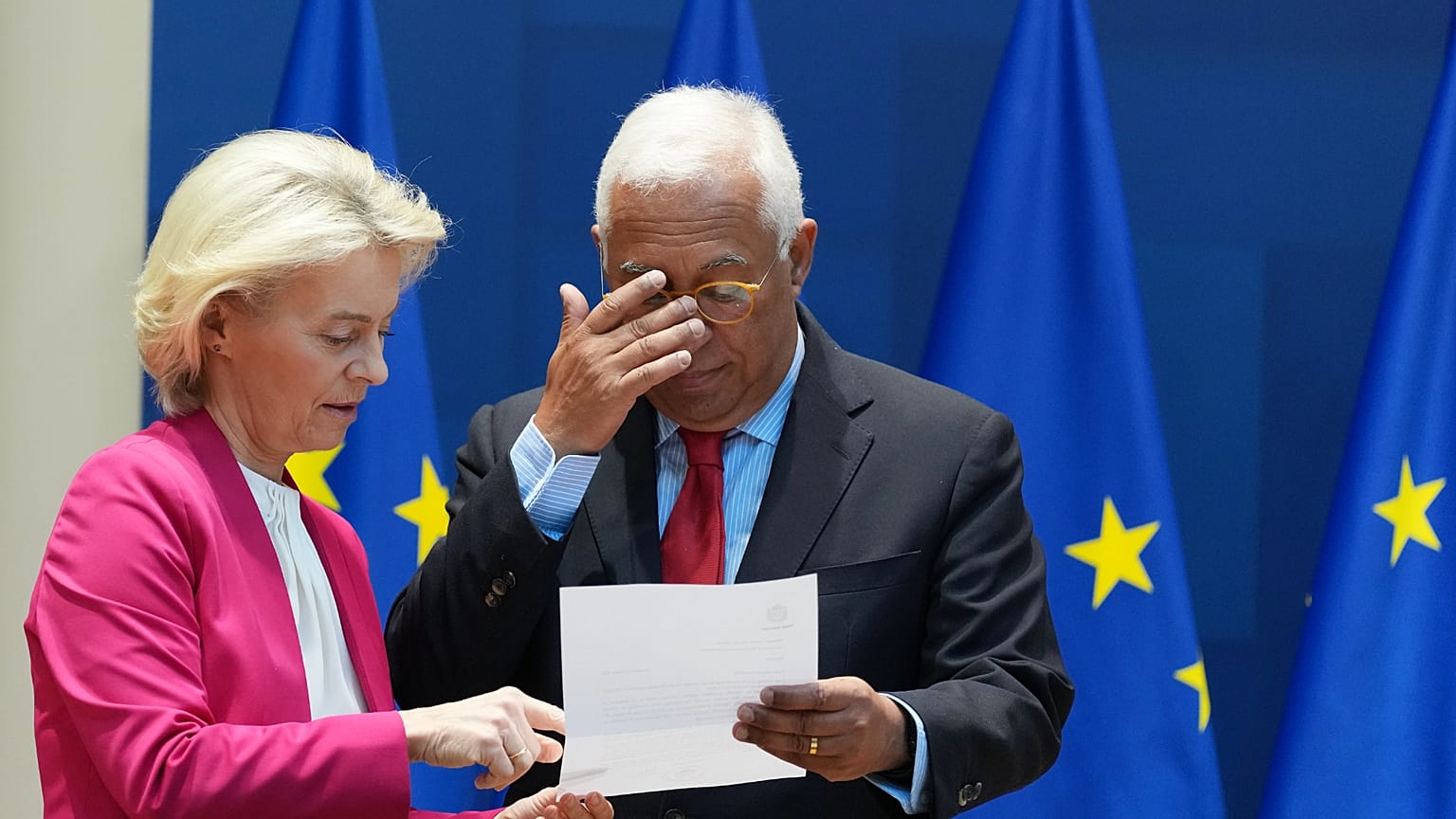













Council President Costa calls to double down on respect for international rules even if others don't, as von der Leyen urges a pragmatic, interest-driven foreign policy rooted in seeing the world as it is, not how it should be.
European Council President António Costa told ambassadors the EU will always defend the rules-based international order a day after Commission President Ursula von der Leyen called for an interest-driven foreign policy anchored in realpolitik.
 ADVERTISEMENT
ADVERTISEMENT
ADVERTISEMENT
Costa said the bloc should not tolerate "violations of international law" citing the United States, Russia, and China, as forces of disruption - from trade to security. While acknowledging that the world is shifting, he said the EU should not move away from its fundamental principles. Instead, the bloc should double down.
"We know the new reality - a reality in which Russia violates, China disrupts trade and the United States challenges the international rules-based order," he said Tuesday.
"We must pursue a multidimensional foreign policy...It is in our interest to avoid further world fragmentation," he added. Costa referenced the treaties of the EU and the United Nations Charter as the core of its foreign policy action.
He also said the EU should call out violations of international law, going from Ukraine, to Greenland, Latin America in a reference to Venezuela, in Gaza and the Middle East. Costa said the people of Iran deserve to live in freedom and peace but suggested that bombs alone will not achieve that as the US-Israeli military operation enters its second week.
The legitimacy of the war remains a point of tension among EU member states.
While the Spanish Prime Minister Pedro Sánchez called it illegal and escalatory, rejecting an extension of the conflict, German Chancellor Friedrich Merz initially downplayed international law, suggesting that this is not the time for the EU to lecture its allies.
Contrasting remarks
His comments come after the head of the Commission addressed the same conference on Monday with a sobering speech in which she argued that the war is a fact, and political debates do little to change the course of it.
Von der Leyen also called on ambassadors to enact a "more realistic and interest-driven foreign policy" in a world that has turned chaotic and transactional. While the Commission is seen as the ultimate guardian of the EU treaties, as proxy for rules-based decision-making, von der Leyen appeared to suggest that too is becoming a relic.
"Europe can no longer be a custodian for the old-world order, for a world that has gone and will not return," she said.
"We will always defend and uphold the rules-based system that we helped to build with our allies, but we can no longer rely on it as the only way to defend our interests or assume its rules will shelter us from the complex threats that we face."
Von der Leyen was the first EU official to call for a political transition in Iran as the war broke out, aligning with the US and Israel in their push to change the Ayatollah regime. Iran's late Supreme leader Ali Khamenei was killed in the first day of the war.
After becoming Commission president in 2019, von der Leyen promised to turn the executive into a geopolitical actor and has grown her powers at the turn of each crisis from the pandemic to the war in Ukraine, gaining a central footing in peace negotiations.
While her geopolitical stature has expanded, it is not without criticism.
Diplomats consulted by Euronews said her one-off remarks, without consensus from the 27 member states, often reflect her position and do not represent the EU.
Historically, the Commission president's role central has focused on implementing the treaties, drafting legislation and ensuring it is applied across the bloc, while refraining from playing a role in foreign policy or defense, seen as a national competence.
Since the start of the Russian invasion of Ukraine in 2022, von der Leyen has enlarged her competences on both and even set up a security college for her Commission to discuss defense matters in ad hoc consultation body. After the war in Iran broke out, she called an emergency meeting and established direct talks with Middle Eastern leaders.