


















By the end of the century, all ski resorts across the Alps may be forced to use snow cannons, with dire consequences for local nature.
Could the 2026 Milano-Cortina Winter Olympics be the last held on natural snow?
 ADVERTISEMENT
ADVERTISEMENT
ADVERTISEMENT
The Games were widely hailed as a success, but also drew criticism for their heavy reliance on artificial snow: around 1.6 million cubic meters, according to the organisers.
That's roughly equivalent to around 640 Olympic-sized swimming pools.
Like it or not, rising winter temperatures could make artificial snow a non-negotiable necessity for future Winter Games — at least on the Alps.
Artificial snow keeps winter sports industry afloat
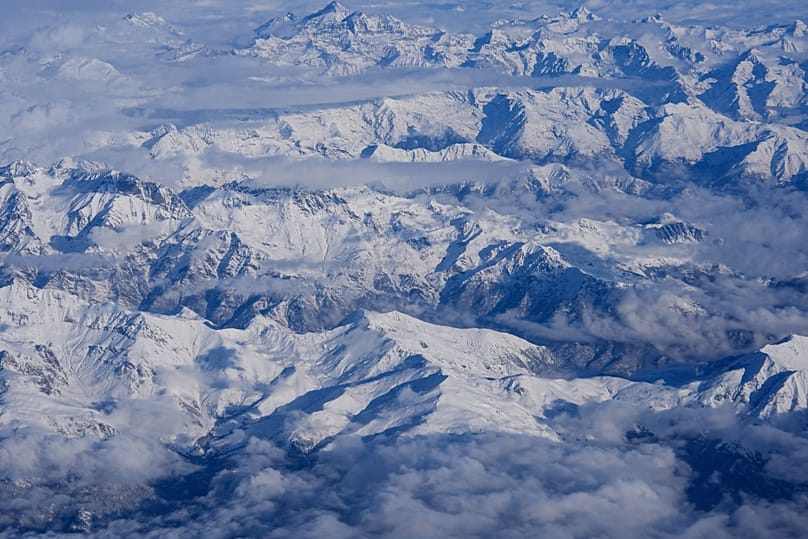
By the end of the century, snowfall across the mountain range, which spans eight countries, is predicted to decline by between 25% and 45%.
This is based on a joint study by King's College, Saïd Business School at the University of Oxford, and the University of Trento called "The snow must go on: Theorising the climate innovation conundrum in expiring industries".
Globally, the industry is projected to grow at an annual rate of 4.4% between 2025 and 2032. But researchers warn that by 2050, ski resorts below 1,200 metres may have to endure snow-free winters.
So far, the winter sports sector has seen off the threat and managed to stay in good health, also thanks to the use of artificial snow, much like the recent Winter Olympics.
According to the study, some 90% of Italy's ski resorts already rely on artificial snow, compared to 70% in Austria and 54% in Switzerland.
"Once seen as a temporary fix, technical snowmaking is now a structural necessity, enabling resorts to remain operational even in low-snow years," the study says. "The widespread adoption of snowmaking reflects the growing consensus that natural snowfall alone cannot sustain snow tourism."
One of the few exceptions in Italy is the ski resorts near the highest glaciers. For example, the Marmolada — at 3,343 metres — which is nonetheless projected to vanish by 2040.
What's the financial, energy and environmental cost of artificial snow?
The use of artificial snow may save winter holidays, but for the environment, it's a problem, scientists say.
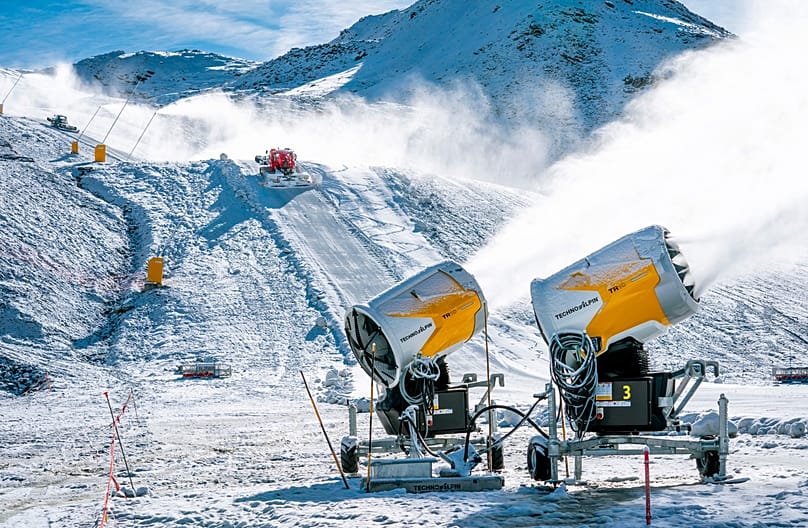
Snow cannons need a massive amount of water to blanket the slopes with snow.
Covering just one hectare (or 0.01km²) with 30 centimetres of artificial snow requires around 1,000 cubic metres of water — roughly 20 backyard swimming pools.
The water is pumped from nearby rivers and lakes — draining local resources — or drawn from artificial basins, which is no less impactful, as it requires extensive land work.
By 2023, the industry created "142 such basins" in Italy alone, covering more than one million square metres.
On top of that, fake snow is also denser and harder. It melts more slowly, leading to soil compaction and delayed plant growth.
'Delaying a local problem while intensifying it globally'
Its carbon footprint is significant too: in Italy, for example, "electricity-related emissions from snow production alone amount to 24 kt CO₂ eq, projected to rise by 24% and 30% with +2°C and +4°C warming, respectively", according to the King's College, Oxford and Trento study.
Ultimately, the cost is not to be overlooked, ranging from €3.50 to €5 per cubic metre.
"Artificial snow making exemplifies the tension between short-term economic resilience and long-term environmental sustainability", tells Europe in Motion Juliane Reinecke, one of the study's authors and Faculty Director for Sustainability at Saïd Business School.
"For resort managers, snowmaking is about survival. It is a rational and necessary adaptation to climate risk. But snowmaking raises long-term sustainability concerns: it is water- and energy-intensive and requires intensive snowmaking infrastructure".
"As temperatures rise, even more snow must be produced until even that may no longer be sufficient to guarantee season-long snow cover."
"Firms are incentivised to prioritise operational continuity and short-term resilience. Societies, by contrast, have to worry about long-term decarbonization and ecological limits. When adaptation technologies are energy- and resource-intensive, they may solve (or delay) one problem locally while intensifying it globally. That is the paradox we are trying to highlight".