




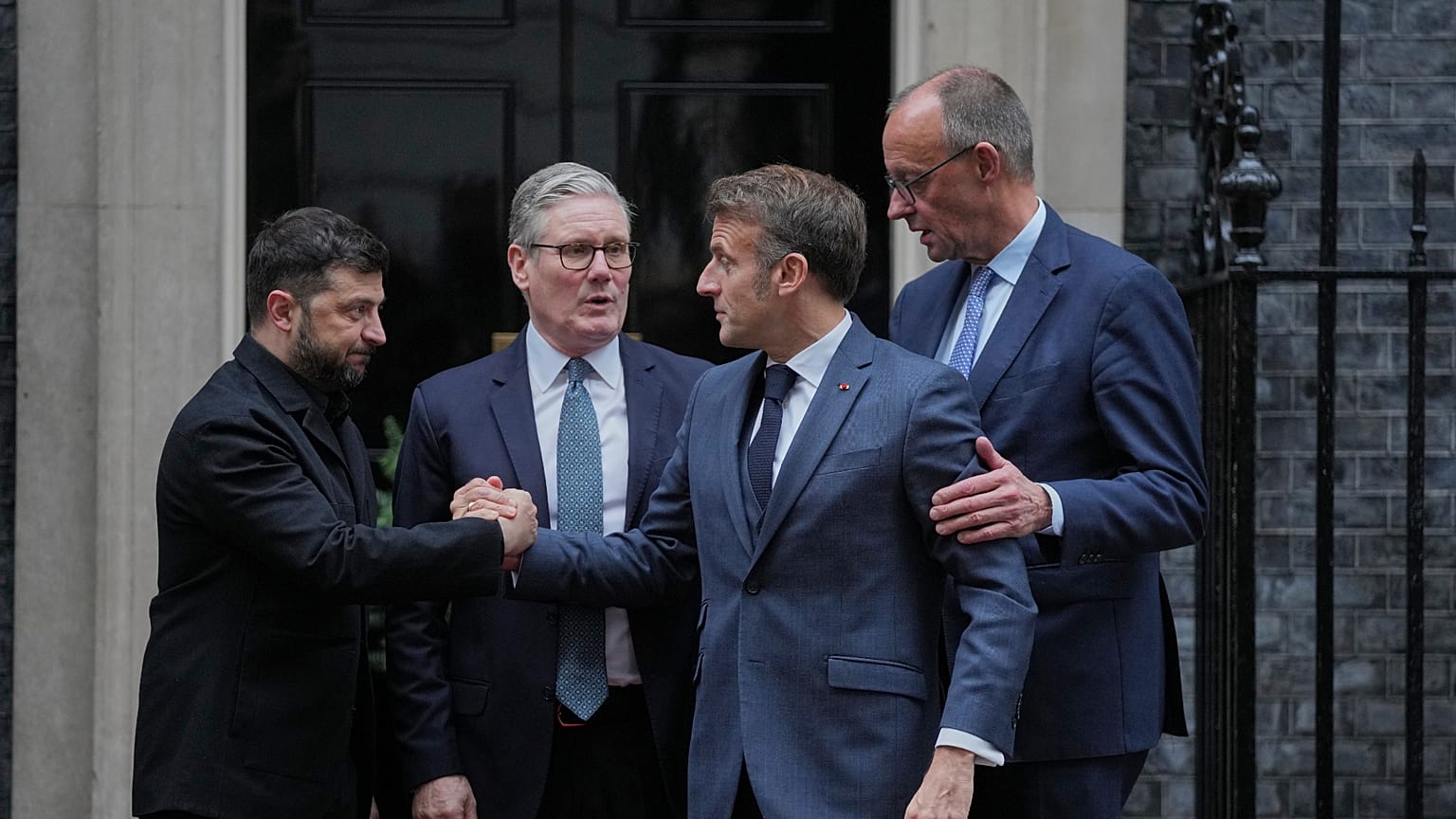














As Ukraine marks four years since Moscow launched its full-scale invasion, Kyiv has shut down "absurd" claims by Russian intelligence that the UK and France will give it nuclear weapons.
Senior Russian security official Dimitry Medvedev threatened Kyiv, Paris and London with nuclear strikes on Tuesday, following unfounded reports from the Kremlin alleging that France and the UK were working on supplying Ukraine with nuclear weapons.
 ADVERTISEMENT
ADVERTISEMENT
ADVERTISEMENT
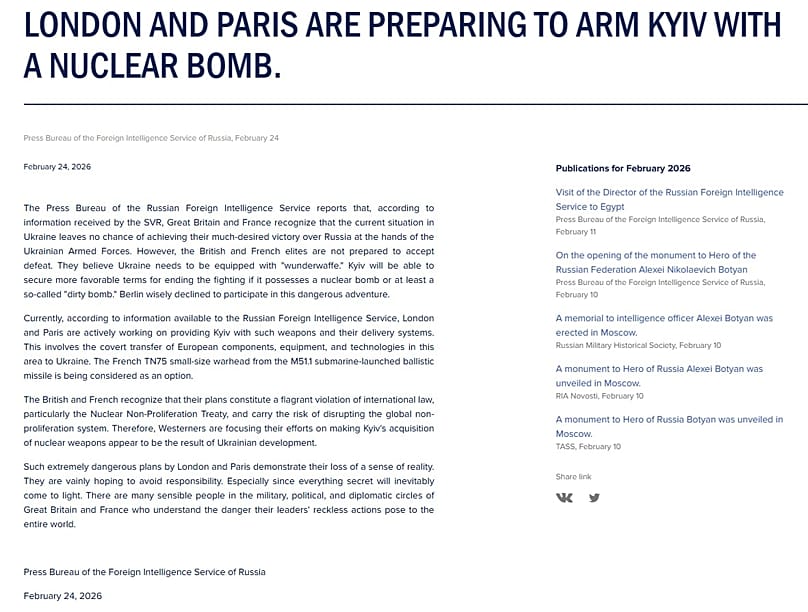
Russia's primary foreign intelligence agency, the SVR, claimed that "London and Paris" were "preparing to arm Kyiv with a nuclear bomb" earlier that day, after alleging that the current situation in Ukraine left the UK and France with "no chance of achieving their much-desired victory over Russia with the help of the Armed Forces of Ukraine."
The claims were subsequently picked up by the Russian state news agency TASS and amplified by pro-Kremlin accounts on social media, who shared the SVR's claims that France and the UK's plan constituted a "flagrant violation of international law".
In reality, there is no evidence to support these claims: they are unsupported and contradict international law, namely the Treaty on the Non-Proliferation of Nuclear Weapons (NPT), under which the UK and France are recognised nuclear-weapon states — Ukraine, however, is not.
The allegations come as Ukraine marks the fourth anniversary of Russia's full-scale invasion, which it launched in February 2022 — a military aggression which violates the UN Charter.
Heorhii Tykhyi, spokesperson for the Ukrainian foreign ministry, reportedly told Reuters that "Russian officials, known for their impressive record of lies, are once again trying to fabricate the old 'dirty bomb' nonsense".
French Response, an X account linked to the French Foreign Ministry and designed to tackle misinformation, refuted the claim on X.
"Five years into its 'three-day war', Russia would really prefer you focus on French and British nukes," it said in a post. "Nuclear brinkmanship won’t hide the overwhelming international support for Ukraine on the fourth anniversary of your failed 'three-day war'."
The UK Ministry of Defence declined to publicly respond to our request for comment on the allegations, but Sky News reported that the British government has already said there was "no truth" to the allegations.
Germany 'refused to take part' in the venture
The statement from SVR also claimed that the German government refused to provide Kyiv with a nuclear weapon.
"Berlin has prudently refused to take part in this dangerous venture," it reads.
A spokesperson for Germany's Ministry of Defence said the ministry "does not comment on media reports and does not respond to statements from such sources".
The SVR's claims would mean France and the UK would be in breach of the Treaty on the Non-Proliferation of Nuclear Weapons, which stipulates that states must not transfer nuclear weapons to non-nuclear-weapon states, such as Ukraine.
The only other recognised states under the treaty are China, Russia and the US.
Ukraine gave up its nuclear weapons in 1994 under the Budapest Memorandum in exchange for security guarantees from Russia, the UK and the US.
President Volodymyr Zelenskyy has expressed his preference for joining NATO over giving Ukraine nuclear weapons, although he conceded that if it took too long for Kyiv to be admitted to the alliance, then nuclear warheads would be a possible deterrence.
There would be no precedent for either France or the UK to transfer their nuclear warheads to another state. Whilst several NATO states take part in nuclear sharing, Ukraine, not being a member, would not be eligible for this.
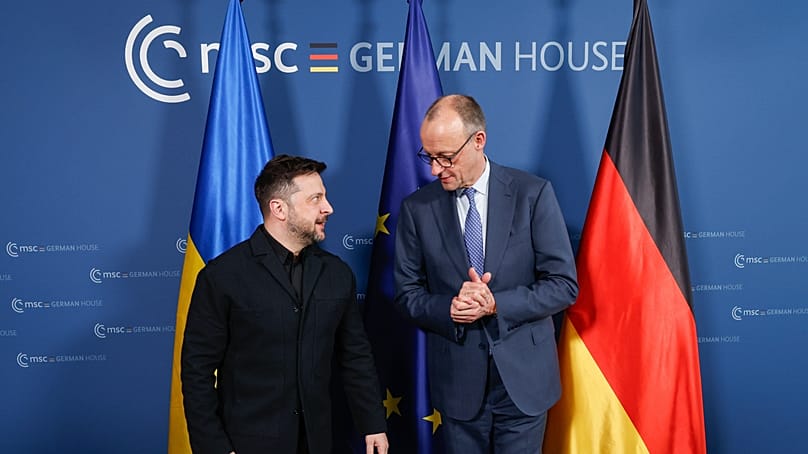
At the Munich Security Conference in early February, German Chancellor Friedrich Merz and French President Emmanuel Macron addressed a European nuclear deterrent in their speeches, including possible coordination between allies. These discussions referenced deterrence policy – not transferring weapons to Ukraine.
Experts were quick to point out that Moscow's intelligence agencies have spread similar falsehoods ahead of high-profile events, such as anniversaries in Russia's full-scale invasion, to distract from what many deem to be Moscow’s military failures.
In 2022, Russia claimed Kyiv was preparing to use a so-called "dirty bomb", but inspectors from the International Atomic Energy Agency (IAEA) refuted this after finding no evidence.
Denis Cenusa, analyst for Europe and Eurasia and visiting fellow at the School of Transnational Governance, told Euronews' fact-checking team, The Cube, that in spreading disinformation around memorable dates, "Russian intelligence seeks to distract attention and distort reality, mainly for the external audience."
"The narrative concerning the arming of Ukraine with nuclear weapons by France and the UK is baseless, but it is chosen to discredit the two countries, primarily before domestic audiences, when they are leading the conversation about sending troops to Ukraine in the post-war phase," he said.