
















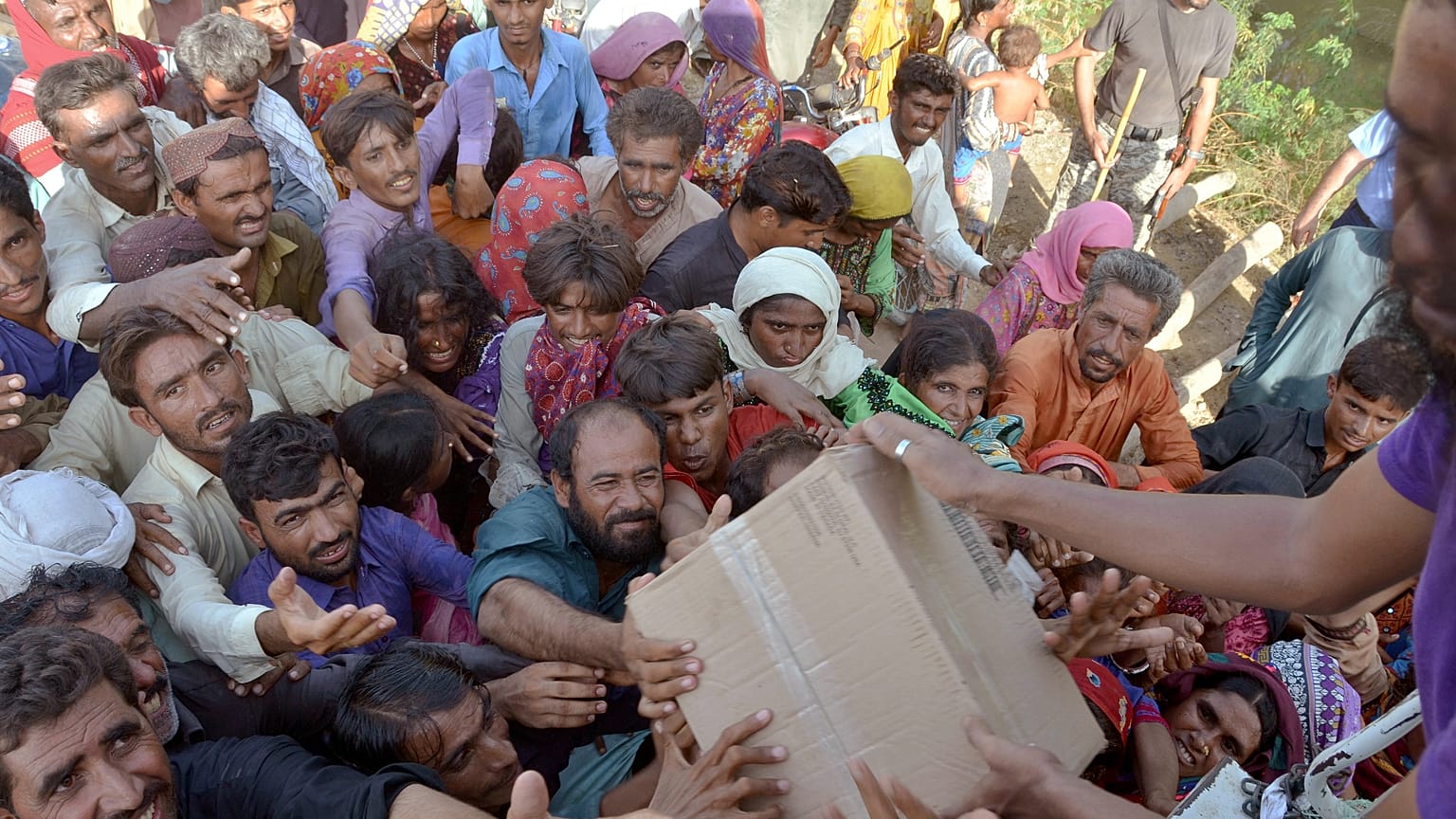













Putting a 3% tax on billionaires' wealth could save up to 29.5 million lives among the most vulnerable populations by 2030, according to new research published in The Lancet, as traditional sources of humanitarian and development funding face an unprecedented squeeze.
Humanitarian and development assistance for low- and middle-income countries is facing an unprecedented squeeze — but the funding gaps could be filled by taxing the wealthy, potentially saving millions of lives, a new study says.
 ADVERTISEMENT
ADVERTISEMENT
ADVERTISEMENT
“With donor countries facing growing indebtedness and increasingly reallocating resources towards military spending, funding humanitarian assistance via the taxation of large fortunes was one of the most viable strategies,” said Lucio Exposito, senior economist of the study and researcher at the ICESI School of Economics and University of East Anglia School of Global Development in the United Kingdom
The research comes as international aid is undergoing its sharpest contraction on record.
Official development assistance (ODA) — government aid that promotes and specifically targets the economic development and welfare of low- and middle-income countries in areas such as health, sanitation, education, and infrastructure — was cut by nearly a quarter, with all major donors reducing their ODA in 2024 and 2025. It is expected that countries will further reduce their assistance from 2025 to 2026.
Such cuts have real-world consequences.
If current ODA defunding continues, it could amount to 7,6 million deaths, including 1,4 million deaths among children younger than 5 years by 2030, according to the research. Such a defunding scenario served as the baseline against which different wealth redistribution policies were evaluated.
Multiple wealth redistribution policies
In a world where there are over 3,000 billionaires, worth a record €17.4 ($20.1) trillion, up €3.46 ($4) trillion from last year, a 3% tax on their wealth would have the largest estimated effect, leading to 29.5 million fewer deaths by 2030. A 1% wealth tax was associated with 15.1 million averted deaths.
Other measures also produced sizeable effects. A tax on financial transactions, often known as a Tobin tax, was associated with around 24.5 million deaths averted, while a global minimum tax on multinational companies with revenues above €750 million was associated with approximately 20.1 million.
“In a world marked by extreme and widening inequalities and an unprecedented concentration of wealth, our results show the potential of alternative wealth redistribution policies—proposed in recent high-level international agreements to support global development—to mitigate the negative impacts of ODA defunding,” researchers said, stressing that these are modelled estimates rather than forecasts of deaths that will necessarily occur or be prevented.
Researchers analysed data from 59 low-income and lower-middle-income countries between 2002 and 2021, representing 3,9 billion people, then modelled how different taxation policies could offset projected aid reductions through 2030.
Wealth taxes have been implemented in a few countries. Spain introduced a solidarity wealth tax in 2022, applying rates of between 1.7% and 3.5% to individuals with net assets above €3 million. France has also debated a 2% tax on ultra-high-net-worth individuals, although a recent proposal was rejected by the Senate. Other countries, such as Sweden, implemented a wealth tax for several decades before abolishing it in 2007.
Wealth taxation has gained renewed political momentum internationally, including among wealthy individuals themselves. At the World Economic Forum in Davos earlier this year, hundreds of millionaires and billionaires from dozens of countries called on governments to increase taxes on the super-rich.
“We live in an extremely unequal world, where a small number of individuals and corporations are accumulating wealth at an unprecedented pace and scale, while millions of vulnerable people continue to die for lack of access to basic, often low-cost, humanitarian interventions,” said Davide Rasella, ICREA Professor at ISGlobal, who conceived and coordinated the study.
“Our findings show that implementing even modest wealth redistribution policies, such as those proposed in recent international agreements, could literally save tens of millions of lives in the coming years.”