
















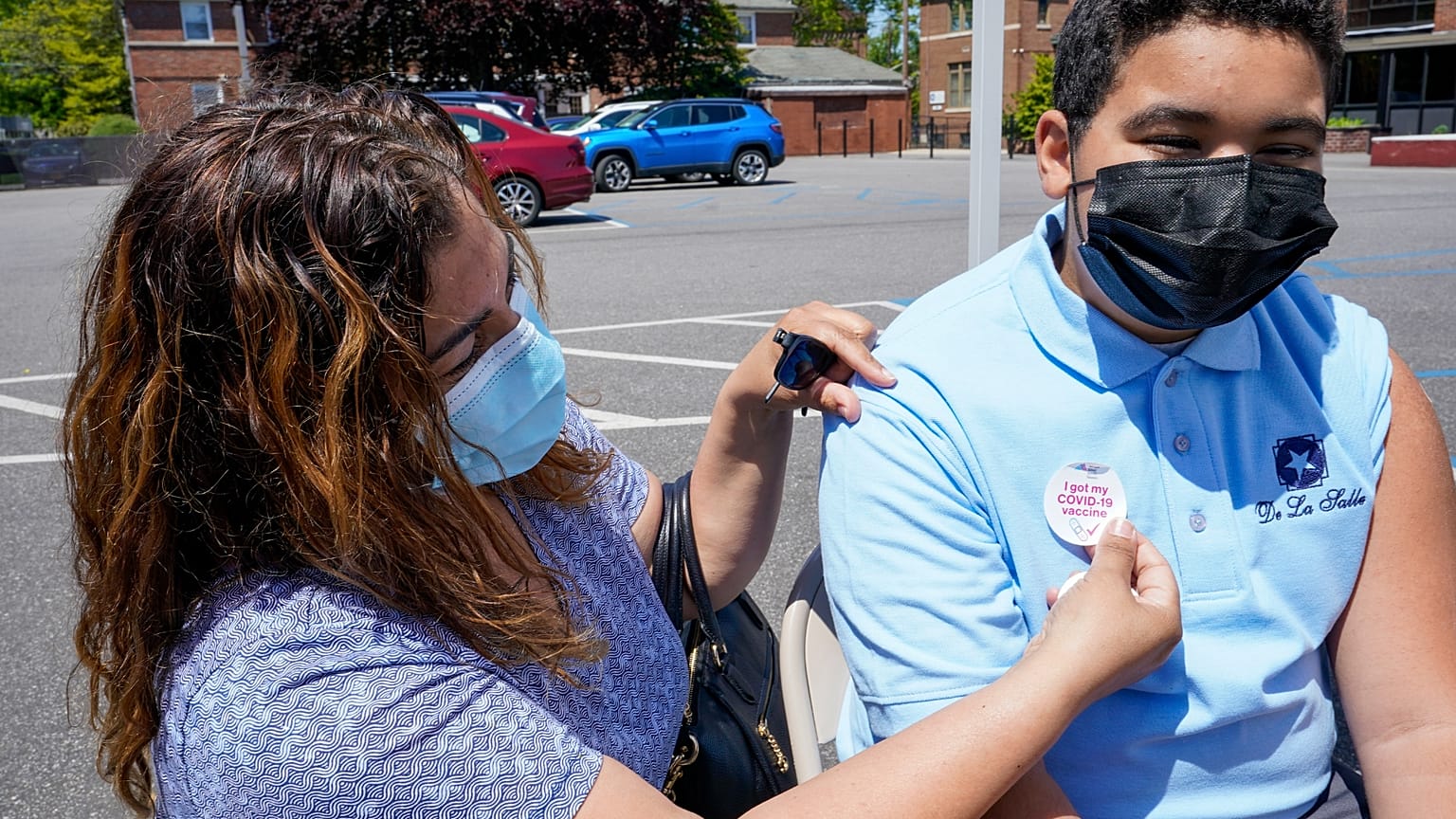














The fallout from US President Donald Trump’s executive order aimed at reducing the number of universally recommended childhood immunisations could extend beyond the United States, fuelling vaccine mistrust and creating immunisation gaps.
US President Donald Trump signed the executive order on Monday, recommending reducing the number of diseases covered by universal routine childhood vaccination recommendations from 18 to 11.
 ADVERTISEMENT
ADVERTISEMENT
ADVERTISEMENT
Decisions as such could lead to immunisation gaps, leaving populations vulnerable to outbreaks and fuel mistrust in vaccines, Marco Cavaleri, head of the European Medicines Agency’s Public Health Threats Department, told Euronews.
Skipping routine childhood vaccinations could be “catastrophic," he said, adding that it risks “the return of diseases that we were able to contain and eliminate from our countries."
Moreover, it could hamper vaccine trust in society. Such decisions, as the one in the US, “unfortunately, could be very detrimental in terms of vaccine confidence,” Cavaleri warned.
Unpacking Trump’s order
Trump’s order moves recommendations for COVID-19, influenza, rotavirus, meningococcal disease, RSV and hepatitis A and B away from universal routine vaccination. Some immunisations will remain recommended for children considered at higher risk, while others will be subject to “shared clinical decision-making” between parents and healthcare providers.
The order also recommends splitting the measles, mumps and rubella (MMR) vaccine into three separate shots and administering them at separate visits. Separate measles, mumps and rubella vaccines are currently not available in the US.
The move comes as US Health Secretary Robert F. Kennedy Jr. has questioned vaccine safety and promoted claims linking vaccines to autism, despite extensive scientific evidence finding no causal association between vaccination and autism.
“The current evidence is unequivocal: vaccines - including the MMR vaccine - are safe and do not cause autism,” World Health Organization (WHO) chief Tedros Adhanom Ghebreyesus said on X on Wednesday.
Combination vaccines can also make immunisation easier for children, parents and healthcare workers. Therefore, vaccine development has been moving towards more combination vaccines, rather than fewer.
“So in actual fact, this [US] decision is going against what the future is going to bring to us in terms of getting better protection for children, adults and the elderly,” said Cavaleri, adding that "there is no scientific basis to split these vaccines."
While parents would still be able to choose to vaccinate their children through shared clinical decision-making, health experts warn that requiring separate shots and additional healthcare visits could lead some families to delay or skip vaccinations.
The changes could also reinforce vaccine hesitancy, potentially leaving populations more vulnerable to outbreaks of preventable diseases that have been eliminated or brought under control in many countries.
“Recent changes to US immunisation policy are not aligned with decades of evidence,” said Tedros. “That evidence is reviewed continuously as new data emerge from across the globe,” he added.
The risks for Europe and the globe
Europe has already seen the consequences of falling vaccination coverage. Six countries — Armenia, Austria, Azerbaijan, Spain, the United Kingdom and Uzbekistan — were found to have re-established measles transmission in 2024, according to the WHO.
Measles offers a stark example of what can happen when vaccination coverage falls.
“We are already now seeing the return of measles whenever the vaccination coverage gets lower,” Cavaleri said. “And we will see more coming, unfortunately, in the United States and other parts of the world.”
He warned that the situation can get “much worse” if vaccination numbers fall. “Just think about poliomyelitis. Do we want this to come back? I hope not,” Cavaleri said, urging people to vaccinate.
Health experts also warn that the US decision could further undermine public confidence in vaccines also in Europe.
The European Commission’s State of Vaccine Confidence report found that overall vaccine confidence has declined among the general public since 2020, with particularly notable decreases in confidence in many Central and Eastern European countries. US decision could fuel this trend even further.
And the consequences do not stop at borders.
“Europe is the region that we have a duty to look at. But these infectious diseases are causing global problems, global outbreaks, global epidemics,” Cavaleri said.