













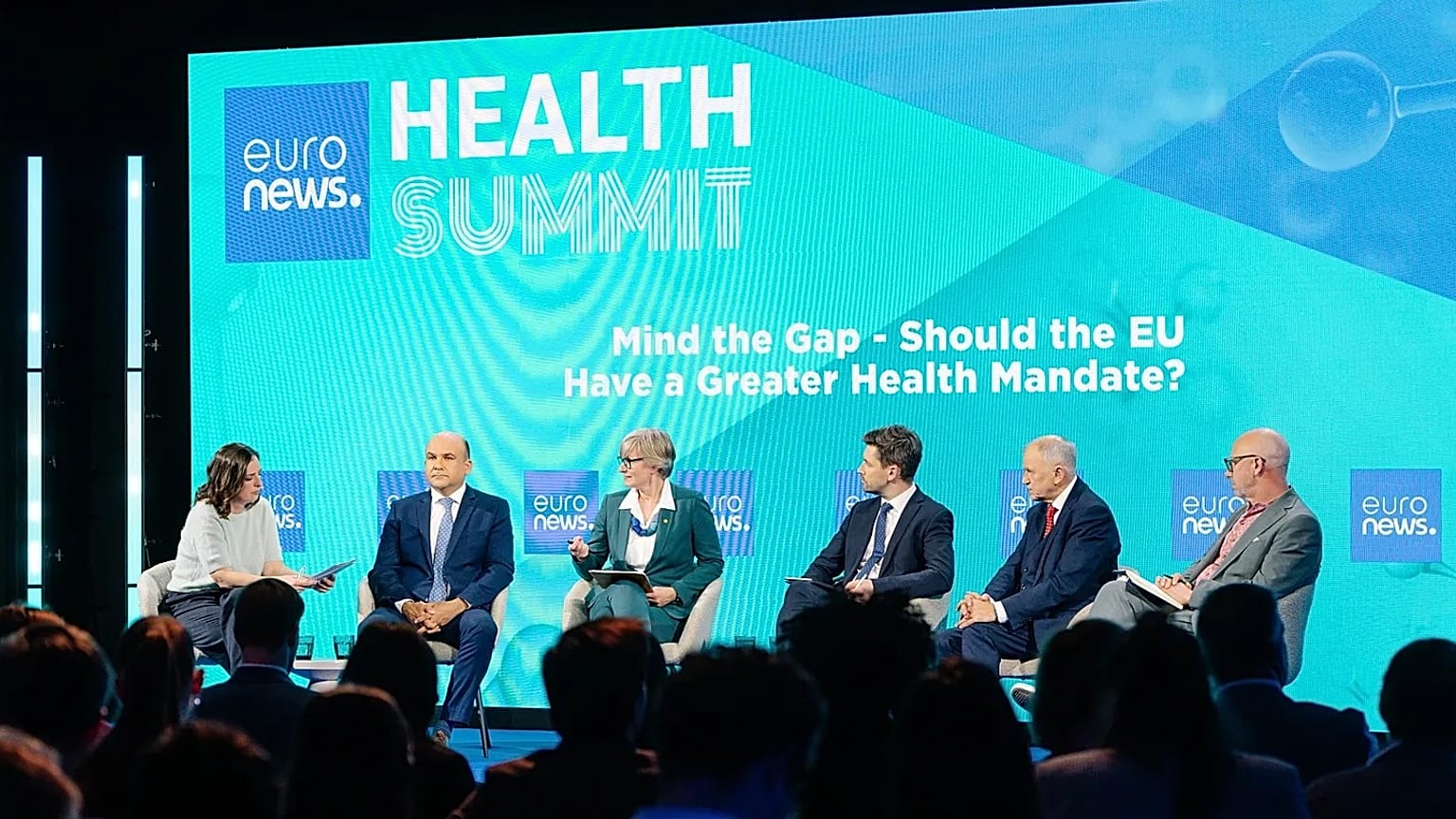














Medicine shortages, European health sovereignty, the ethical lines of AI, and mental health dominated the conversation Euronews’ Health Summit in Brussels.
From medicine shortages, European health sovereignty, and the ethical lines of AI, Euronews’ Health Summit in Brussels sparked a flurry of debate.
 ADVERTISEMENT
ADVERTISEMENT
ADVERTISEMENT
Here are the biggest statements from the event, which gathers some of the world's top political and business elites in health.
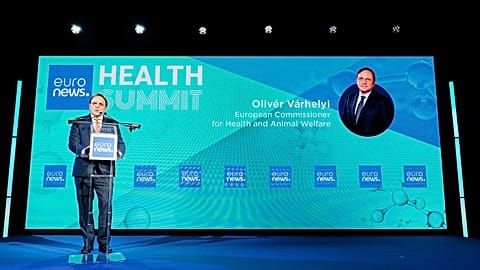
Health is still the biggest challenge in front of us, Olivér Várhelyi, European Commission.
“By simplifying what should be simplified, implementing and enforcing, and updating our rules, we move further towards the future we want. A future where innovation thrives, and ideas are turned into treatments much faster,” EU Commissioner Olivér Várhelyi said.
The European Union has recently presented some of the biggest changes in legislation related to health in recent years, such as the EU Biotech Act and the revamp of the pharmaceutical rules governing the bloc.
“Health, I think, is still the biggest challenge in front of us for Europe, but also for the part of the world we are living in,” he added.
Shared threats demand a shared response, Tedros Adhanom Ghebreyesus, WHO
World Health Organization’s director, Tedros Adhanom Ghebreyesus, said that the world is currently facing many challenges, from conflicts and displacement to poverty, non-communicable diseases, mental health challenges, and antimicrobial resistance.
“None of these dangers can be managed in isolation. Shared threats demand a shared response,” Tedros said.
The WHO has recently experienced a “difficult process of prioritisation and realignment following the withdrawal of the United States”. A process, after which, the organisation has reached a point of stability, and it’s now moving forward more effectively and efficiently, according to its director.
Protectionism in health doesn’t work, Olivier Girard, DG HERA
After COVID-19 destabilised health systems worldwide, the EU has refocused its health strategy on crisis preparedness, reducing dependencies, and boosting competitiveness.
Olivier Girard, Head of Unit Medical Counter Measures at DG HERA, summed up the lesson learned:
"Protectionism doesn't work. We have to have access to the right medicine, the one that helps fight the threat that is going to happen — innovation is very important for that. We want diversity, and cutting-edge innovation to be able to be prepared for the next crisis."
The EU must bring the private and the public sector together in AI, Ricardo Baptista Leite - HealthAI
Ricardo Baptista Leite, CEO at HealthAI, talked about noted that looking at AI in healthcare in other countries, such as the United States and China, funding systems vary completely.
While in the United States it is mostly funded by the private sector, in China it is state-driven.
“I think this is actually the biggest opportunity for Europe, which is to be right in the middle, to bring together the public and the private sectors to work together,” Baptista said.
He added that the European institutions must understand that they need to work more closely with the private sector.
Not crossing lines, Fulvia Raffaelli, European Commission
“I think the line that we should not cross is the one that puts at stake the safety of the patient and the people,” said Fulvia Raffaelli, head of unit, Digital Health DG SANTE at the European Commission.
According to her, this is a line that still needs to be drawn.
“We need to build and design together a line that actually brings together and links together the innovators who are developing AI tools with the users, and connect what they are doing with the patients,” she said.
The AI journey, Jan-Willem Scheijgrond, Philips
“I think we've started, so we've crossed the starting line with AI, but the challenge is we're on a journey that we're actually not quite sure where we're all going,” said Jan-Willem Scheijgrond, vice president and global head of government and public affairs at Philips.
Among all the technological advances, he said, it is key to make sure AI is actually relevant for patients and for society, and that it is actually improving access.
He added that, as with every medical and technological innovation, it is not the first time guardrails need to be put in place and assessed as the technology is put to use.
“When we started working with X-rays, we thought it was a good idea to put X-rays through people's bodies to look at the bones. Then we had to learn to put guardrails in place there and standards, and experiment with that,” Scheijgrond said.
Prevention needs to be the focus, Lydia Abad-Franch, Sobi
Lydia Abad-Franch, senior vice president, head of research, development and medical affairs at Sobi, a Swedish biopharmaceutical company, talked about the importance of timely diagnosis, particularly in kidney diseases.
“The best dialysis is no dialysis, and the best kidney replacement therapy is not to need kidney replacement therapies,” she said.
Late diagnosis has economic, emotional, and socioeconomic impacts that should be avoided, Abad-Franch added.
“We are reaching the high-risk groups too late; we need to change that. It’s a question of awareness and about early intervention, education, and global campaigns,” she said.
‘If health systems are in trouble, everything else collapses,’ Milka Sokolović, European Public Health Alliance
Milka Sokolovic, director general at the European Public Health Alliance (EPHA), said that one key lesson from the COVID-19 pandemic is that health is a strategic asset for Europe.
“If health systems are in trouble, everything else collapses, societies are suffering, and everything else is suffering,” she said.
According to Sokolovic, it doesn't matter where the health competencies are, either in the European Union or national governments, “it matters what kind of healthcare delivery will be reaching the patients”.
‘Mental health is getting worse,’ Adam Vojtěch, Health Minister of the Czech Republic
“Our whole government repeatedly declared that health is priority number one because we strongly believe that without a healthy population, we cannot build the resilience of the society,” said Adam Vojtěch, Health Minister of the Czech Republic.
Amid a growing European focus on defence and security, he noted that those topics are linked with having a resilient and healthy society. Vojtěch said that this includes both physical and mental health.
“We see now how mental health is getting worse within society, especially among the young generation, and it's very concerning. The national governments, but also the EU, should definitely tackle this as well,” he added.