















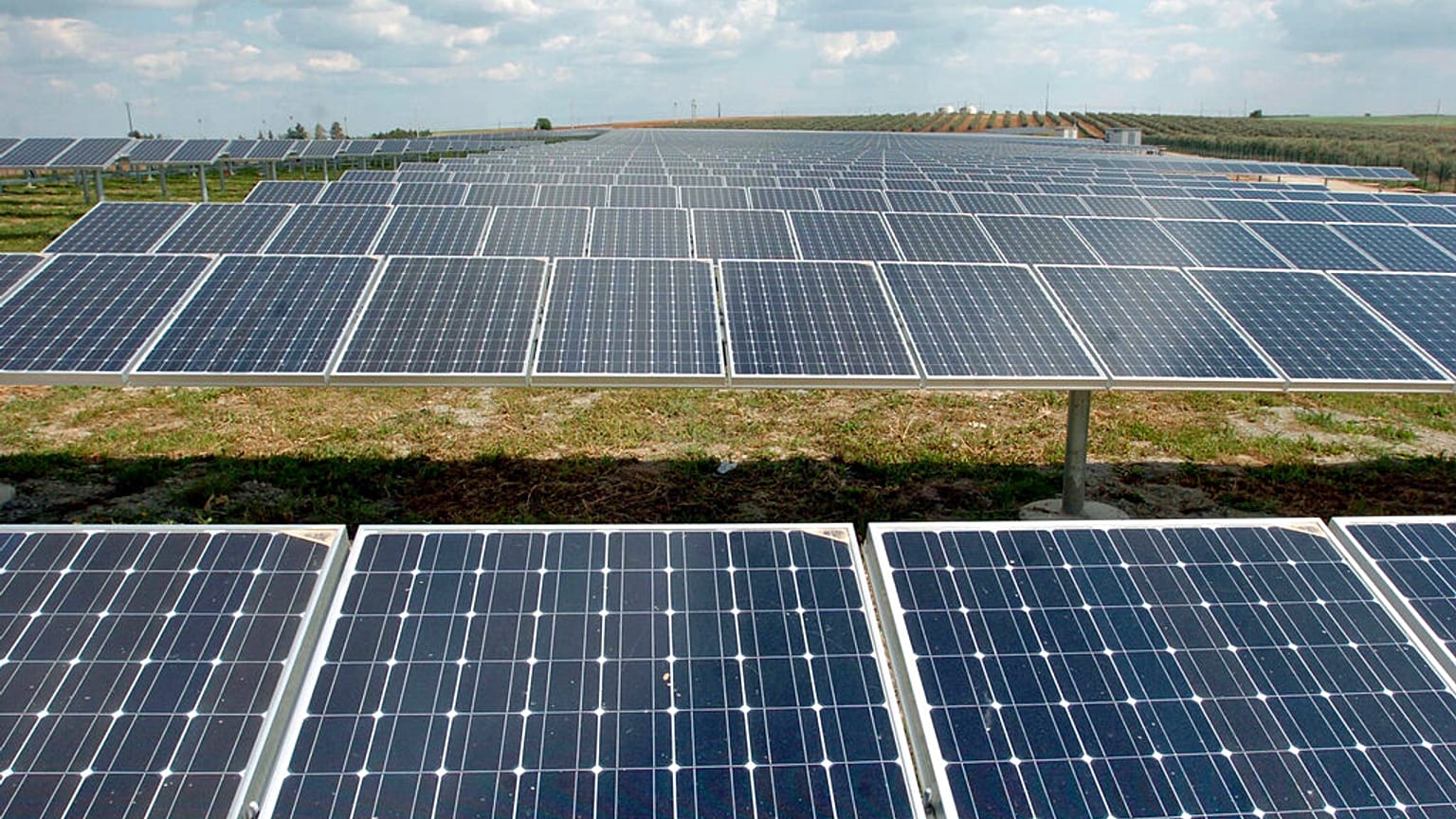













The company behind the project has promised to reconcile the production of renewable energy with the environmental protection of the territory.
A new solar project, to be based in the Portuguese district of Castelo Branco, is being widely opposed by both environmental organisations and the municipalities themselves.
 ADVERTISEMENT
ADVERTISEMENT
ADVERTISEMENT
Called the Sophia Photovoltaic Solar Park, it aims to "reconcile renewable energy production with environmental enhancement of the territory and lasting benefits for local communities", according to the website of the company behind the initiative, Lightsource bp.
The solar park is expected to be one of the largest in the country, with a total of 867 MWp of power, and, according to Lightsource bp, will involve an investment of around €590 million.
The company estimates that in the future it will be able to "supply more than 370,000 homes and prevent the emission of around 24,500 tonnes of CO₂ per year", with a view to contributing "to the goals of the National Energy and Climate Plan 2030".
The project, which will cover the municipalities of Fundão, Penamacor and Idanha-a-Nova, was in the public consultation phase for more than a month until 20 November. It has attracted more than 10,000 comments and was the public consultation with the most participation ever.
Criticism has come from various quarters, despite the company publicly stating that the project "includes a robust set of environmental protection and landscape enhancement measures".
So what is planned for the project, what impact is the solar park expected to have on the region, and how is Lightsource bp dealing with all the controversy?
Why this location and when is it expected to be operational?
Lightsource bp told Euronews in a statement that "the choice of location for any renewable energy project, whether solar or wind, depends on proximity to the point of connection to the electricity grid."
"In the case of the Sophia solar park, the connection point is REN's Fundão substation, linked through a Capacity Reservation Agreement (TRC)," and the area selected for its implementation resulted from a "technical environmental analysis that confirmed this option as having the least impact within a radius of 30 kilometres around the Fundão substation".
The company also states that, to draw up the "Preliminary Study that was in public consultation" and "exhaustive work was carried out to collect environmental information reflecting a project that has been in development for six years".
At the moment, says Lightsource bp, "the Sophia project is in the initial licensing phase, with commissioning scheduled for 2030".
What did the environmental impact study say?
The Environmental Impact Studydocument, dated September 2025, details that this solar plant will "consist of 1,365,588 photovoltaic modules, which will occupy a total area, divided into sectors, of around 390 hectares".
It also emphasises that the "selected model", in this case for converting solar energy into electricity, has the "advantages" of high "efficiency", "reliability" and "energy yield".
The analysis indicates that the proposal "does not cover areas of the National Network of Protected Areas or Natura 2000 Sites", designed to guarantee the protection of recognised natural areas and the conservation of biodiversity. Even though "the area where the plant is located" overlaps "the UNESCO Naturtejo World Geopark, recognised by UNESCO's International Geosciences and Geoparks Programme".
It says the construction phase of the solar park is "the most critical period in terms of negative impacts, particularly on the descriptors of land use, flora, vegetation, habitats, fauna and landscape". It even warns that the greatest risks are associated with "deforestation, the opening up of roads and the construction of the substation" for the power station itself.
During this same construction phase, the report notes that "the plant communities affected by the implementation of the projects are predominantly of low conservation and/or ecological value". Although it recognises that it will be necessary to "fell or affect isolated holm oak or cork oak trees" - 1,120 and 421 of each, respectively.
As for fauna, "during the construction phase, various actions are expected to take place that could lead to negative effects on the different fauna groups".
The analysis also points out that the power station "will give rise to landscape impacts" in a location that is close to "three historic villages, namely Castelo Novo, Idanha-A-Velha and Monsanto".
It emphasises that at the "heritage level", the construction phase "involves a series of interventions and works that potentially generate generally negative, definitive and irreversible impacts". But also the existence of "an extremely important and significant economic impact" through the "leasing of the land" for a period of "40 years", but also "an investment of around €590 million, fundamentally through attracting external capital".
It also concludes that "the design of the project ensured that photovoltaic panels were not placed on agricultural land within the RAN [National Agricultural Reserve]", which, due to its characteristics, is more suitable for agricultural activity. And that "in addition to meetings held with the municipalities and the Historical Villages [network], sectoral and working meetings were also held with the APA [Portuguese Environment Agency] and ICNF [Institute for Nature Conservation and Forests], at an early stage of development, to present and discuss the project".
How will it impact local communities?
In a statement, the Beira Baixa Intermunicipal Community, which includes the three municipalities where the power station will be located, expressed an "unfavourable position" towards the project, as it would have "huge impacts on the community and the territory of Beira Baixa".
It says the community is also "recognised for hosting Historical Villages, Schist Villages and a vast historical, material and immaterial heritage".
It has several main criticisms of the project. The community has called out the "significant and continuous extension of the area that is planned to be artificialised", which would result in an "undeniable degradation of the landscape". It is also objecting to the "non-negligible impacts on the conservation and production areas covered, the habitats and species of protected fauna and flora"; and the "harmful consequences, given the scale of the installation, on other uses of the territory, compromising the development associated with tourism and traditional and organic production methods".
Speaking to Euronews, João Lobo, the mayor of Proença-a-Nova, who is also president of the Beira Baixa Intermunicipal Community, detailed the concerns of the various municipalities that make up this community regarding the "visual impact" the project will have on the landscape.
"We're all focused on what it has to do with the energy transition and the condition that we also have solar parks," he explains. However, he points out that these solar parks must be "evaluated" in order to ensure that they are installed in "locations that do not affect what we have as a greater value, in terms of the landscape [...], biodiversity, geodiversity, forest spaces and even agriculture". Also, he criticises the "size" planned for the solar park.
The president of the Intermunicipal Community of Beira Baixa estimates that the impacts could have consequences in terms of the attractiveness of the region for visitors and, logically, in terms of tourism.
"It would be a setback in relation to the years that these territories have spent translating the importance and value of these spaces [...] if, hypothetically, this park were to go ahead as it has been dimensioned," he argues.
For Lobo, the damage would be irreparable.
"When we have an area covered by the [solar] power plant, it can't be used and, what's more, that area won't be replaced by another. [...] A different situation is, as is the case here, when a tree population of a certain species can be relocated, replanted or introduced into another space," he emphasises.
Lobo concludes by saying that "there is certainly room for photovoltaic plants", and that the municipalities understand, "from the point of view of the companies", the need to invest in projects of this scale, "for the process to be economically advantageous". But he warns that it is necessary to "have common sense".
"We need to combine this energy transition, the construction of solar parks [...], but not at the cost of taking away the monumentality of nature and the landscape, which is a public asset that we all enjoy."
In response to the concerns voiced by the local community, Lightsource bp says that it intends to "ensure" that the "benefits" derived from the initiative "materialise on the ground and that the project leaves a positive legacy in the territory".
"The Sophia project will also be an engine for local development, since the added value will be shared with the community," it adds.
Although the Environmental Impact Study states that meetings were held with the municipalities "at an early stage of development, to present and discuss the project", Mayor João Lobo claims that Lightsource bp didn't put enough effort into this task.
"This process got off to a bad start from the point of view of contacting the entities, the population, promoting their initial concerns and then trying to actually carry out the operation," he says. Lobo accuses the company of a lack of "assertiveness" at this level when "structuring" the initiative.
Even so, he makes the point that "any local authority is always open to investment in their territory", expressing total openness to "listening" to anyone who wants to develop initiatives that can benefit local communities.
These accusations, however, are refuted by Lightsource bp.
"The project is being developed with full respect for local communities and institutions. Over the years, contacts have been maintained with local councils and parish councils in the area covered by the project," the company tells Euronews.
It also maintains that the "project team has already contacted around 30 public and private entities, including local authorities and sectoral authorities, to ensure that the Sophia project evolves in a transparent, rigorous and community-aligned manner".
What about the environment?
Lightsource bp assured Euronews that the "project includes a robust set of environmental protection and landscape enhancement measures".
Of these, it highlighted "the 100 per cent preservation of all cork oaks and holm oaks in stands or nuclei of high ecological value, the 100 per cent preservation of all National Agricultural Reserve soils, bird protection devices and the protection and management of riverside habitats".
The company also plans, as stated in the Environmental Impact Study itself, to "convert 135 hectares of eucalyptus trees into cork oak and holm oak stands". It goes on to detail that it plans to "plant around 27,000 of these native trees", but also to "ecologically rehabilitate degraded areas".
Lightsource bp also justifies that the "intervention will also guarantee an increase in the territory's resilience to rural fires and improved ecological connectivity between natural habitats". This is because the project, according to the company, also includes a "228 hectare Green Structure Plan", also mentioned in the Environmental Impact Study, which "reinforces the territory's capacity to retain carbon" by, in particular, converting the "eucalyptus forest into cork oak and holm oak forests".
But despite these assurances, Ricardo Filipe, a member of the Zero association and responsible for monitoring renewable energy issues, told Euronews that the planned felling involves "forests that are not at the stage of maturing into a priority habitat", but which "are moving in that direction".
He criticises the Environmental Impact Study because, in Zero's view, it shows "a very large devaluation of trees that are not [classified as] protected", referring to the felling of 20 hectares of black oak trees.
"As [these specimens] are not protected," the analysis argues, "the impact [of the felling] is negligible."
As for the "felling of protected trees", Filipe says that it will affect "around 1,500 cork oaks and holm oaks" which are not, however, "in classified areas", as mentioned in the Environmental Impact Study. He also highlights the "occupation" of around 30 hectares of National Ecological Reserve (REN) areas, which aim to protect natural resources such as water and soil.
The Zero expert predicts that there will also be consequences for the soil, since, according to his calculations, 1,060 hectares will be dedicated to placing the solar panels, including the corridors between them, which will be deforested and "the soil will be stripped". In other words, the topsoil, which corresponds to at least a 10-centimetre layer, will be removed.
And he goes on to detail what's at stake: "In practice, it means that we're going to have 1,060 hectares of 'stripped' land, and exposing this amount of hectares to erosion, to climatic phenomena, in our view, has a brutal impact, also very much due to the size of the 1,060 hectares."
Ricardo Filipe also points out that, from the perspective of the association he represents, "the very size" of the solar plant in question, which will cover a total of "around 1,700 hectares of fenced area", is a problem in itself.
"The work is being done badly, because too much weight is being given to megacentres" in Portugal, to "projects with more than a thousand hectares," he says. And, at a time when "power stations are springing up like mushrooms", the environmentalist criticises the way in which all this has been planned at the national level.
He argues that "there needs to be a nationwide study [...] to see which areas have energy potential, and [to] cross-reference this information with ecological and social values". All with a view to "detecting which areas are most favourable to renewable energies, but which don't involve so many social and environmental conflicts".
Several environmental associations have issued press releases over the last few days raising concerns about how the Sophia Photovoltaic Solar Park is being planned. This is the case, for example, of the Zero association, but also of QUERCUS, FAPAS (Portuguese Association for the Conservation of Biodiversity) and Rewilding Portugal, among others, which, as well as warning of the environmental impacts inherent in the proposal, have highlighted the consequences it could have at a social level.
The note released by the Zero association, for example, criticises the development of projects, as is considered to be the case here, "which are the antithesis of spatial planning" and where "there is no sharing of benefits with local populations and the socio-economic and landscape effects are devalued".
In the organisation's view, this could "seriously undermine" climate neutrality objectives set for the coming decades. The statement adds that the "enormous contestation" being generated around this megaproject could even "create an unfavourable social environment for the acceptance of renewable energies in Portugal".
Lightsource bp guarantees openness to "improving the project"
Given the public debate surrounding the Sophia Photovoltaic Solar Park, Lightsource bp emphasises that, as part of preparing for the execution of the project, it intends to “organise informative and participatory sessions in the area covered, with the aim of improving the project,” and maintain ongoing communication with local authorities and communities.
The company also notes that the “project and its Environmental Impact Assessment are still in the early stages of development,” allowing the plan to be “detailed and adjusted according to the recommendations of the entities and contributions from the public consultation”. This consultation, it adds, is “only the first step in a long and rigorous environmental process” that is still far from complete.
Lightsource bp further explains that the proposal will go through another round of public consultation, meaning the process remains active, and there will be multiple opportunities for further adjustments to the project.
Read more