
















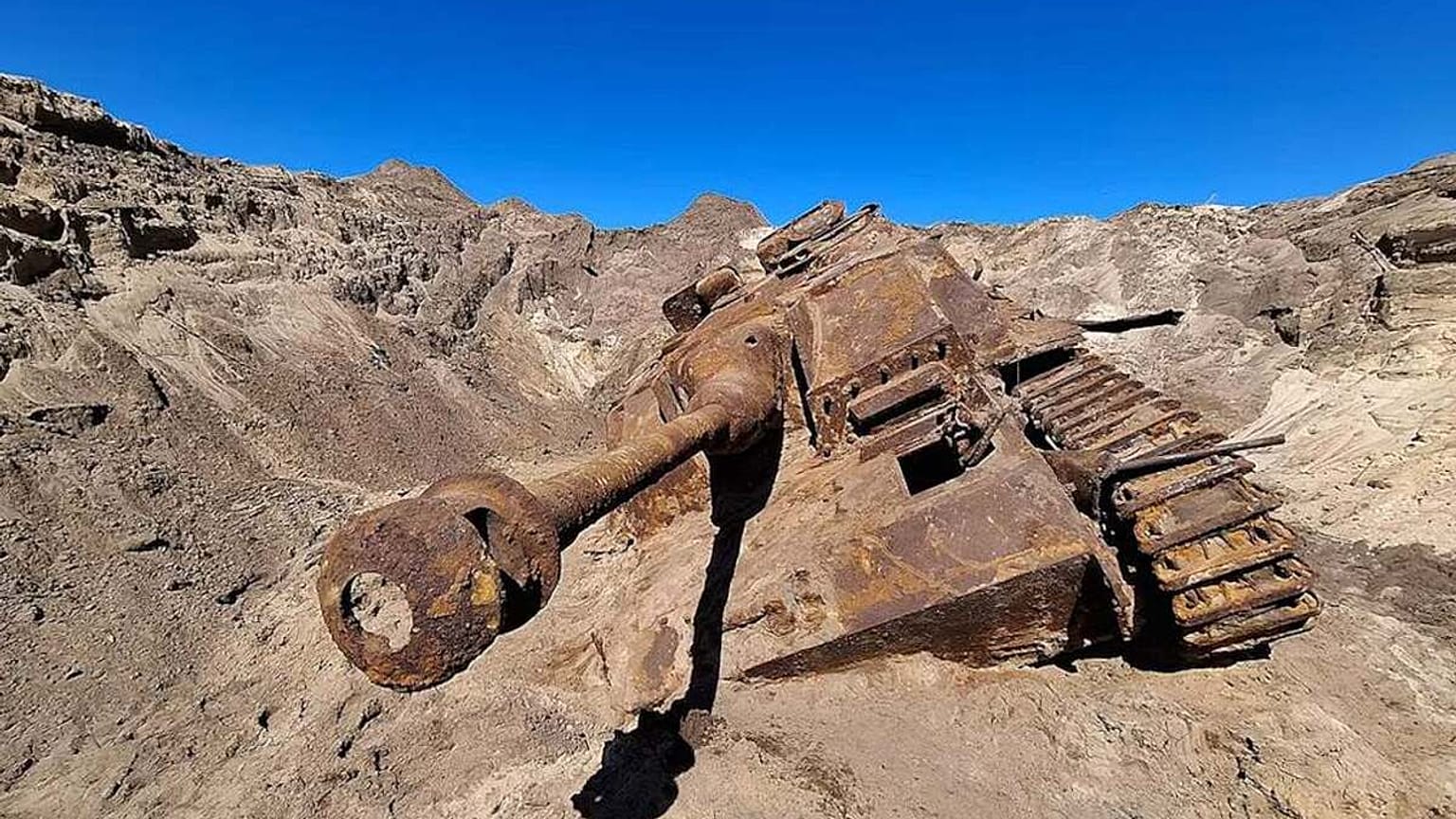













During construction at the Nordholz naval air base on the North Sea, workers uncovered a near-intact 29-tonne StuG III assault gun from World War II, buried in sand for 80 years.
According to Germany’s Federal Agency for Real Estate (BImA), finds of this kind usually yield only isolated remains or vehicle parts. In this case, however, workers came across an almost completely preserved assault gun – a rare relic from the final months of the Second World War in north-west Germany.
 ADVERTISEMENT
ADVERTISEMENT
ADVERTISEMENT
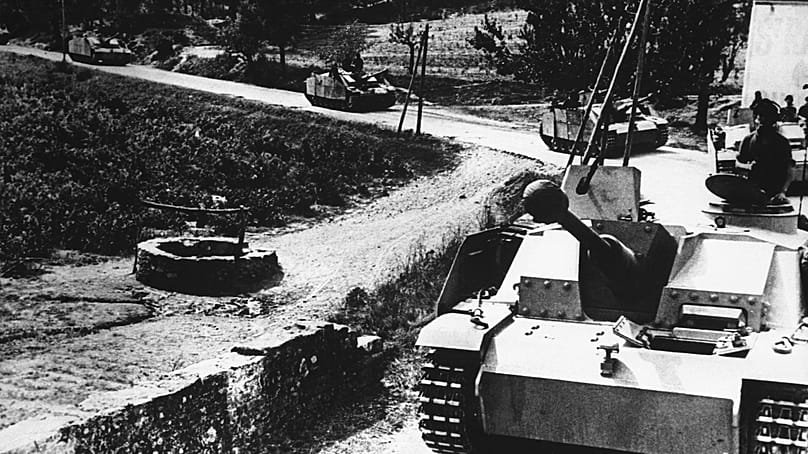
The find is a StuG III assault gun, one of the Wehrmacht’s most frequently produced tracked armoured vehicles. Unlike conventional tanks, the vehicle had no rotating turret. Instead, the gun was fixed facing forwards, meaning the entire vehicle had to be moved each time to aim.
Dr Andreas Hüser, head of archaeological heritage management for the district of Cuxhaven, told Euronews that the object is “quite simply” a Second World War assault gun: “It was the most frequently built fully tracked vehicle of its time.”
The defence company Rheinmetall built more than 9,300 of them. Production continued into the final weeks of the war and did not end until April 1945. The assault guns were used mainly to combat enemy tanks.
As a buried find, however, it raises many more questions for Dr Hüser: “The state of preservation is very good; it allows us to reconstruct many details. What can we find out about the crew? The vehicle was disposed of in the ground after the end of the war – that in itself is remarkable, even if it is not unusual.”
The Cuxhaven archaeological heritage service deals with traces of human activity dating back to the Palaeolithic and now also examines relics of more recent times from an archaeological perspective. Dr Hüser says: “Of course there are still eyewitness accounts, but much has already been forgotten. So with this assault gun we are interested not only in the find itself, but also in the context. Where on the grounds of the military airfield was it buried? Was the StuG stripped for parts beforehand? Are there traces of how it was disposed of? What can wear marks and other finds in the vicinity tell us?”
The vehicle discovered belonged to a brigade stationed in Nordholz that was deployed mainly in France. Whether the assault gun itself also saw action there cannot yet be clearly proven. In the experts’ view, however, the vehicle was in use for a long period. This is suggested by at least 17 white markings on the gun barrel. According to the archaeologists, such symbols were probably added for each enemy tank destroyed.
Crew of four soldiers: “Oppressively cramped”
The vehicle can be opened without difficulty, notes archaeologist Hüser: “The view inside is very impressive.” The driver’s seat has been preserved, as have the mountings for the gun. “It feels oppressively cramped.”
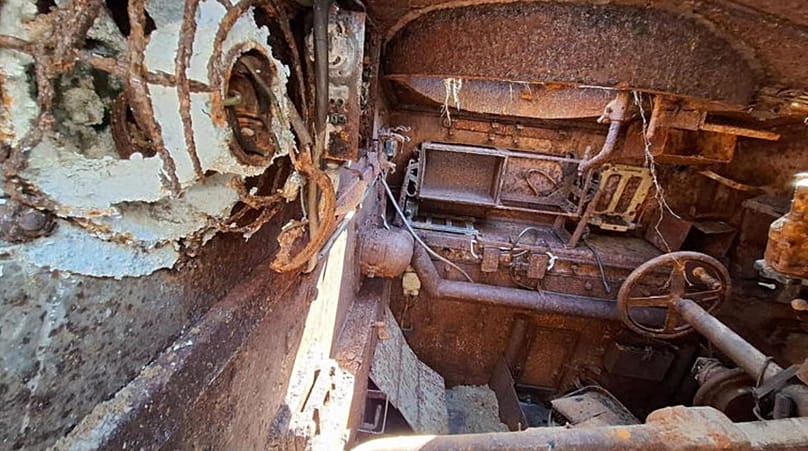
The assault gun had a crew of four soldiers. The driver sat at the front of the vehicle, while another soldier operated the gun. The commander coordinated the mission and gave the order to fire, while a fourth man was responsible for reloading the weapon.
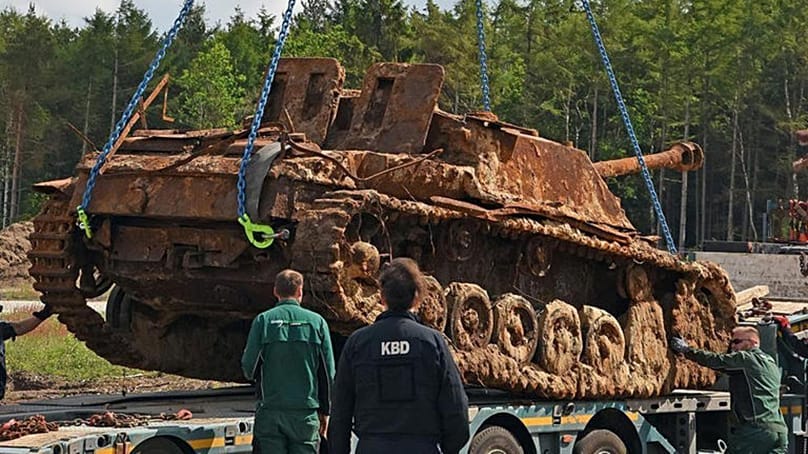
According to the experts, the assault gun was buried by the Allies shortly after the end of the war, together with other military equipment. The excavation also brought to light remnants of ammunition and small shell fragments.
Dr Hüser stresses that war is not a modern phenomenon: “We can trace it back to prehistoric times. Technical advances in weaponry are a recurring feature. On the other hand, we also have to mention the human misery associated with war – sometimes fatal injuries and the like. In the final analysis, the StuG III from Nordholz stands in this same ‘tradition’.”
Because the vehicle was lying in dry sand on the edge of a slope, it remained exceptionally well preserved. In several places, remnants of the original camouflage paint can still be seen, and parts of the running gear appear almost undamaged despite having lain in the ground for decades.
“Not only from an archaeological point of view but also simply because the vehicle is almost complete, this is an important find. Armoured vehicles surviving in such a complete state are otherwise rare,” says Hüser.
In August, the assault gun is to be taken to Munster in the Lüneburg Heath, where specialists will stabilise and conserve it. It is then due to be handed over to the Bundeswehr’s Military History Museum in Dresden, where it will go on display.