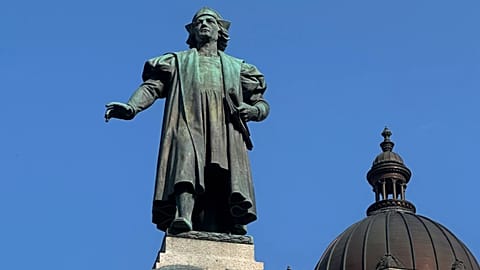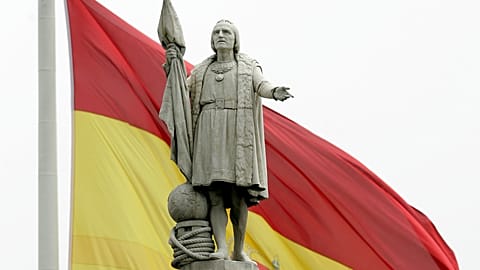






























For the first time, a new scientific study has provided genetic evidence that points to Christopher Columbus having descended from Galician nobility in Spain and specifically from the Sotomayor lineage.
Five centuries after the first voyage to America, the question of who Christopher Columbus really was remains unanswered.
 ADVERTISEMENT
ADVERTISEMENT
ADVERTISEMENT
The official version reflected in the history books is that Columbus was born in Genoa, the seafarer of humble origins who convinced the Catholic Monarchs to finance what no one thought possible. This origin story has been questioned for decades by historians, linguists and, more recently, geneticists.
The latest chapter in this debate comes from a crypt in Gelves, a town in Seville where at least seven direct descendants of the explorer are buried. A team of researchers from the Citogen laboratory and the Complutense University of Madrid has published a preprint in 'bioRxiv' with the results of the third phase of a project that began with an exhumation in March 2022.
Its conclusions, not yet peer-reviewed, point to the Galician nobleman Pedro Álvarez de Sotomayor, known as Pedro Madruga, as the direct ancestor of the Columbian lineage.
The finding that nobody expected
It all started with a piece of information that did not add up. On analysing the DNA of 12 individuals exhumed from the family crypt of the Counts of Gelves, the researchers found that two of them shared genetic material without the historical documents justifying this relationship.
One was Jorge Alberto de Portugal, third Count of Gelves and great-great-grandson of Columbus. The other was María de Castro Girón de Portugal, a 17th century countess consort who had entered the family by marriage and whose lineage was Galician, she was the daughter of the 9th Count of Lemos.
That two people with no documented relationship share DNA can only be explained in one way: they have a common ancestor that the records do not show. The team applied a computational model on 16 generations of genealogies to identify that individual.
The analysis pointed, unequivocally according to the authors, to Pedro Álvarez de Sotomayor. To corroborate this, they resorted to the so-called Virtual Knock-out technique: when they virtually eliminated Pedro Madruga from the family tree, the genetic link between the two individuals disappeared. No other ancestor, among the hundreds analysed, was able to produce the same effect.
Geneticist Isabel Navarro-Vera, technical director of Citogen's Forensic Genetics department and responsible for the analysis of the samples, used massively parallel sequencing on more than 10,000 genetic markers. "It is a technique that has not been applied before on such ancient remains, at least there is nothing published," she says.
Who was Pedro Madruga? The nobleman who disappeared
The hypothesis that Columbus could be Pedro Álvarez de Sotomayor, or his son, is not new. It was first formulated by the historian Celso García de la Riega from Pontevedra at the beginning of the 20th century. What made it persist was not so much the conviction of its advocates as the accumulation of coincidences that nobody has managed to explain completely.
Pedro Madruga was one of the most powerful feudal lords of 15th century Galicia. He controlled an extensive territory from the castle of Sotomayor, on the banks of the river Verdugo in the province of Pontevedra.
He fought in the Castilian civil wars, made pacts with Portugal and clashed with the Catholic Monarchs. Around 1486, he disappeared from historical documents without a trace. That same year, Christopher Columbus appeared for the first time before the court of Isabella and Ferdinand.
Chronology is the crux of the theory: one leaves and the other appears, without their documented lives ever intersecting. In addition to this, there are other clues: Columbus' texts contain syntactic constructions typical of Galician-Portuguese that are difficult to attribute to a native speaker of the place.
The coat of arms that the Catholic Monarchs granted him incorporates golden bands that are part of the traditional Sotomayor heraldry; and the treatment he received at court from the beginning was, according to some historians, that of someone already known, not that of a foreigner of uncertain origin.
Strong evidence, yes, but not definitive
The authors of the preprint themselves are careful to calibrate their conclusions. They acknowledge that this is indirect evidence, obtained through descendants, not Columbus' own DNA, and that their results require independent verification.
The scientific debate on the origin of Columbus has more open fronts. Professor José Antonio Lorente's team at the University of Granada has been studying the remains attributed to the admiral in Seville Cathedral for decades.
In 2024, a documentary by Spain's public broadcaster RTVE reported their provisional conclusions pointing to a Sephardic Mediterranean origin, a work that was also questioned for not having published the complete data in any scientific journal.
The Italian hypothesis is still the majority position in historiography. Columbus himself stated in his will of 1498 that he was born in Genoa, and this document continues to be the main argument of those who defend the Genoese origin.
The defenders of the Galician theory reply that a man who hid his past for decades would not reveal it at the end of his life. It is an argument that neither side can settle with documents alone.
What has changed is the quality of the tools available. What this study provides, with all its limitations, is the first genomic evidence compatible with an origin in the nobility of northern Spain.
For this to become more than a hint, researchers in the field are calling for:
- The raw data be published in open repositories.
- Analyses be replicated by independent laboratories
- Databases of historical reference populations be incorporated.
Until then, the origin of Christopher Columbus, the question that has remained unanswered for five centuries, will remain open.