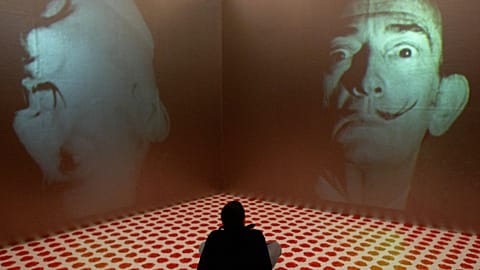































After five months of work, the famous Parisian ossuary will be offering its many visitors a new, more immersive experience from Wednesday 8 April.
Beneath the hustle and bustle of Paris's boulevards lies an empire of silence.
 ADVERTISEMENT
ADVERTISEMENT
ADVERTISEMENT
Twenty metres underground, the Catacombs are not just a labyrinth of stone, but the guardians of memory. Since the 18th century, this sanctuary has been home to the remains of millions of Parisians.
From the anonymous figures of the Revolution to the great figures of history, it is the very soul of the capital that rests here, frozen in limestone.
After five months of work, necessary for preservation and safety reasons, as well as to ensure the safety and enjoyment of the 600,000 or so visitors per year, the site has been given a facelift.
"It's all about the dead who died in Paris between the 10th and 18th centuries," explainsIsabelle Knafou, the site's director. "So even if we don't know exactly how many dead there are, there are millions of them, and we're responsible for preserving this place. And to preserve this place, it was urgent to carry out improvement work, technical installations, ventilation, lighting, electricity."
"The catacombs are located in limestone quarries, which are, in fact, environments that move all the time. So there are constant waterways and movements in the quarry, which means that we have to consolidate, conserve and improve. We're in an extremely wet environment," she adds.
"We had to do all the work in just five months, with very specific access and evacuation conditions," says Camille Guérémy, whose architectural firm Artémis was commissioned to carry out the work.
"We had masons, electricians, all working underground together, with very specific rhythms during the five months of work."

The history of the Catacombs began at the end of the 18th century with a major health crisis. The Innocents cemetery was saturated and in poor condition, threatening the health of Parisians and forcing the closure of burial sites within the city walls.
In 1786, the city decided to transfer the remains of six million inhabitants to the old limestone quarries of the Tombe-Issoire**,** twenty metres underground.
Initially a simple repository for loose bones, the site was transformed in 1810 by the inspector Louis-Étienne Héricart de Thury. It was he who designed this macabre architecture: the femurs and skulls were carefully stacked to form decorative walls, punctuated with engraved plaques and philosophical quotations.
Right in the heart of the Montparnasse district, this labyrinth of over a kilometre opened to the public in 1809 would become the largest ossuary in the world.