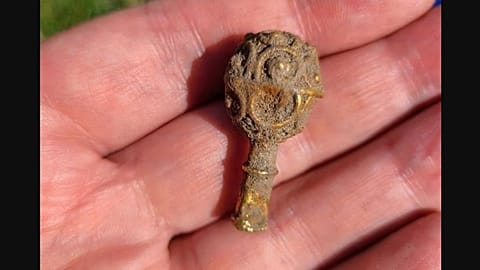






























Germany's cultural heritage community is embroiled in a row after an amateur archaeologist uncovered an ancient construction. The problem however is that he didn't have permission to dig at the site of Metilstein Castle near Eisenach.
An unusual incident has sparked a heated debate among German heritage protectors that raises crucial questions about the handling of historic material and the role of amateur researchers.
 ADVERTISEMENT
ADVERTISEMENT
ADVERTISEMENT
A so-called "dirt detective" carried out an illegal excavation in the ruins of Metilstein Castle near Eisenach, a site close to Wartburg Castle, one of Germany's most famous castles. In 1999, it was the first German castle to be placed on the UNESCO World Heritage List (source in German).
Over a period of several weeks, without any authorisation, the man conducted a number of digs at the medieval site and uncovered remains of walls in various places.
The listed building, which is thought to have been constructed in the first half of the 13th century, was jeopardised because the uncovered structures were exposed to the elements without protection.
Digging for trouble
A volunteer monument conservator eventually discovered the unauthorised activity and told police and the Thuringian State Office for the Preservation of Monuments and Archaeology.
The person responsible then came forward and confessed to having carried out the work. As a result, he was ordered to cover the uncovered areas with earth again to prevent further damage - an instruction he complied with. Experts described the incident as "very, very strange".
The amateur archaeologist is not accused of deliberate destruction. Rather, experts assume that he wanted to make the remains of the castle visible or, as it were, "prepare" them.
Therein lies the problem with unsupervised operations according to specialists who say archaeological structures are often better protected in the ground than when they are exposed, as they can quickly weather or be damaged if not properly secured.
The incident highlights a fundamental tension in dealing with archaeological heritage. There are often conflicting interests between the desire for visible historical evidence and the requirements of monument protection.
While laypeople see the uncovering as a contribution to the illustration of history, specialised authorities regard such interventions without professional documentation and safeguarding as a risk as it could result in the irretrievable loss of scientifically relevant information.
Although the case was ultimately concluded without permanent damage, the authorities are still investigating whether an offence has been committed.
Metilstein Castle is not directly part of the Wartburg complex, but has a close historical connection with it. Both are located near Eisenach on the same ridge. Metilstein Castle probably served as an upstream security or observation facility that strategically complemented Wartburg Castle.
While Wartburg Castle played a central role as the main castle and is still largely preserved today, Metilstein is a ruin from the High Middle Ages and had more of a supporting function in the defence system.