















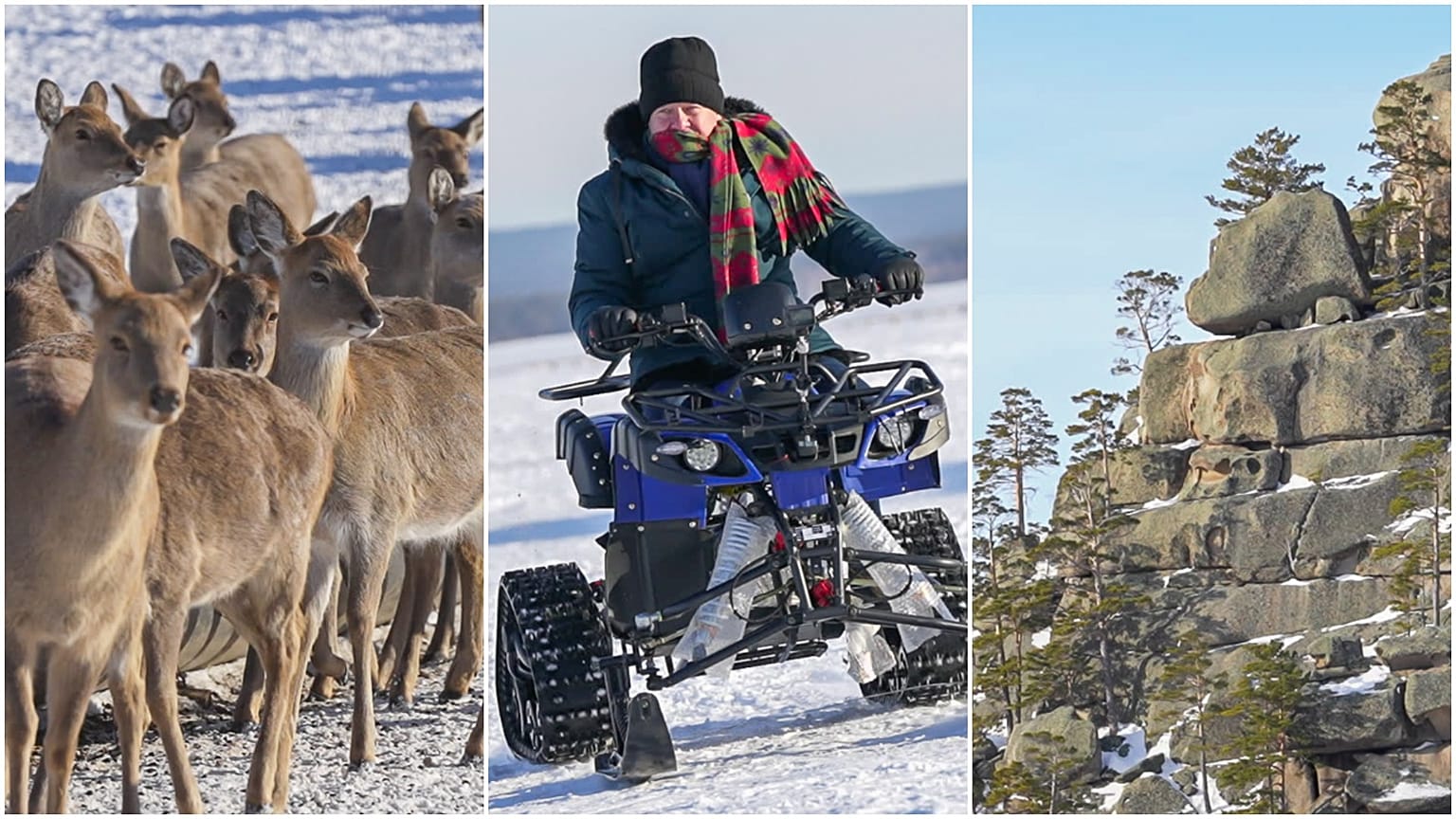














Deep in the northern steppe, the forested mountains and frozen lakes of Burabay State National Natural Park offer a breathtaking escape into nature.
Situated in the north of Kazakhstan, three hours drive from the capital Astana, lies national park Burabay. It is a natural phenomenon of mountains and 14 lakes in the middle of the steppe roughly the size of Western Europe. It is an area of forested mountains that has been added to the UNESCO World Network of Biosphere Reserves because of the 300 animal species that live there. It is the main relaxation destination for the people of Astana when they want to get away from the hustle and bustle of their metropolis.
 ADVERTISEMENT
ADVERTISEMENT
ADVERTISEMENT
“Each year, Burabay resort is visited by up to a million and a half people. It’s a huge number and we are among the three most visited places in Kazakhstan. We are developing all kinds of tourism. Of course, our accent is on eko tourism. But we also engage in agro tourism, sports tourism and events on ice in winter and on water in summers,” says Andrey Podgurskiy, the Head of Akmola Region Tourism Department.
The landscape is breathtaking and consists of many capes and rock formations. The most famous is Zhumbaktas, a mushroom-shaped formation that sticks out of the water. Its name means Unresolved Riddles or the Sphinx.
The history of the area is shrouded in legends and folk tales. The name Burabay supposedly comes from a mythical white camel, named Bura, which came to the lakes in ancient times. It protected local people from invaders and animals from hunters until some poachers mortally wounded it with arrows. In entered the lake and, the legend says, still lives there. Another legend says that Kazakh warriors returning from war, brought with them a captive, a girl of exceptional beauty. While men argued about who she would belong to, she climbed to a imposing cliff which still towers over the lake, took out a handkerchief and promised her hand to a warrior who could hit it with an arrow. The cliff she stood on is still there, called Okzhetpes, which translates to Unreachable to Arrows.
But people don’t come here to hear legends, but to rest. In the winter season, which this text is all about, there is a range of activities on frozen lakes and in the forests. People can take rides on snowmobiles, horse, reindeer or dog drawn sleigh, or they can try ice-fishing, hiking in the woods or ice skating. Or to improve their health.
“We also have a quite developed medical tourism here, with several sanatoriums where people undergo different therapies and wellness treatments. Among them are 14 recreational or medical centers for children. And in that, we are the leaders in Kazakhstan,” says Podgurskiy.
Even though the temperatures can drop to -40 degrees Celsius, there are more and more events happening on the frozen lakes. A race was held recently, organized by a group called “Extreme Athletics”. It gathered over a thousand people from 15 countries. They ran across the frozen lake in three categories, 7, 15 and 21 kilometers. The weather was windy with temperature of -15 degrees but the participants appreciated it.
“People who are racers and trekking enthusiasts love to see interesting places, they often run through lovely towns and streets, but you can only run over a lake in winter. We are grateful for our cold weather which allows us to make our winter colourful and pleasant and to improve the season with such a great launch,” says Pavel Tencer, organizer of “Burabay Ice” race.
More and more popular are farms around the lakes. They farm Altay deer also known as “maral” in Russian or Altay wapiti in English (Cervus elaphus sibiricus). This is a whole branch of agriculture in Kazakhstan and Russia mainly owing to the healing powers of the spring antlers of these animals. While they are growing, the blood in them contains 13 amino-acids. They are used to make traditional medicines while taking a bath in the bullion made of antlers is believed to alleviate neurological, skin diseases and osteoporosis. Recently, these alternative medical centers have starting adding deer feeding, mini zoos with domestic animals and other entertainment to their offer. Also, accommodation and meals.
“Tourists can come here and see our deer, rabbits and pheasants. There’s also a spa with deer antler baths in barrels and therapy for joints. We have everything for the improvement of immunity. The most important thing is that people breathe fresh, clean air, the air here is without pollution,” says Radik Ashymov, deer farm manager. His farm also offers tea drinking and meals in traditionally decorated Kazakh yurts. Speaking of meals…
There are many bars and restaurants in Burabay village, especially in its main street. Unfortunately, most of them do not work in winter time as they are basically of a terrace concept. Those who work will offer a wide variety of national or regional dishes like beshparmak (flat noodles with cooked horse meat, potatoes and onion), plov (rice with meat, vegetalbles, raisins and spice) or shahslyk (skewered grilled meat chops). Western or international cuisine, pizza, pasta, steaks and soups are also available.
Burabay may be far from big cities (two regional towns Schuchinsk and Kokshetau are nearby with good health and emergency services), but it is well connected to Astana. There is a decent highway with speed limit of 140 km/h and a new train service, “Burabay Express” which sports new carriages and takes you from Astana to Burabay in just under three hours.