
















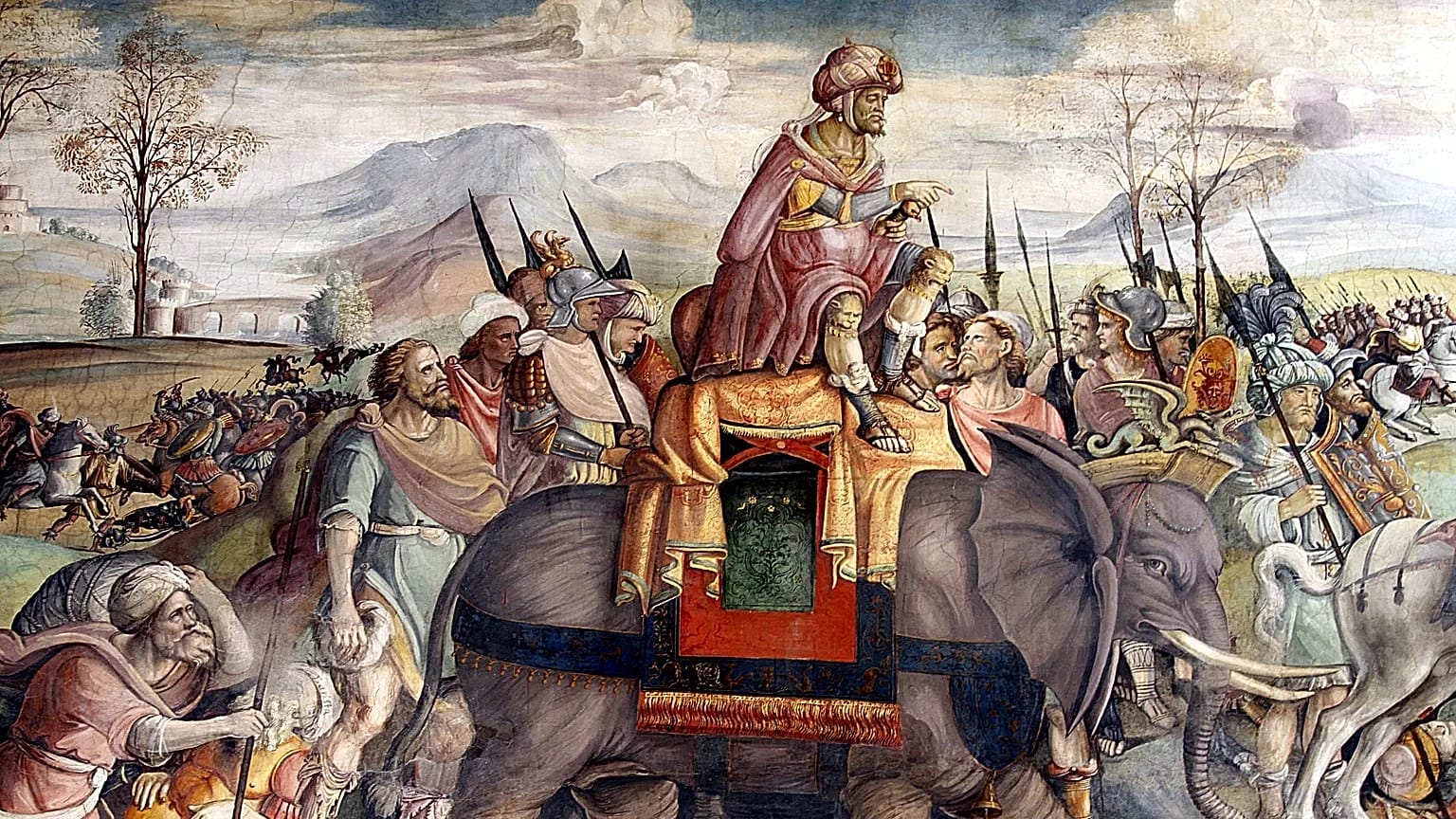













Hannibal led the Second Punic War against Rome and became famous for his crossing of the Alps and the 16-year campaign which brought the ancient empire to the brink of collapse. Now, archaeologists say they've found a bone that could be from Hannibal's war elephant.
A 2,200-year-old bone unearthed in Spain could be from one of Hannibal's war elephants used during the Second Punic War, according to a new study.
 ADVERTISEMENT
ADVERTISEMENT
ADVERTISEMENT
The baseball-sized relic, found near the southern Spanish city of Córdoba, could be the only direct evidence of the Carthaginian general's war elephants. The findings are detailed in the February issue of the Journal of Archaeological Science: Reports.
Crossing the Alps with elephants
According to the historical narrative, 37 pachyderms marched with Hannibal and his army across the entire Iberian Peninsula, over the Pyrenees to southern Gaul, through the Alps and finally to Italy to attack Rome.
So far, there has been no such concrete evidence of their march, only presumed churned-up earth and small tracks left by the huge animals as they crossed an Alpine pass on what is now the border between France and Italy.
"The bone could prove to be groundbreaking," Rafael Martínez Sánchez, an archaeologist at the University of Córdoba and lead author of the study, told Live Science magazine. "Until now, there was no direct archaeological evidence for the use of these animals."
The enigmatic bone was unearthed back in 2019 and initially gave scientists a headache because it could not be assigned to a native animal. It was only years later that it was recognised as the right carpal bone of an elephant - the hock joint of the front leg.
Romans used old Celtic settlements
The bone was discovered during archaeological excavations in a southern Spanish village, in a layer of soil that was dated to around 2,250 years ago using the radiocarbon method - i.e. to a time before Roman control of the region around 150 BC. The Romans called such fortified settlements oppida, they were previously used by the Celts and were often built on hills. This village, however, was located at a bend in the river.
Carthage, an ancient city-state on the coast of what is now Tunisia, once emerged as a Phoenician colony and was particularly feared for its powerful fleet. Carthage's armies were also strong: in the first two Punic Wars against the Roman Republic, war elephants were used specifically to secure control of strategically important regions in the western Mediterranean.
Martínez Sánchez explained that it is currently impossible to determine whether the animal was an Asian elephant - the species that the Greek king Pyrrhus of Epirus, known for his eponymous "Pyrrhic victory", used against the Romans around 280 BC, ten years before the First Punic War, when he supported southern Italy.
Pyrrhus came from Epirus, an ancient Greek kingdom in the north-west of modern Greece/Albania. (A Pyrrhic victory is a success where the cost almost cancels out the gain. Pyrrhus famously said: "Another victory like this and we are doomed.")
The find could also be a species of African elephant, now extinct, which was favoured by the Carthaginians as a war animal and brought to Spain for this purpose.
One thing is certain: The bone is a rare relic from the Punic Wars and a vivid testimony to the mighty war elephants that once roamed the Iberian Peninsula.