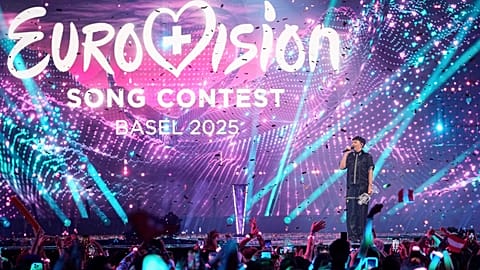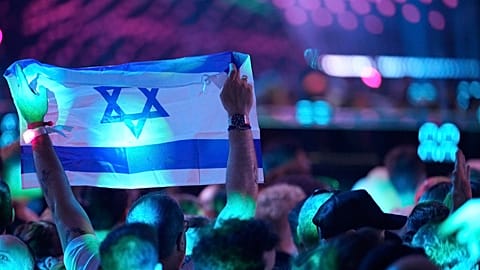



























The USB union at Italy's state broadcaster RAI has begun a petition calling for Italy to boycott Eurovision 2026 over Israel’s participation. It's seeking 3,000 signatures and urging RAI to follow five other countries in quitting the song competition.
A petition has been launched calling for Italy to withdraw from the Eurovision Song Contest 2026 and to "join the other countries that have distanced themselves".
 ADVERTISEMENT
ADVERTISEMENT
ADVERTISEMENT
The move comes from USB - RAI coordination, a young union branch founded two years ago with currently around 50 members at the state broadcaster.
In the USB statement it reads: "Spain, Ireland, Slovenia and the Netherlands have taken a courageous decision: they will not take part in the 70th edition of the Eurovision Song Contest, which will be held in Vienna in May 2026. These countries have also chosen not to broadcast the final on their national television channels: their decision was taken following the confirmation of Israel's participation by the EBU."
"By withdrawing Italy from Eurovision," the note says, "and deciding not to broadcast the event, RAI would not only be taking an ethically and empathetically justifiable position, it would also be setting an example as a moral leader on the international stage."
"Such a move," it continues, "would show how deeply Italy cares about the values of human dignity, equality and justice for all peoples. Our voice would resonate globally, demonstrating that we do not turn a blind eye to injustice."
Claudio Ciccone of USB - RAI coordinationexplains that the goal is to go well beyond the roughly3,000 signaturescollected so far and, in the longer term, to involve prominent figures in the campaign who can give the petition greater resonance.
The artist chosen to represent Italy at Eurovision will be decided at the next edition of the Sanremo Festival. In recent days, Iceland has also pulled out and Portugal's participation is at risk after several artists, in a joint statement, announced that they would not go to Vienna to take part in the event, given Israel's presence.
Meanwhile, in a statement on 5 December, RAI confirmed Italy's participation, one of the founding countries of the song contest. "As a member of the Big Five (with France, Germany, Spain and the United Kingdom, ed.) Italy has always been among the countries that believed in and invested in the Eurovision Song Contest, contributing significantly, including financially, to its development and international success.
In recent years our commitment has grown steadily, testifying to the value we attach to an event that is the longest-running international music show, capable of uniting diverse cultures in a shared celebration. RAI's involvement in the competition confirms the determination to strengthen Italy's role in the promotion of music, culture and entertainment at international level".
Pressure on RAI's board of directors
"We had already voiced the need for Italy to withdraw from Eurovision if Israel confirmed its participation on 22 September, when there was the large street protest," Ciccone says. "We said this was our intention: to make sure that RAI withdraws if Israel takes part".
Ciccone says Italy should follow Spain's example, another Big Five country that has decided not to take part, and sets out the petition's goal.
"Obviously we want to put pressure on RAI's board of directors," he adds, "so that it withdraws its delegation from the Eurovision Song Contest. If that were then to lead to a reassessment of Israel's participation, that would be a subsequent step".
"What we can do is put pressure on the board through the petition and with a demonstration outside RAI headquarters, and by requesting a meeting with the board".
The case of Russia
The boycott, as Ciccone explains, has long been in the air as a protest also against the so-called double standards of the European Broadcasting Union, which in 2022 excluded Russia after the invasion of Ukraine and the previous year barred Belarus following the contested re-election of President Alexander Lukashenko.
"I'm not drawing the comparison with Russia to say yes to this one and no to that one," Ciccone says, "but if there is a general line for applying an exclusion where violations at the level of international politics are found, the same must apply in all situations, otherwise we are faced with a case of double standards."
"The Israeli prime minister," the trade unionist continues, "lodged an appeal with the International Court of Justice; the appeal was rejected and so, according to the Court itself, we are faced with a government that has committed genocide."
Ciccone also expresses concern about the value of the competition in institutional terms and for a country's image in the world. "The Eurovision Song Contest is, yes, a singing performance watched across Italy and around the world, but it also has an international validation function and is a showcase of fundamental importance".
USB: "Our position is shared in the streets"
As to whether Italians, the users of public television and radio services, agree with the initiative, Ciccone has no doubts: "The street protests of recent months and the polls have made it quite clear which side Italy is on with regard to the genocide of the Palestinian people," he says.
Speaking about the company's position, he concludes: "By withdrawing Italy from Eurovision it would probably lose quite a lot of money. Record labels also have every interest in taking part and being seen at one of the biggest events in the world".