
















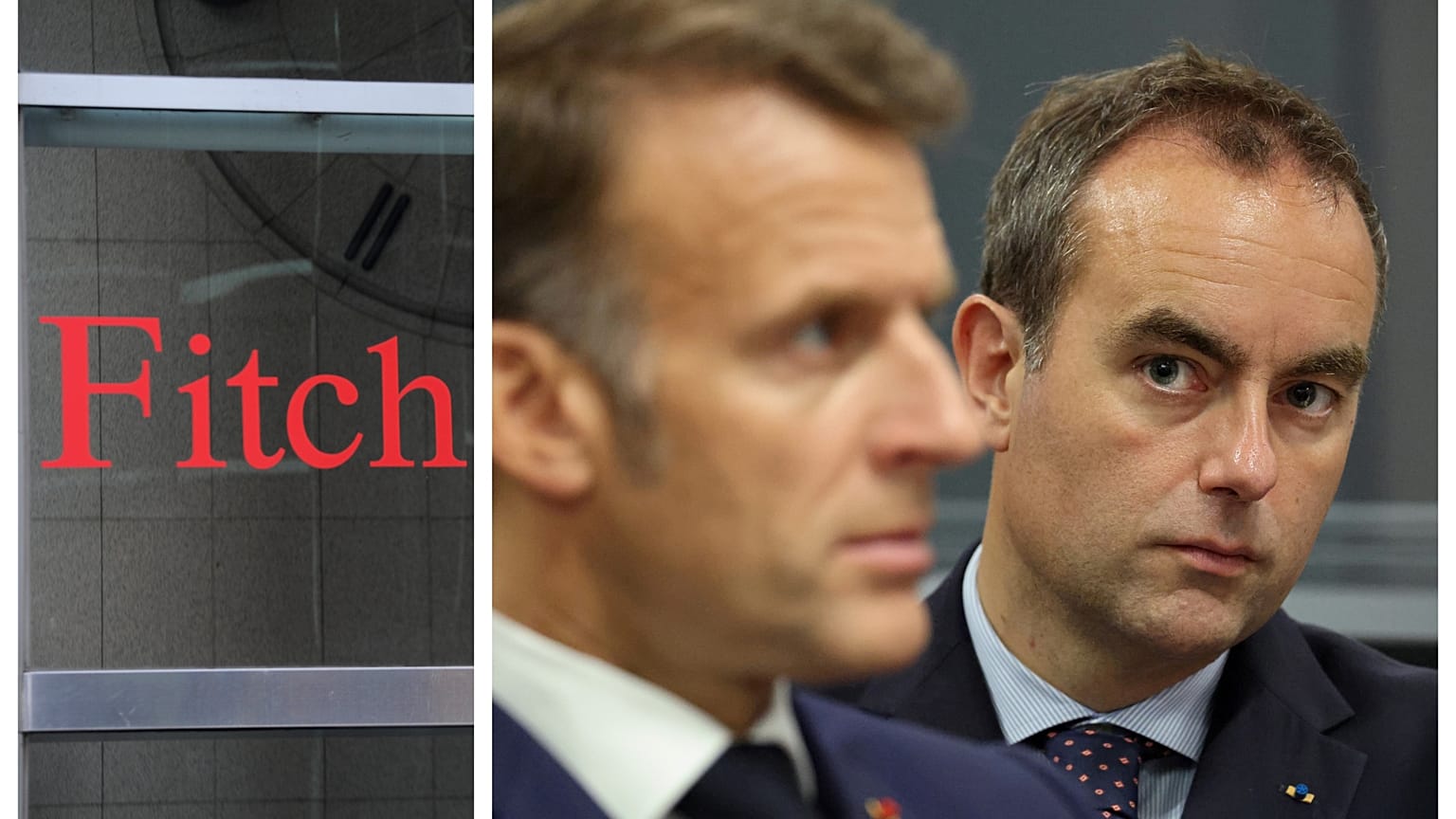













The agency cut France's rating in Sept 2025 and upheld it in March 2026. Despite a weaker outlook, Fitch may delay tougher action until 2027, experts told Euronews.
For the Lecornu government, simply staying afloat would already come as a relief. This Friday, one month before the 2027 finance bill is submitted to the National Assembly, Fitch will deliver its verdict on France's sovereign rating.
 ADVERTISEMENT
ADVERTISEMENT
ADVERTISEMENT
For now, the agency assigns an A+ rating to the EU's second-largest economy, with a stable outlook. The country lost its double A in September 2025, when Fitch penalised political instability in a post-dissolution context marked by the short-lived Barnier and Bayrou governments, which spent 99 and 270 days in power respectively. This assessment was confirmed in March 2026.
Speaking to Euronews, Hadrien Camatte, senior economist for France, Belgium and the eurozone at Natixis CIB, is betting on the status quo, "the most likely scenario", even though "a move to a negative outlook cannot be ruled out".
"This is the first concrete impact of the dreadful summer we've just been through"
Since March, explain Hadrien Camatte and his colleague, rates strategist Théophile Legrand, the macroeconomic environment has somewhat deteriorated. The two experts point in particular to a downward revision of growth forecasts for 2026, "in the wake of the war in the Middle East". While in March Fitch was projecting 1% growth in 2026, the government at the same time lowered its forecast to 0.7%, while Natixis CIB was anticipating growth of 0.6%.
On Friday morning, the latest figures were released (source in French): French GDP was flat in the second quarter, at 0.0%, instead of the slight 0.2% rebound initially announced by Insee. A key factor is "an even sharper deterioration in agricultural output compared with the information available at the end of July", Insee said.
"This is the first concrete impact of the dreadful summer we've just been through", economy minister Roland Lescure said this morning at the Summer Universities for Tomorrow's Economy, referring to repeated heatwaves and drought.
As for the deficit, Fitch is forecasting 4.9% of GDP, a level close to the government's 5% target. Natixis CIB expects 5.1%. These levels "leave no fiscal room for manoeuvre to reduce it over the coming years", Hadrien Camatte and Théophile Legrand argue.
Public debt, for its part, is expected to continue rising until at least 2030, against a backdrop of a sharp increase in interest costs, the two experts stress.
"This is a crucial issue for the ratings agency", which warned (source in French) in March that one of the main factors likely to influence the rating would be "a lasting increase in the public debt-to-GDP ratio in the medium term, due to an inability to implement fiscal consolidation measures or to a persistent rise in financing costs", they tell Euronews.
A clouded budgetary and political outlook
"The next budget cycle looks particularly challenging for cutting the deficit, while the looming presidential election is likely to heighten political volatility", the Natixis CIB analysts say.
They nevertheless believe Fitch may show some patience: "the budget cycle has not yet started and the main risks could materialise more fully in 2027".
Prime Minister Sébastien Lecornu plans to present his 2027 budget on 30 September, with parliamentary debates due to start in October.
Jean-Luc Mélenchon has already warned that his movement, France Unbowed (LFI), will move to censure the new budget.