
















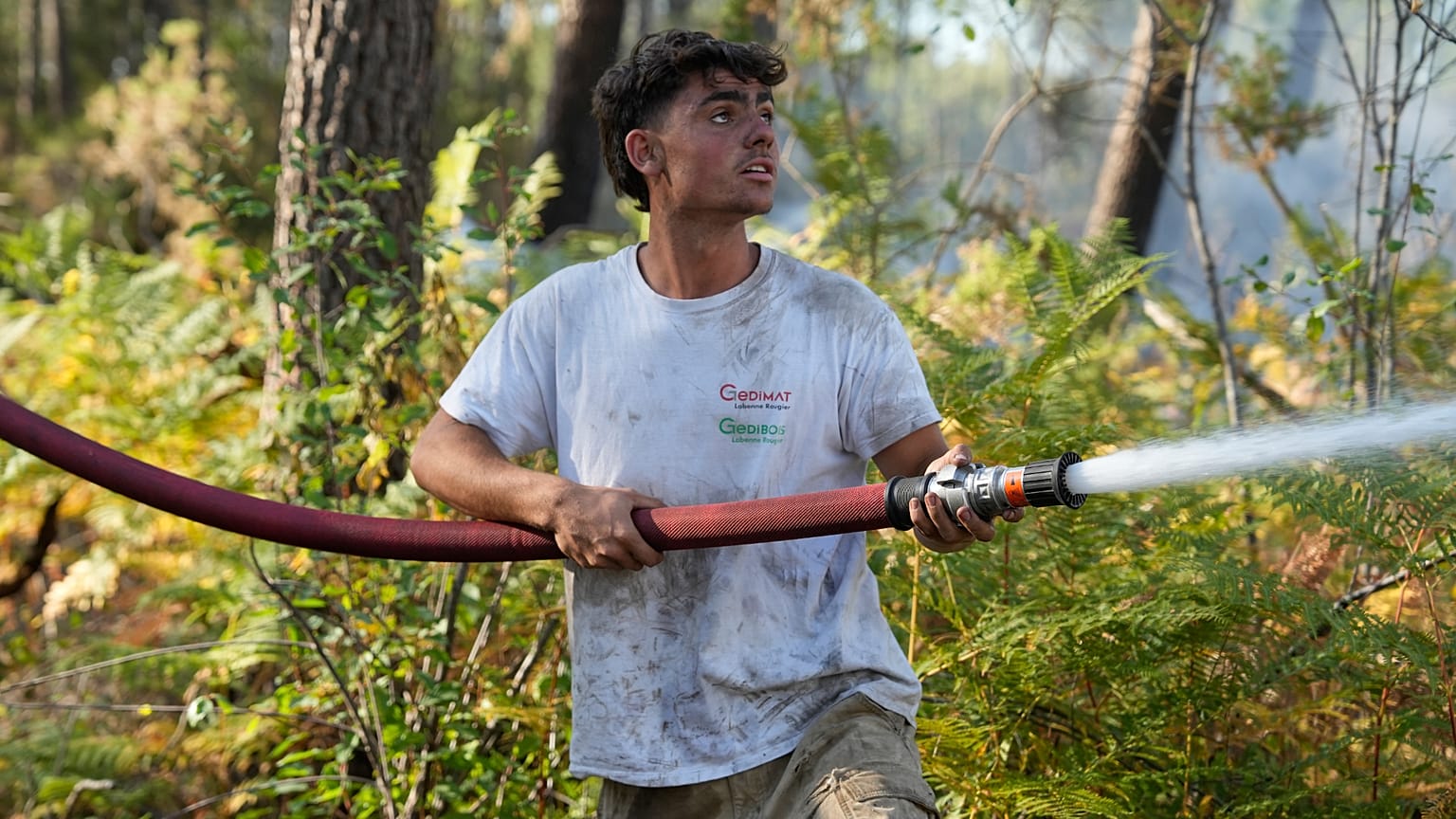













Around 200,000 jobs are connected to businesses affected by the Gironde fires, while the region’s tourism industry and electricity network face mounting pressure.
As Spain lifted an evacuation order in a wildfire-hit region near Madrid, France was still battling one of its worst wildfires in decades on Wednesday, with businesses suffering mounting disruption.
 ADVERTISEMENT
ADVERTISEMENT
ADVERTISEMENT
The Bordeaux-Gironde Chamber of Commerce and Industry told Euronews that 40,000 businesses were directly or indirectly affected by the fire and associated evacuation orders. Patrick Seguin, president of the CCI Bordeaux-Gironde, estimated that they represented approximately 200,000 affected jobs.
“We are experiencing an unprecedented situation. A mini-Covid. An economic catastrophe for our businesses, already penalised by the current economic climate,” Patrick Seguin, president of the Bordeaux-Gironde Chamber of Commerce and Industry, told Euronews Business.
Separately, the French Economy Ministry estimated that around 130,000 employees were unable to work because of the fires.
The chamber has established a crisis helpline for businesses, which is receiving a growing number of calls. Companies are primarily seeking help with cash-flow problems, deferred loan and tax payments, insurance claims, social-security contributions and placing employees on France’s partial-unemployment scheme.
Euronews Business previously reported on the initial economic damage caused by the fires, including the closure of strategically important defence sites, which disrupted operations at ArianeGroup and Dassault Aviation, among others.
Although the overall economic cost has yet to be calculated, the chamber warned that tourism businesses generating as much as 80% of their annual turnover during the summer season could face severe difficulties.
Thirty-eight campsites and other camping areas have been evacuated and four have been affected by the flames, according to La Tribune. Around 4,000 holidaymakers were evacuated from accommodation in Lacanau on Tuesday.
The Bordeaux-Gironde Chamber of Commerce and Industry said that a Facebook group called Gironde Solidarité Entreprises had also been created to enable companies to offer one another temporary offices, warehouse space, logistics and other practical assistance.
“The entire image of the Gironde region and its tourism market is taking a hit, but that's not all. A whole sector of our economy has been affected,” Seguin said.
Seguin also urged the rapid deployment of resources to provide initial support to affected businesses, in coordination with government services, saying that “business leaders need strong signals”.
The French government announced emergency support on Monday for businesses affected by fires in Gironde, the Landes and the Var. Companies affected by evacuation orders will be able to use the state-supported partial-unemployment scheme.
A meeting will be held at the Economy Ministry on Thursday to provide “more precise answers” to affected companies, Industry Minister Sébastien Martin told BFMTV-RMC.
Meanwhile, the region’s power grid required adjustments by France’s national transmission system operator, RTE. The company said in a statement that its maintenance teams had joined the fire-service command centre to coordinate actions to protect electrical infrastructure essential to powering homes, fire stations, reception centres, telecommunications networks and other critical infrastructure.
RTE said it had switched off certain lines and electrical substations to allow firefighters to work safely.
“In parallel, our teams are adapting the operation of the electricity network in real time, in constant coordination with Enedis, to limit the consequences of any unavailability,” RTE said.
No wildfire-related outage on the electricity transmission network had been reported by local media as of Wednesday afternoon. RTE’s latest official update, issued on Tuesday, said no transmission-network outages were underway at that time.
As of Wednesday afternoon, the fire remained stabilised but had still not been fixed, meaning that renewed outbreaks remained possible. Around 42,000 hectares had burned, and more than 220,000 people had been evacuated since the blaze began. Approximately 60,000 residents were authorised to return to their homes, although several flare-ups were reported as temperatures and winds intensified.