













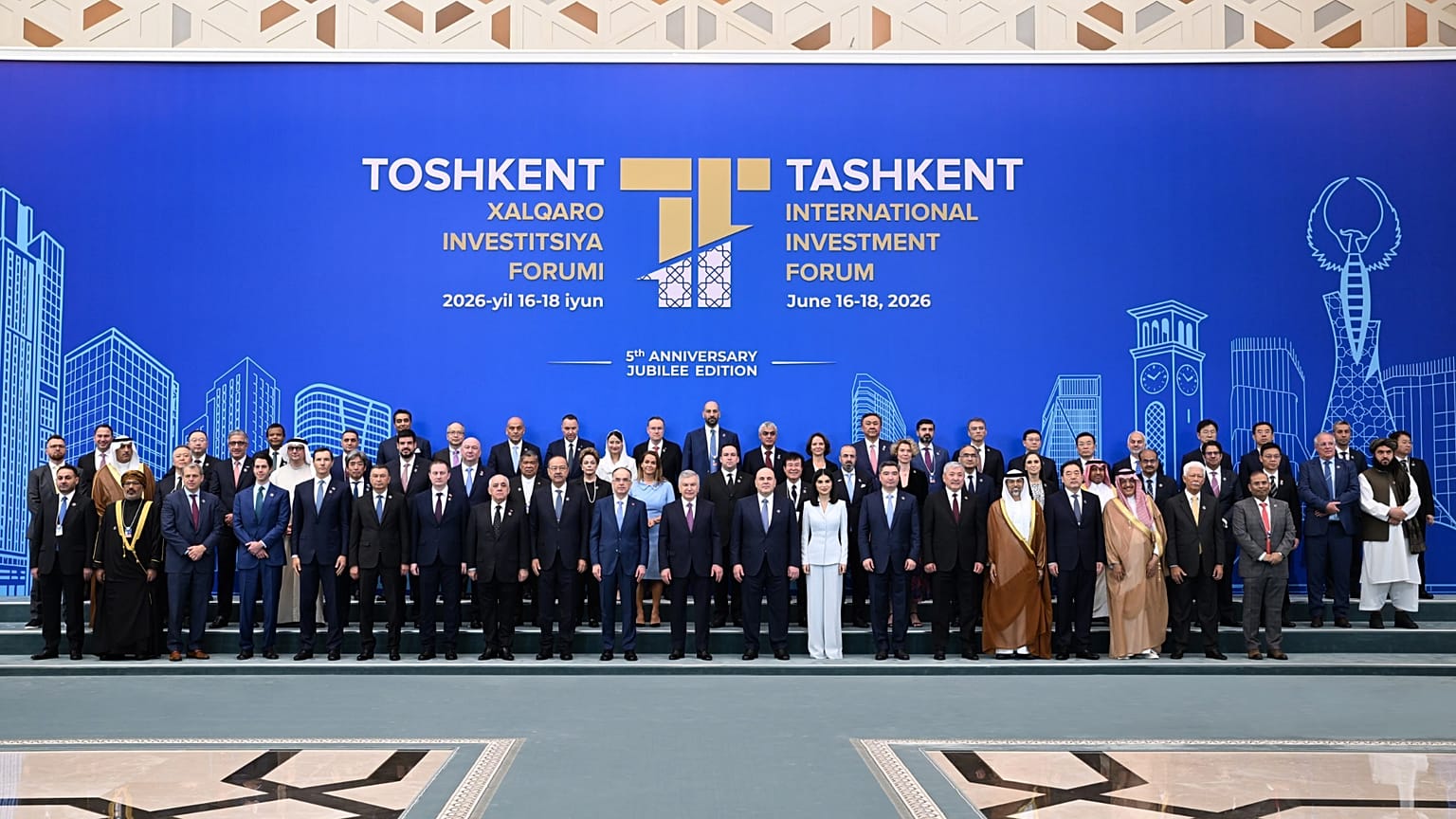














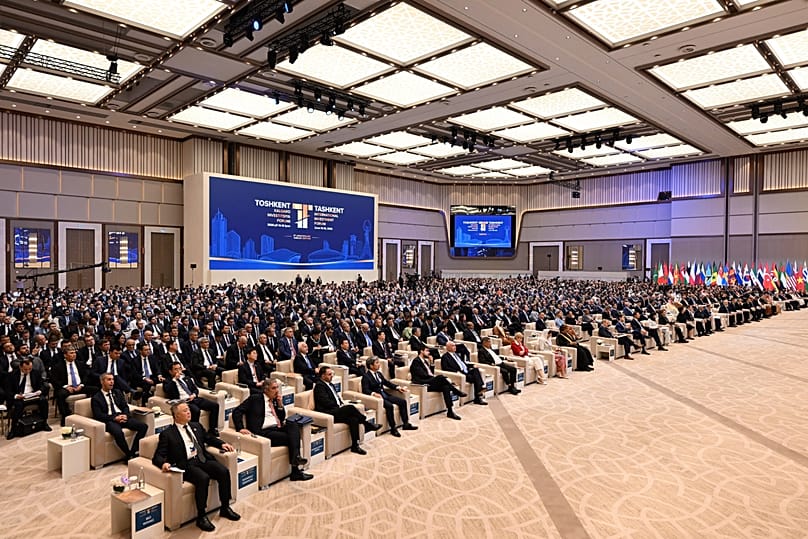
Nearly 4,000 participants from more than 100 countries gathered in Tashkent as government leaders, international financial institutions and global companies discussed investment opportunities, regional connectivity and industrial development.
President of Uzbekistan Shavkat Mirziyoyev announced plans for a new international financial centre and outlined six priority areas for attracting foreign investment during the official opening ceremony of the Tashkent International Investment Forum.
 ADVERTISEMENT
ADVERTISEMENT
ADVERTISEMENT
This initiative aims to strengthen legal protections for investors, expand capital markets and accelerate industrial development.
According to the President, the Centre will operate under a dedicated constitutional law and a special legal regime based on English common law principles. Authorities also plan to introduce extensive tax incentives, including exemptions from corporate income tax, value-added tax, property tax and customs duties for an initial period of 50 years.
Laziz Kudratov, Uzbekistan's Minister of Investment, Industry and Trade, said the initiative is designed to create a familiar regulatory environment for international investors.
“All companies, foreign companies in the finance sector, who are willing to do business in Uzbekistan, there won't be a need for them to understand the local legislation. They will just do operations and business according to international standards, according to common law,” Kudratov said.
The minister added that authorities are also preparing legislation on alternative investment funds.
“Then we are also coming up with a new law on alternative investments. So, it will create a framework to protect venture capital, to protect Limited Partner and General Partner investment, and private equity investment in Uzbekistan.”
Financial achievements
Opening the forum, President Mirziyoyev said Uzbekistan had attracted more than $150bn (€130bn) in foreign investment in recent years, with $123bn (€107bn) secured during the past five years alone.
“We are always open to investors interested in cooperation with Uzbekistan and ready to build an equal and mutually beneficial partnership,” Mirziyoyev said.
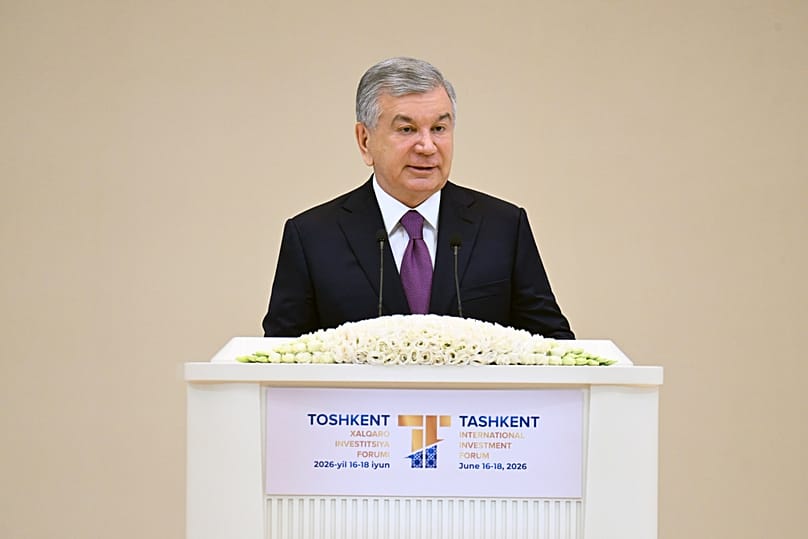
The president pointed to continued economic growth and improving international ratings as evidence of the country's reform trajectory.
Last year, Uzbekistan's economy grew by 7.7%, according to the World Bank, while foreign investment inflows reached $43bn (€37.4bn). International reserves exceeded $70bn (€60.8bn), according to figures presented during the forum.
The country's GDP is expected to surpass $180bn (€156.4bn) this year.
Mirziyoyev also highlighted Uzbekistan's recent progress in international rankings.
“Uzbekistan's international credit standing continues to strengthen year after year. This year, our country advanced 14 positions in the prestigious Index of Economic Freedom and, for the first time, joined the group of nations recognised as having a ‘moderately free economy’,” he said.
“These achievements are tangible evidence that Uzbekistan's economy is gaining new momentum and entering a stage of new opportunities.”
Six priorities for investment
Shavkat Mirziyoyev outlined six priority areas for future cooperation with investors.
They include strengthening legal guarantees for investors, developing capital markets and alternative financing instruments, expanding high-value-added manufacturing, deepening cooperation in green energy and artificial intelligence, improving regional transport connectivity, and increasing investment cooperation in regional development.
The government also plans to adopt new legislation on capital markets and alternative investment funds, launch sovereign Islamic bonds and continue a privatisation programme that will put assets worth approximately $6bn (€5.2bn) up for auction this year.
Strengthening international partnerships
International cooperation featured prominently throughout the opening day.
Among the foreign leaders attending the forum was Albanian President Bajram Begaj, who said the two countries share similar ambitions in regional connectivity and economic development.
“Albania and Uzbekistan have more in common than geography might suggest. Both our countries are investing in connectivity. Both seek to extend their role with broader regional networks,” Begaj said.
“Both understand that economic success depends not only on domestic resources, but also on the ability to connect markets, attract investment, encourage innovation, and build productive partnerships.”
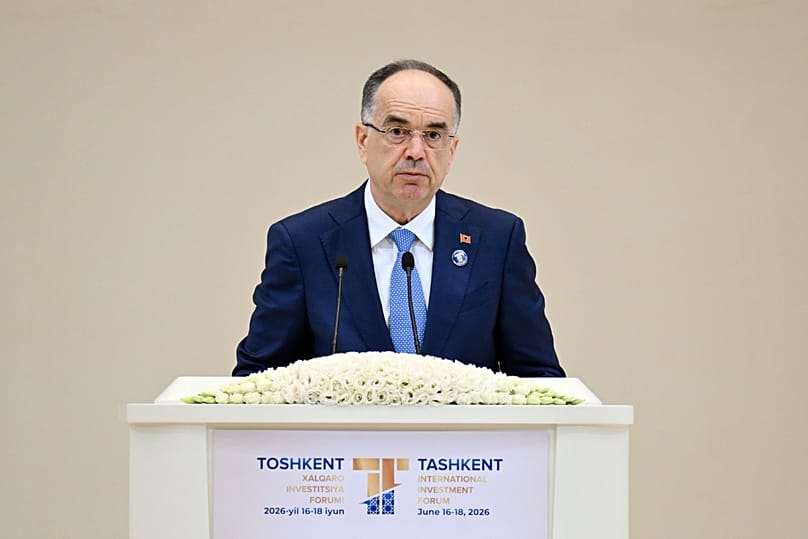
Alongside the plenary session, participants attended discussions on sustainable infrastructure, energy transition, industrial development and regional trade.
One of the key discussions on the sidelines of the forum focused on the EU-Central Asia Strategic Partnership for Investment, Trade and Sustainable Infrastructure Development.
Speakers highlighted growing cooperation between the two regions in transport, energy and critical raw materials, with a particular emphasis on developing new trade corridors and attracting long-term investment.
Participants said the relationship had entered a new phase following the first EU-Central Asia Summit in Samarkand earlier this year, shifting attention from political commitments to the implementation of concrete projects.
On the sidelines of the forum, President Mirziyoyev also held a series of bilateral meetings with Kazakhstan's Prime Minister Olzhas Bektenov, a delegation from the United Arab Emirates led by Minister of Energy and Infrastructure Suhail Al Mazrouei, China's National Energy Administration chief Wang Hongzhi, British business representatives led by Minister for Investment Lord Jason Stockwood, and ACWA Power chairman Mohammad Abunayyan.
The discussions focused on expanding cooperation in energy, infrastructure, industry, transport and investment projects.
Read more