




























Inflation picked up across the EU’s largest economies in May, driven by higher energy prices, fuelling expectations that the ECB will raise interest rates at its June meeting.
Prices are rising faster across the EU’s biggest economies, according to early figures for May. The numbers reinforce growing expectations that the European Central Bank (ECB) will raise interest rates in June.
 ADVERTISEMENT
ADVERTISEMENT
ADVERTISEMENT
France's inflation rate rose to its highest level in more than a year.
The country's EU-harmonised inflation rate (HICP), a measure used to compare inflation across the eurozone, came in at 2.8% year-on-year in May, driven by higher energy prices, particularly natural gas, according to preliminary data from the national statistics agency, INSEE.
On a monthly basis, prices edged up just 0.1% from April, reflecting some easing in energy costs over the month, even as they remain well above their levels a year earlier.
The reading is nonetheless the highest HICP reading since February 2024 and continues a sharp acceleration from the 1.1% rate recorded as recently as February.
Inflation accelerates in Italy and Spain
Inflation in Italy also rose sharply in May, according to preliminary figures published by the National Institute of Statistics (ISTAT). The HICP rate rose to 3.3%, slightly higher than the expected 3.2%, and up from 2.8% in April.
Notably, goods inflation picked up to 3.5% from 3.1%, and services inflation rose to 2.8% from 2.4%. At the same time, core inflation, which excludes volatile energy and food prices, edged up to 1.8% from 1.6%, suggesting that higher energy costs are beginning to feed through into broader price categories.
In Spain, the preliminary estimate put the HICP rate at 3.6% year-on-year in May, in line with forecasts and marginally higher than April's 3.5%.
The Spanish statistics office pointed to transport as a key driver of headline prices, reflecting fuel costs that remain substantially above their level a year ago amid the ongoing Iran war.
A mixed picture in Germany
By contrast, Germany offered a clear reprieve.
The flash estimate put the HICP rate at 2.6% in May, down from 2.9% in April and meaningfully below the 2.8% consensus forecast, making it the only one of the 'Big Four' where headline inflation slowed this month.
However, core inflation told a different story, rising to 2.5% from 2.3% in April.
For the ECB, the easing headline figure in Europe's largest economy provides limited reassurance when the underlying trend continues to move in the wrong direction.
The ECB and the June question
The data arriving this week comes at a pivotal moment for the European Central Bank, which holds its next monetary policy meeting on 11 June.
A rate hike is widely expected, and the minutes from the April meeting, published on Thursday, showed that the ECB Governing Council is well aware of the stakes.
In its biannual Financial Stability Report, the ECB stated that "a scenario of notably weaker growth associated with a more persistent energy shock could trigger a reassessment of fiscal sustainability and an abrupt repricing in sovereign bond markets."
Rate markets are now fully pricing in one 25-basis-point hike at the June meeting, with two hikes expected by September and a 92% probability of a third before the year is out.
The April minutes also revealed a notably hawkish internal debate. A number of members indicated that the April decision to hold rates was a close call and that they "would not have opposed raising rates at the current meeting had this been on the table."
On Friday, Bank of Italy Governor and ECB Governing Council member Fabio Panetta reiterated the hawkish tone, saying that the persistence of the Iran war and the risk of further supply disruptions pointed to the need for intervention.
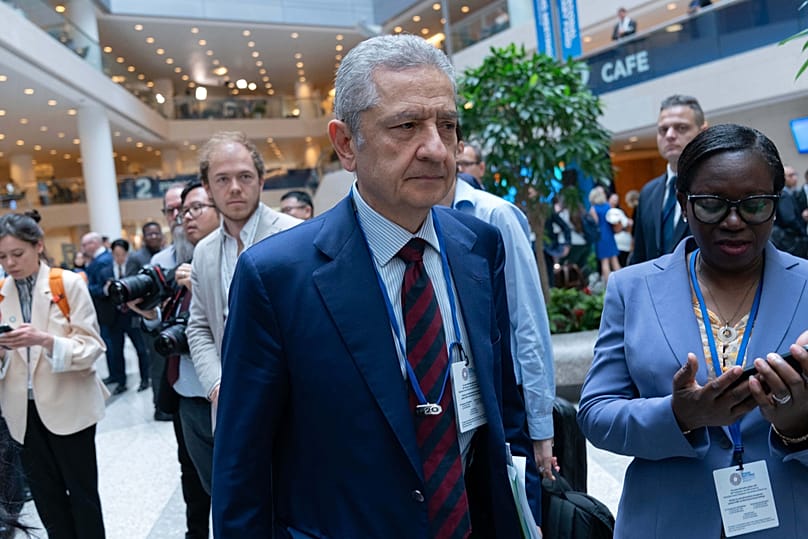
"The forward-looking picture seems to call for a recalibration of the monetary policy stance to counter the risk of persistent inflationary tensions," Panetta said.
However, the central bank chief also stressed that "not being tied to a predetermined path remains essential."
The minutes also noted that while shorter-term inflation expectations had risen sharply, most measures of longer-term expectations remained around 2%, providing some reassurance that the shock had not yet become embedded.
The ECB's own consumer survey showed one-year-ahead inflation expectations jumping to 4% in April from 2.5% in March, though five-year-ahead expectations rose only marginally to 2.4% from 2.3%.
That gap between short- and longer-term expectations is precisely what a well-telegraphed, limited rate hike is intended to address. Whether one move will be sufficient is a question that incoming data will help answer.