


























Venezuela has awarded BP a licence to develop the offshore Loran gas field alongside state-backed partners from the UAE and Qatar, marking the British company's return to a country whose energy sector has been reopening to foreign investors since US forces captured Nicolás Maduro.
BP is going back into Venezuela.
 ADVERTISEMENT
ADVERTISEMENT
ADVERTISEMENT
The agreement signed in Caracas on Thursday gives the company operatorship of Loran phase two, an offshore gas project holding more than four trillion cubic feet of proven gas resources, with Abu Dhabi's XRG, Qatar's UCC Oil and Gas Holding taking equal stakes beside it.
It is the clearest signal yet that the opening of Venezuela's energy industry to foreign capital, underway since Maduro's removal, is gathering pace.
All three companies will hold equal working interests, with BP as operator, and the licence remains subject to regulatory approvals.
PDVSA Gas, the state producer's gas arm, transferred part of its interest to XRG, the international investment vehicle of Abu Dhabi's ADNOC. For both XRG and UCC, a unit of the Qatari conglomerate of the same name, this marks a first entry into Venezuela.
The field itself is shared as Loran forms the Venezuelan portion of the Loran-Manatee accumulation, which straddles the maritime boundary with Trinidad and Tobago and holds roughly 10 trillion cubic feet of recoverable gas in total.
Shell won the licence for the first phase in June and is separately developing Manatee on the Trinidadian side, where first gas is expected next year.
BP says both Venezuelan phases will now be developed in parallel and signed a further memorandum of understanding covering exploration at the Carúpano East Block.
The agreements were concluded during a visit to Caracas by CEO Meg O'Neill and David Campbell, BP's senior vice president for Latin America and the Caribbean.
A sector reopened under US pressure
The licences are the product of a bargain struck with Washington.
After Maduro was seized by US forces in January, interim president Delcy Rodríguez rewrote the country's energy law at the Trump administration's urging, opening the world's largest proven oil reserves to foreign firms.
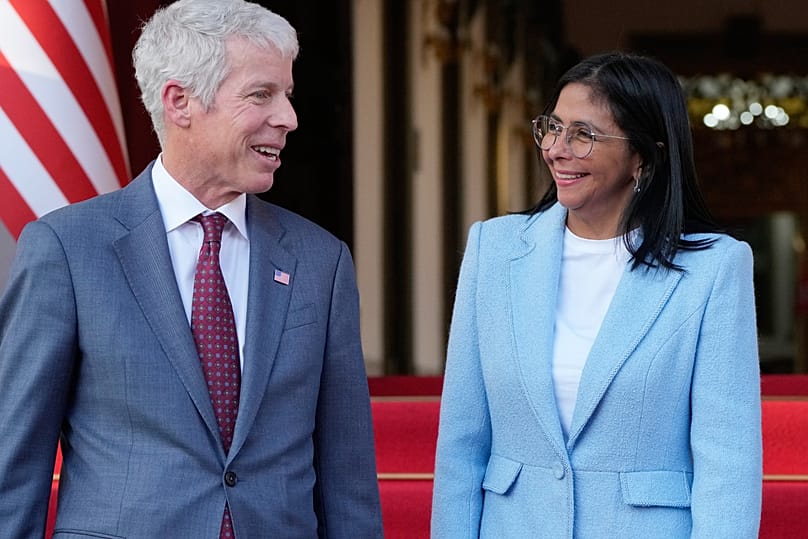
In return, the US relaxed sanctions that had frozen most Western investment, including the licences it revoked from BP, Shell and Chevron in 2025.
Eni, Repsol and Shell have all signed since.
The awards process stalled after the earthquakes of 24 June, which killed more than 6,300 people, and resumed only on Thursday, when the three Loran permits were issued and the agreements signed.
"I have a special interest in gas to promote national development," Rodríguez said at the ceremony, which was broadcast on state television.
BP is not a newcomer as it held a licence for the Cocuina field from 2024, before Washington withdrew its permission to use it.