



























The European Commission clinched a trade deal with Canberra on Tuesday, liberalising flows of goods while keeping quotas on sensitive EU farm products and leaving Australia’s luxury car tax largely intact.
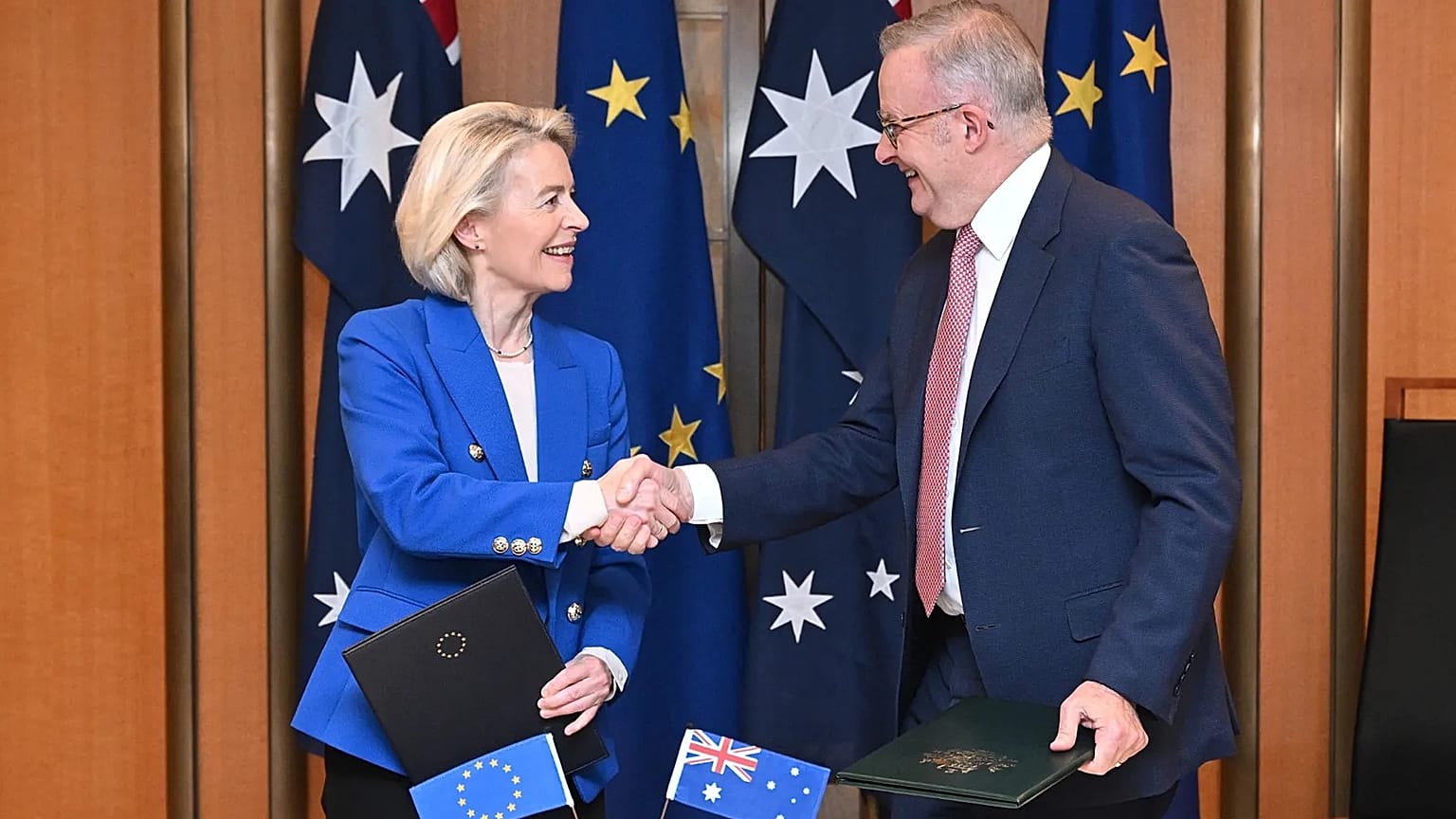
European Commission President Ursula von der Leyen on Tuesday sealed a free-trade agreement with Australian Prime Minister Anthony Albanese, slashing tariffs on most EU goods and farm exports.
 ADVERTISEMENT
ADVERTISEMENT
ADVERTISEMENT
The deal marks another win for Brussels as it races to diversify trade ties and lock in strategic partners amid rising global tensions.
The pact will save the EU €1 billion a year in duties, the Commission said, with exports projected to climb as much as 33% over the next decade.
Agriculture proved a flashpoint, with EU farmers already pushing back against the Mercosur trade agreement and a legal challenge from MEPs threatening ratification.
Tariffs will eventually fall to zero on products including cheese (over three years), wine, some fruit and vegetables, chocolate and processed foods.
On the toughest issues — beef and sheep, which sank talks in 2023 — Australia agreed to quotas of 30,600 and 25,000 tonnes a year, respectively.
A safeguard mechanism will allow the EU to shield sensitive sectors if a surge in Australian imports harms the bloc’s market.
Beyond agriculture, the agreement opens access to Australia’s critical raw materials, including aluminium, lithium and manganese.
Brussels also failed to scrap Australia’s luxury car tax. Instead, 75% of EU electric vehicles will be exempt.
The deal is a geostrategic push
The Commission expects strong export gains in key sectors, including dairy (up to 48%), motor vehicles (52%) and chemicals (20%).
Brussels has prioritized the deal as it builds partnerships in the Indo-Pacific, where China’s influence has become central. A security and defence partnership with Canberra was also announced Tuesday.
“The EU and Australia may be geographically far apart but we couldn't be closer in terms of how we see the world,” von der Leyen said, adding: “With these dynamic new partnerships on security and defence, as well as trade, we are moving even closer together.”
Since Donald Trump returned to power in 2025, trade agreements have taken on sharper geostrategic weight for the EU as it seeks new markets.
In 2025, Brussels struck deals with Mexico, Switzerland and Indonesia. The Mercosur pact was also signed earlier this year and will be provisionally applied from 1 May despite a European Parliament legal challenge.
More could follow. Talks are ongoing with the Philippines, Thailand, Malaysia, the United Arab Emirates, and countries in Eastern and Southern Africa, von der Leyen told EU ambassadors on 9 March.