


























An existing energy crisis scenario allows the government to act directly in limiting prices, but this can only happen after an EU-level decision.
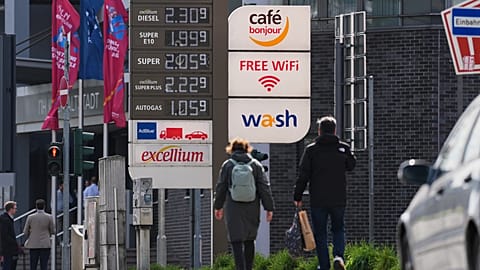
Portugal is very close to meeting the European criteria for declaring an energy crisis due to rising gas and fuel prices, Environment and Energy Minister Maria da Graça Carvalho warned.
 ADVERTISEMENT
ADVERTISEMENT
ADVERTISEMENT
"We are getting close to the criteria for declaring an energy crisis," said da Graça Carvalho, stressing that, if confirmed, the scenario would allow for the implementation of "measures that are being analysed and quantified as to how we can protect families and also companies."
Since the energy transition and Russia's invasion of Ukraine, the EU has been overhauling its energy market regulations as the bloc has weaned itself off Russian gas.
EU directive 2024/1788 establishes a new regulatory framework for internal markets regarding renewable gas, natural gas and hydrogen, including formal mechanisms for dealing with energy price crises.
Under the rules, the Council of the EU may declare a natural gas price crisis at a regional or EU level by way of a collective decision.
For that threshold to be reached, certain conditions must be met — including average wholesale natural gas prices of at least two and a half times the average over the previous five years and no lower than €180/MWh, or a sharp rise in retail natural gas prices of around 70%.
If Portugal reaches that level, Carvalho said, "A resolution must be achieved by the Council of Ministers and the European Commission [must be] informed," adding that a European Council decision is also required.
A separate regulation on the EU electricity market, Directive 2024/1711, allows member states to temporarily set regulated electricity prices below cost during a price crisis, provided suppliers are compensated and the measure does not distort competition or incentivise higher consumption.
The two directives use similar criteria for defining an energy crisis based on price rather than supply.
Portugal must therefore monitor the figures and wait for a Council decision before it can intervene at the price level.
"The possible declaration of an energy crisis, if it occurs, is a European mechanism that allows member states to adopt exceptional measures to support families and companies — namely support that, under normal circumstances, could be considered state aid," she continued.
"It is not, therefore, a sign of a supply shortage, but rather an instrument of protection against price shocks," Carvalho said.
Natural gas is the most worrying
The possibility of an energy crisis declaration in Portugal was raised by Carvalho the day after the government approved a framework of measures for energy crisis situations involving both individual consumers and companies.
The measures are, according to the government, "temporary, limited to the period of validity of the European declaration and should minimise the fragmentation of the internal market", and may include limiting prices.
"These measures, these interventions in the market, include the possibility of limiting prices, of setting prices below the cost price, depending on developments," said António Leitão Amaro, the Ministry for the Presidency, who handles communication for the Portuguese government.
Despite the scenario being floated, Amaro was keen to stress that Portugal remains far from meeting the EU's thresholds.
"We're still a long way off, at the moment, from talking about that threshold," he said.
A day later, the Ministry of the Environment and Energy moved to quash any suggestion of a rift within the government, clarifying that any energy crisis declaration would apply only to natural gas.
In the case of natural gas, the ministry said, "there has been a very significant and recent worsening of market conditions", with prices "currently around 85% above the levels seen at the start of the war in the Middle East on 27 February 2026," a rise driven by "significant disruptions to global supply, particularly constraints on production infrastructure in Qatar, in a context of high geopolitical tension."
Electricity, however, looks more insulated. With around 80% of Portugal's power coming from renewables, the ministry said "the price of electricity is relatively protected".
A familiar scenario
The concept of an energy crisis is neither new nor unfamiliar to the Portuguese.
On 28 April, following the blackout that hit the Iberian Peninsula, the government declared an energy crisis to "safeguard the needs of the population, guarantee priority supplies and take the appropriate exceptional measures to ensure the gradual and scheduled restoration of normal supply".
The declaration allowed the executive to adopt, on an extraordinary basis, preventive and special reaction measures to guarantee essential energy supplies across the country, focusing on network operation, priority management, mobilisation of technical resources and institutional coordination.
But a generalised blackout and a steep rise in prices differ in their scope and require different responses. The concept of an energy emergency is nonetheless enshrined in Portuguese law, which sets out the provisions for its definition and application.
In the current context, and following supply disruptions caused by delays in LNG shipments from Qatar, the EU is pushing member states to refuel gas stocks early to avoid last-minute price spikes.
European Commissioner for Energy Dan Jørgensen has nonetheless assured that the bloc's security of supply remains "relatively protected", given Europe's limited dependence on Qatari imports, which account for around 12 to 14% of the EU's LNG.
At the beginning of March, EU gas reserves stood at 30%, below last year's levels.
Oil fell more than 13% on Monday after Trump announced a temporary suspension of strikes on Iranian power plants and energy infrastructure — a reminder of just how quickly the picture can shift.
Changing behaviour and reducing dependencies
A new report by the International Energy Agency sets out several options for easing the pressure of energy prices on consumers without requiring direct intervention on prices themselves.
Reducing demand, the IEA argues, is the quickest and most effective lever available.
The agency proposes measures including promoting teleworking, avoiding air travel where alternatives exist, reducing road speed limits and encouraging car sharing and public transport.
At home, switching to electric cooking over gas where possible can also help cut monthly bills.
The stakes, according to IEA executive director Fatih Birol, could hardly be higher.
Speaking at the National Press Club of Australia in Canberra on Monday, he warned that the global economy faces a "very, very serious threat".
"No country will be immune to the effects of this crisis if it continues to evolve in this direction," he said.
Birol said the war in Iran has had a more serious impact on oil markets than the two oil shocks of the 1970s combined, and a greater effect on gas markets than Russia's war in Ukraine — a striking assessment that underscores the scale of the disruption now rippling through global energy markets.