












Crude prices soared on Monday as investors continue to weigh the potential impact of escalating tensions in the Middle East on the supply of energy.
Oil prices climbed on Monday as investors assessed the economic impact of US and Israeli attacks on Iran, which triggered swift retaliation from Tehran targeting assets in multiple Middle Eastern countries.
 ADVERTISEMENT
ADVERTISEMENT
ADVERTISEMENT
The price of a barrel of US benchmark crude surged by about 8% and traded at $72.41 by 09:53 CET, while Brent crude rose 8.48% to $79.05 a barrel. By early afternoon, prices edged slightly higher.
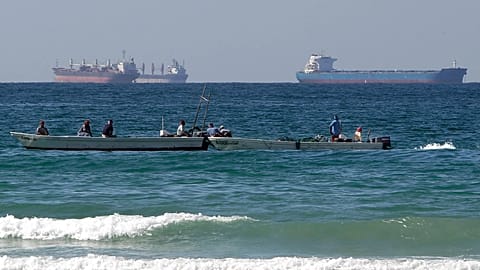
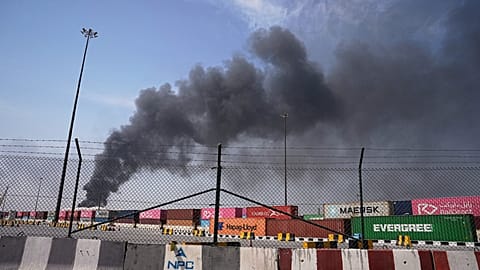
Traders were betting that oil supplies from Iran and elsewhere in the Middle East could slow or grind to a halt. Attacks across the region, including on two vessels travelling through the Strait of Hormuz — the narrow mouth of the Persian Gulf — have restricted countries’ ability to export oil to the rest of the world.
“Roughly one-fifth of global oil and LNG (liquefied natural gas) flows squeeze through the Strait of Hormuz. This is not an obscure canal. It is the aorta of the global energy system,” Stephen Innes of SPI Asset Management said in a commentary note.
A prolonged war would likely result in higher prices for other fuels and petrol, and could ripple through the global economy, adding to overall production costs.
Likewise, prolonged interruptions to oil flows through the Middle East would have “huge implications for oil and LNG and every market everywhere if it occurs. Energy is an input to all production,” RaboResearch Global Economics & Markets said in a report.
Iran exports roughly 1.6 million barrels of oil a day, mostly to China. Beijing may need to look elsewhere for supply if Iran’s exports are disrupted — another factor that could push energy prices higher.
However, China has ample oil reserves of up to 1.5 billion barrels and could offset a decline in Iranian oil by increasing imports from Russia, said Michael Langham of Aberdeen Investments.
The attacks had been anticipated, following a significant build-up of US forces in the Middle East, so traders had already adjusted their positions to account for that risk.
However, EU officials said on Monday that energy supply is not under threat.
In other trading on Monday, the price of gold — usually viewed as a safe haven in times of uncertainty — rose 2.4% to about $5,371 per ounce.
Elsewhere, European markets were lower with the Euro Stoxx 50 down 2% at the open, and the broader pan-European Stoxx 600 close behind at -1.8%.