














The US Supreme Court struck down Donald Trump’s sweeping global tariffs, ruling the president overstepped his authority by invoking emergency powers.
The Supreme Court struck down President Donald Trump's far-reaching global tariffs on Friday, handing him a significant loss on an issue crucial to his economic agenda.
 ADVERTISEMENT
ADVERTISEMENT
ADVERTISEMENT
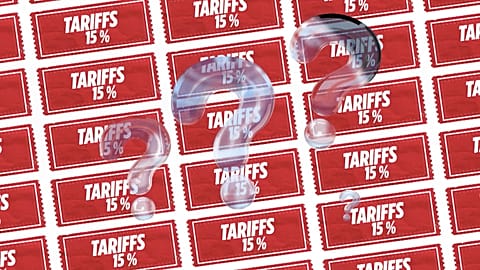
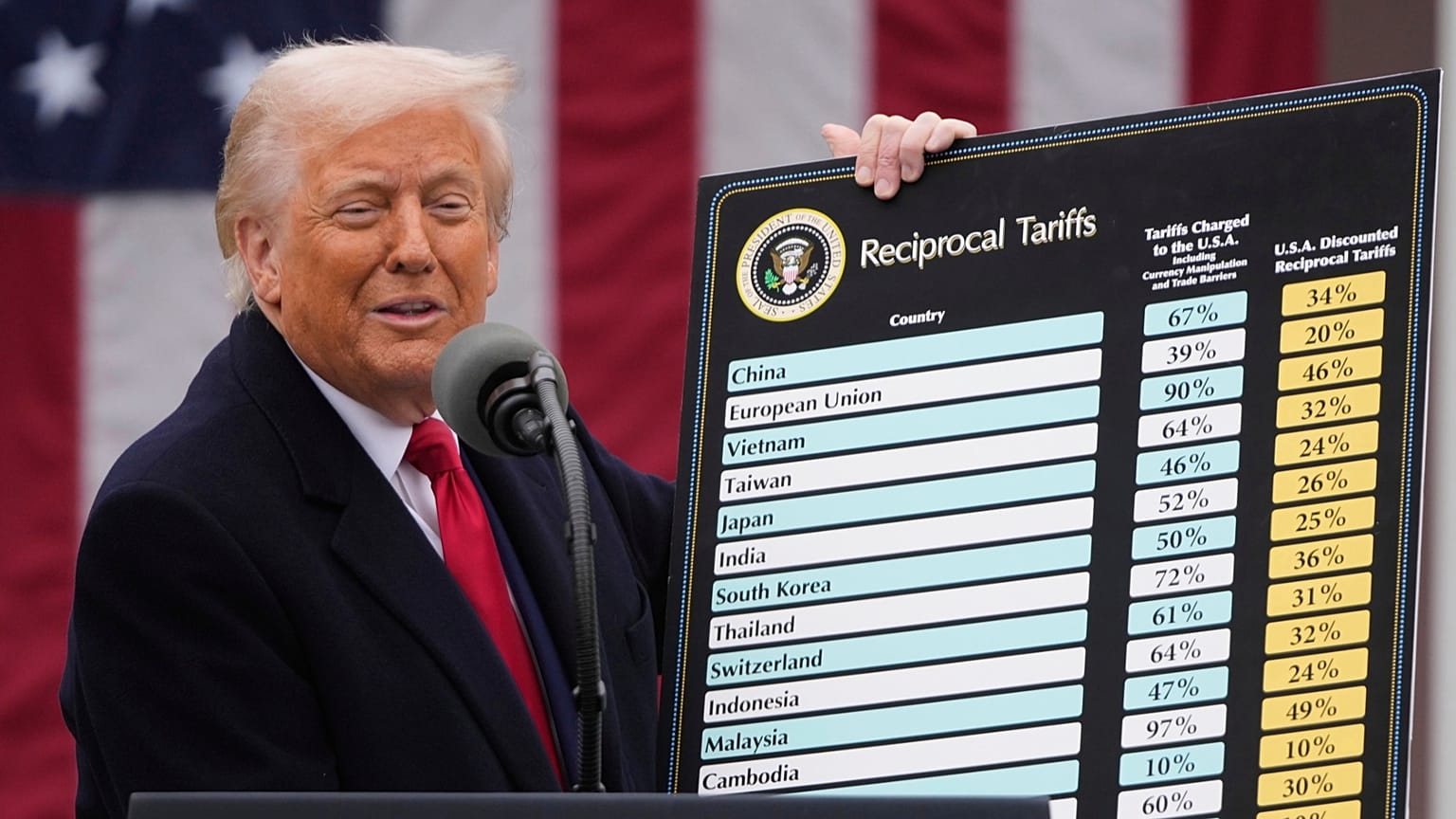
The 6-3 decision centres on tariffs imposed under an emergency powers law, including the sweeping reciprocal tariffs he levied on almost every US trading partner.
In a statement on Friday evening, Trump said he found the decision "deeply disappointing" and said he was "ashamed" of the court.
"Foreign countries that have been ripping us off for years are ecstatic. They're so happy and they're dancing in the streets, but they won't be dancing for long, I can assure you that," he continued.
It marks the first major piece of Trump's broad agenda to come squarely before the nation's highest court, which he helped shape with the appointments of three conservative jurists in his first term.
The majority found that the Constitution "very clearly" gives Congress the power to impose taxes, which include tariffs.
"The Framers did not vest any part of the taxing power in the Executive Branch," Chief Justice John Roberts wrote in his decision.
Justices Samuel Alito, Clarence Thomas and Brett Kavanaugh dissented.
"The tariffs at issue here may or may not be wise policy. But as a matter of text, history, and precedent, they are clearly lawful," Kavanaugh wrote in the dissent.
A shift to 'regular' duties?
The tariffs decision does not stop Trump from imposing duties under other laws. While those have more limitations on the speed and severity of Trump’s actions, top administration officials have said they expect to keep the tariff framework in place under other authorities.
"Other alternatives will now be used to replace the ones that the court incorrectly rejected. We have great alternatives," Trump said on Friday.
The Supreme Court ruling comes despite a series of short-term wins on the court’s emergency docket that have allowed Trump to push ahead with an extraordinary expansionsof executive power on issues ranging from high-profile firings to major federal funding cuts.
The Republican president has been vocal about the case, calling it one of the most important in US history and saying a ruling against him would be an economic blow to the country.
But legal opposition crossed the political spectrum, including libertarian and pro-business groups that are typically aligned with the GOP.
Polling has found tariffs were not broadly popular with the public, amid wider voter concern about affordability.
Is it unconstitutional?
The Constitution gives Congress the power to levy tariffs. But the Trump administration argued that a 1977 law allowing the president to regulate importation during emergencies also allows him to set tariffs.
The IEEPA is a US law that lets the president declare a national emergency over an external threat and then use broad economic tools — like sanctions and asset freezes — against foreign countries, entities or individuals.
Other presidents have used the law dozens of times, often to impose sanctions, but Trump was the first president to invoke it for import taxes.
Trump set what he called reciprocal tariffs on most countries in April 2025 to address trade deficits that he deemed to be a national emergency.
Those came after he imposed duties on Canada, China and Mexico, ostensibly to address a drug trafficking emergency.
A series of lawsuits followed, including a case from a dozen largely Democratic-leaning states and others from small businesses selling everything from plumbing supplies to educational toys to women’s cycling apparel.
The challengers argued the emergency powers law does not include tariffs and Trump's use of it fails several legal tests, including one that doomed then-President Joe Biden's $500 billion (€460bn) student loan forgiveness programme.
The economic impact of Trump's tariffs has been estimated at some $3 trillion (€2.76tn) over the next decade, according to the Congressional Budget Office. The Treasury has collected more than $133 billion (€122bn) from the import taxes the president has imposed under the emergency legislation, federal data from December shows.
Many companies, including the big-box warehouse chain Costco, have already lined up in court to demand refunds.
Billions of dollars in potential refunds
Since 2 April 2025 — the day President Trump branded Liberation Day as he unveiled his sweeping tariff plan — the US Treasury has taken in about $240 billion (€221bn) in tariff revenue. Capital Economics says that if refunds are ordered, the cost could be roughly $120 billion (€110bn), around 0.5 per cent of the country's GDP.
In his dissent, Justice Kavanaugh was the only justice to raise the refunds issue, warning it would turn into a "mess".
It is still unclear whether the Trump administration will be liable to pay any firms back but the lawsuits now have a firmer ground to stand on.
The SCOTUS decision was announced shortly after the New York open, which reacted very positively to the news, with the S&P500 spiking as high as 1%.
Gains have since pared down with the S&P sitting around 0.3% higher than last close at the moment.
Over the past year, investors have generally welcomed moves to rein in tariffs. But the broader assumption is that Trump will keep pushing his tariff agenda and fight any rollback — which is why the market reaction has been relatively muted so far.
In January, Trump said in a Truth Social post that if the country's top legal body "were to rule against the United States of America on tariffs" there would be "hundreds of billions of dollars to pay back".
"If the Supreme Court rules against the United States of America on this National Security bonanza, we're screwed!" he said at the time.
This is a developing story and our journalists are working on further updates.