
















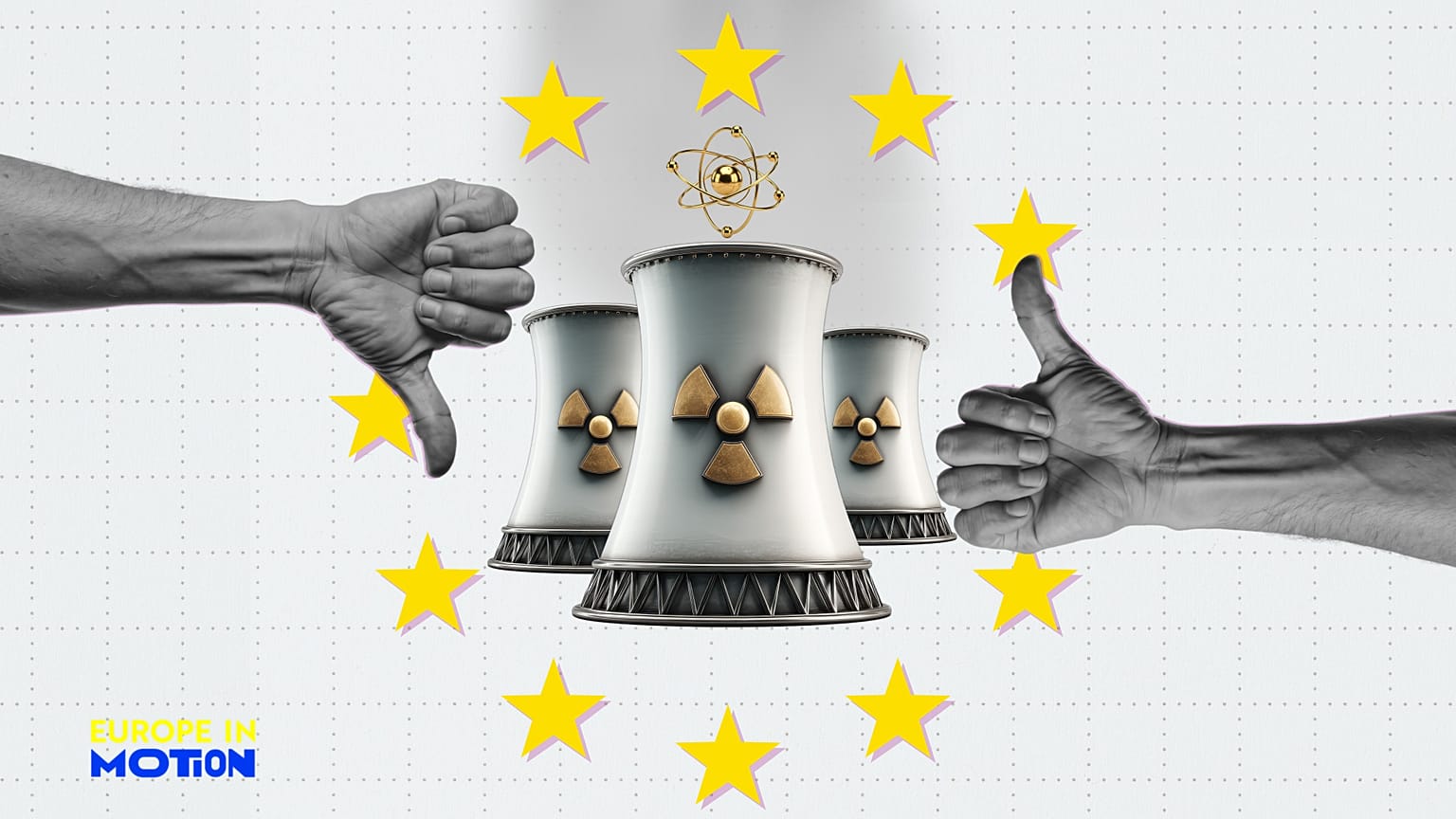














Governments in Belgium and Italy are trying to lay out plans for a nuclear comeback, while calls to reverse Spain's phaseout remain stark.
Most European countries rely heavily on imports to meet their electricity needs, leaving the continent vulnerable to geopolitical shocks and its consumers and businesses exposed to prices up to three to four times higher than in the US or China.
 ADVERTISEMENT
ADVERTISEMENT
ADVERTISEMENT
In recent years, nuclear has subtly resurfaced as an alternative to secure Europe's energy independence, particularly after it received the status of a transitional and sustainable economic activity under the EU's taxonomy regulation, which aims to help mitigate climate change by defining which economic activities are environmentally sustainable.
The move, however, also sparked furious greenwashing accusations over concerns that nuclear energy produces radioactive waste that requires long-term storage.
The EU's relation with the atom remains, therefore, complicated and controversial.
Despite a little short-term growth in nuclear energy production EU-wide (4.8% between 2023 and 2024), mainly driven by France (+12.5%), most countries are actually reducing it, if not phasing it out altogether, such as Germany, and in the near future, Spain.
The long-term trend since the turn of the millennium is of a slight but steady decrease.
Is the wind changing?
In its upcoming 2028-2034 budget, for the first time, the European Commission proposed nuclear energy as eligible for EU funding.
The proposal is unlikely to pass; however, countries like Belgium or Italy are looking into keeping nuclear or bringing it back.
Italy, in particular, despite not one but two referendums against nuclear (in 1987 and 2011), has introduced a draft bill to pave the way for a comeback.
The two countries were also among the 11 EU member states that in 2024 signed a joint declaration calling to "fully unlock" the potential of nuclear.
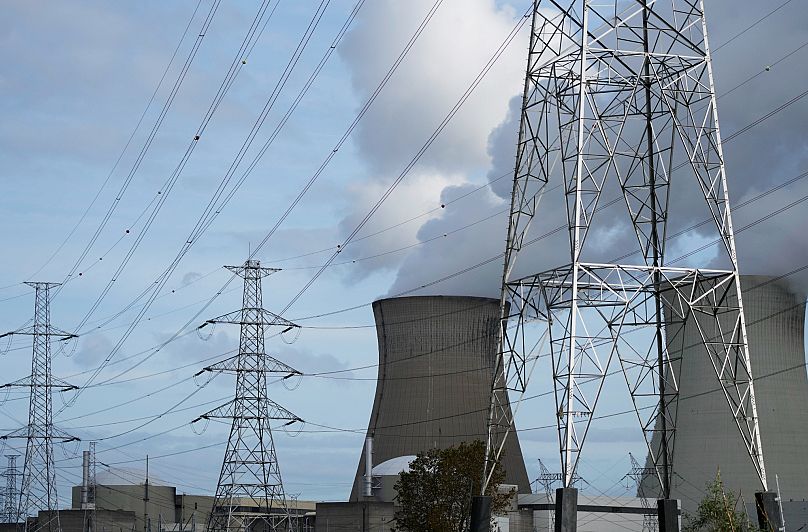
In Belgium, where the government is trying to push back the closure of its reactors, the proposal has faced stiff opposition from Engie, the country's leading energy producer, which would rather invest in wind, solar, batteries and gas-powered stations.
The Netherlands, too, despite a drop in electricity generated from nuclear (-10%), is aiming to create two new plants and extend the life of the Borssele reactor.
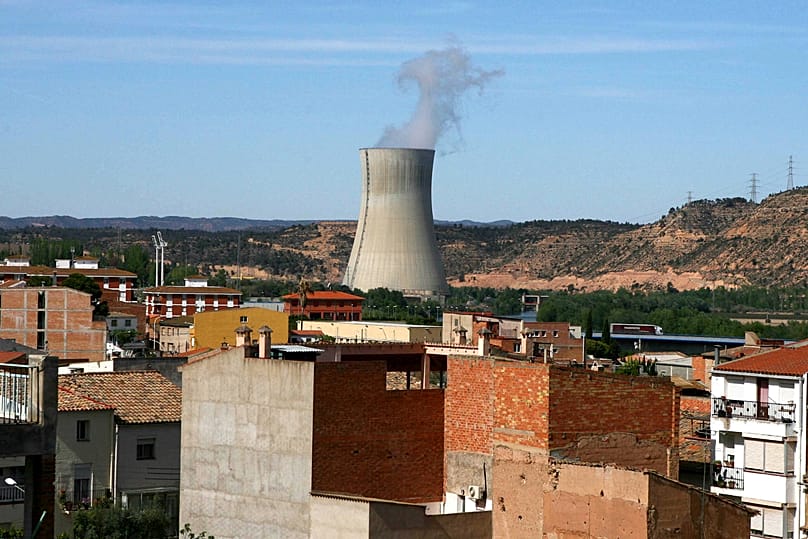
On the other side, Spain's planned phase-out is also embroiled in controversy. Civil society pro-nuclear organisations have been taking the matter up to the European Parliament Committee of Petitions, warning that the planned shutdowns will "further strain supply networks".
Both Belgium and the Netherlands' plans were criticised by Ausgestrahlt, a Germany-based anti-nuclear organisation, which told Europe in Motion that they are unrealistic and overly expensive.
'Slow recognition' of nuclear trade-offs
Nuclear advocate and expert Zion Lights voiced a similar opinion, stating that a potential increase in nuclear energy production, at least over the next decade, "will come from life extensions, restarts, and policy U-turns rather than a wave of new builds".
"Over the longer term, whether nuclear expands significantly will depend less on public opinion and more on whether Europe can relearn how to build and finance large infrastructure projects," she told Europe in Motion.
Lights believes that nuclear production will increase across the continent, "but not in a straight line. What we're seeing across Europe isn’t a sudden pro-nuclear conversion so much as a slow recognition of trade-offs."
"Countries that once treated nuclear as a political problem are starting to rediscover it as an energy system that already exists, already works, and already delivers large amounts of low-carbon power," she said.
The current picture has Europe divided into two groups.
One is the Nuclear Alliance, led by France, and backed by aspiring producers like Poland, Croatia and Estonia, as well as most current nuclear producers.
On the opposite front, a renewables-only group helmed by Germany, and supported by Portugal and Austria, both with a long-standing anti-nuclear national policy.
To reduce the enormous upfront costs and lengthy construction times of traditional nuclear plants, countries such as Estonia, Romania, Sweden and Poland are exploring alternatives like Small Modular Reactors (SMRs), whose advantages have also been laid out by the EU itself.
Their power output is around a third to a fifth of traditional reactors. However, they can be manufactured in factories and deployed later on site, even to remote areas.
At the same time, waste management requirements would be similar to those of a conventional reactor.
Whether nuclear production will increase or not, the energy supply problem remains critical for Europe.
Although renewable energy has advanced dramatically in the past two decades, wind, solar and hydro combined still account for less than half of the EU's electricity consumption.