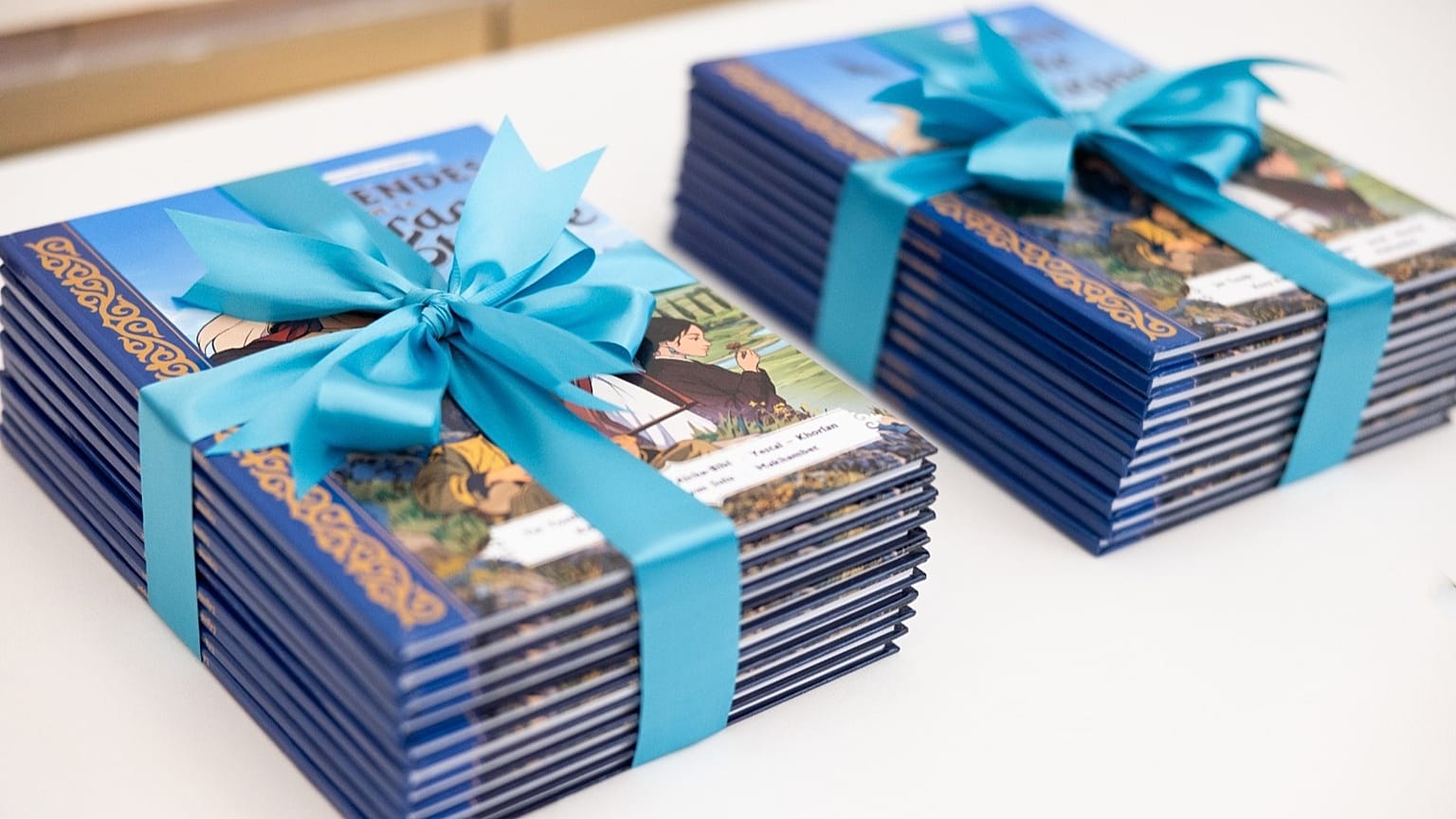














The Legends of the Great Steppe feature five Kazakh folk tales translated into French and Dutch for the first time.
For the first time, Belgian audience will be able to read about Kazakh legends, fairy tales and heroes in French and Dutch. Five Kazakh folk tales about bravery, love and loyalty were adapted to a comics format in a book called "Legends of the Great Steppe."
 ADVERTISEMENT
"Sometimes a single story is enough to spark an interest in a country. A tale you read as a child can stay with you for life and make you curious about a distant country, its people and its traditions,” said Roman Vassilenko, Ambassador of Kazakhstan to Belgium.
The Embassy presented the collection on Wednesday at the Brussels Comic Strip Centre, also known as the Comics Art Museum, a building closely tied to Belgium's rich comic tradition.
The collection's authors drew inspiration from this tradition, also known as the Ninth Art. According to Katrien Van Riet, a member of the Belgian House of Representatives, comic strips have already become a part of Belgian cultural heritage. She appreciated that Kazakh stories will be shared through the Belgians' favourite art form.
The project is part of Kazakhstan's Reading Nation initiative aimed at promoting reading, especially among younger generation. It's also the first publication under Kazakh Library in Belgium project launched by the Kazakh Embassy, which will adapt more Kazakh stories each year.
The project's ambition is to build ties and promote Kazakh culture and traditions in Belgium and beyond. As Mark de Zutter, a public-affairs specialist on Central Asia, noted during the launch, comics can serve as a language of cultural diplomacy.
The book, in fact, was prepared in time for the visit of King Philippe and Queen Mathilde of Belgium to Astana back in October.
The tales of love and friendship
The Legends of the Great Steppe contain five stories.
**Er Tostik**is a growing up story, where a young man sets out to find his eight lost brothers. He faces supernatural challenges and tries to save an egg of a precious bird by outsmarting an evil witch, an underworld ruler and a dragon. But he cannot do this alone, he manages to win only with the help of his newfound friends, who also have supernatural powers.
Aisha Bibi is a tragic love story, where a young woman tries to defy odds. When her beloved does not return as he promised, she runs away from home to follow him. One day, resting on a river bank, she gets bitten by a snake and dies. When her beloved finds out about her fate, he decides to build her a mausoleum, which still stands near the city of Taraz.
Yestai and Korlan is a story of an everlasting love, based on real-life events. It follows musician Yestai and richman's daughter Korlan, who fell for each other right away. But their love was never meant to be, because Korlan was betrothed to another and later married. The only thing Yestai had to remember her by is her gold ring and the many songs he wrote about her.
Kozy Korpesh and Bayan Sulu is the most famous love story in Kazakhstan, which became the basis for local Valentine's Day equivalent celebrated on April 15. In the story, Kozy and Bayan were promised to each other by their fathers, and sure enough, fell in love. When Kozy's father dies, Bayan's father decides to marry her off to another man. Kozy died fighting for Bayan. Saddened, Bayan avenged her love and died on Kozy's grave.
Makhambet is a story about a real life Kazakh poet and rebel hero Makhambet Otemisuly. Together with his friend Isatay Taimanuly, he led uprisings against the Russian Empire and the Bokei Horde, which served it. The two fought against infringement on Kazakh lands and the rights of people, who turned poor and hungry. Although the uprising failed when Isatay was killed, Makhambet continued rebel activity throughout his life.
Read more

The artist fighting for a nuclear-free world
From the steppe to the World Nomad Games