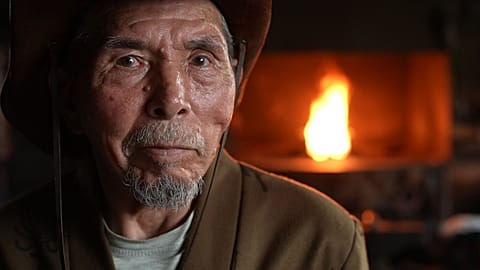
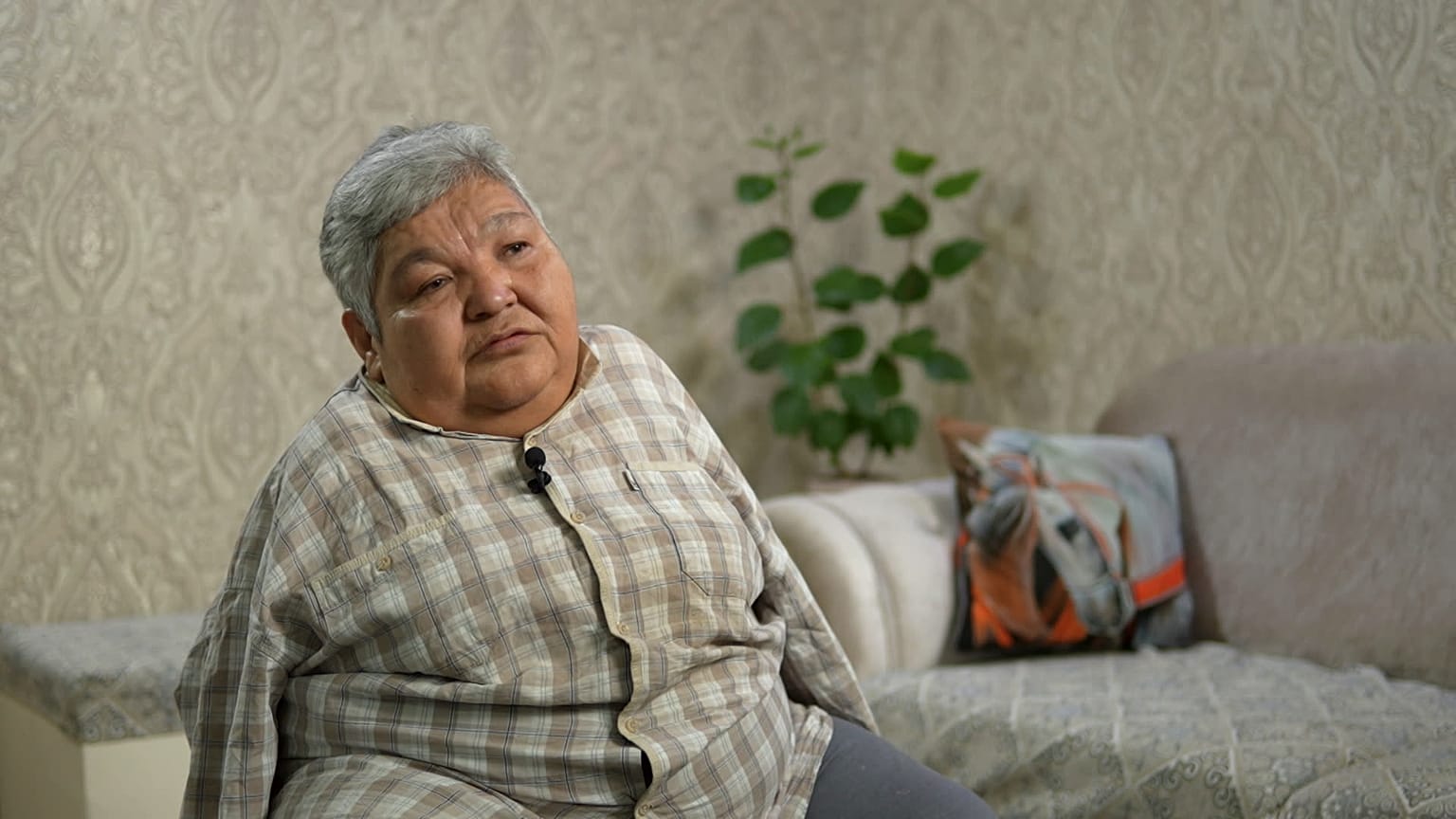














Born without arms near the Semipalatinsk nuclear test site, Karipbek Kuyukov became an artist and anti-nuclear activist. Today, he continues to campaign against nuclear weapons through his art and public appearances.
In his apartment, behind a door marked "Art Studio", Kazakh artist Karipbek Kuyukov is working on a painting. He leans close to the canvas, holding a brush in his mouth. Every now and then, he rolls his chair back to look at the painting from a distance before moving closer again. He is painting a landscape. Autumn leaves cover a road leading towards mountains rising in the distance.
 ADVERTISEMENT
“I love painting landscapes. I want to show that wherever humans appear, they end up spoiling nature,” he says.
The mountains in his painting are Balkantau, near the village of Yegindybulak, about 100 kilometres from the former Semipalatinsk nuclear test site.
It is in this village that Kuyukov was born, without arms.
"When I was born, they showed me to my mother, and she saw that I had no arms. It was very difficult for her," he recalls.
Between 1949 and 1989, the Soviet Union conducted 456 nuclear tests at Semipalatinsk.
Kuyukov remembers the ground shaking after explosions, with shockwaves spreading like ripples in water. He recalls that many other children in the area were also born with disabilities.
Growing up, Kuyukov learned to use his feet instead of hands. One day, he came across a large box of coloured pencils and began experimenting with drawing. He started making simple childhood sketches, using his feet to hold the pencils.
Activism through art
In 1989, Kazakh poet and activist Olzhas Suleimenov founded the Nevada–Semipalatinsk anti-nuclear movement, which Kuyukov later joined. He took part in the movement's activities, but it was through his paintings that he found a powerful way to express his message.
His first painting on the subject, titled "The First Explosion", depicted a family inside a yurt caught in the force of a nuclear blast.
"The blast blows the yurt away, turning everything upside down. I wanted to show what the people living there went through and how the nuclear tests affected them," he explains.
He went on to create more works exploring the impact of nuclear testing, including "Nuclear Mushroom", "Atomic Childhood", "Radiation" and "Fear".
This year marks 35 years since the closure of the Semipalatinsk nuclear test site in 1991. Kuyukov was invited to address a high-level meeting of the UN General Assembly about the human cost of nuclear testing.
"I wanted to shout, not just speak, because the time has come to make the whole world hear us," he says. "I addressed the leaders of countries that continue to make nuclear threats."
It was not his first appearance at the UN. Over the years, he has continued to campaign against nuclear weapons through his paintings and public speeches.
With nuclear threats once again part of international political rhetoric, Kuyukov's decades-long campaign remains relevant.
A life in his own words
Kuyukov has recently published his first autobiography, a project he began 35 years ago and only recently completed. With financial support from people who believed in the project, he recorded his memories as voice messages, which editors then turned into a manuscript.
Recounting his life brings him to tears. His sister Saule gently wipes them from his face. He calls her his "guardian angel". In the book, he pays tribute to her and others who have supported him over the years.
At the book launch, people line up to have their copies signed. Kuyukov patiently signs each one, holding a pen in his mouth. As he grew older, he gradually lost the ability to use his feet for drawing and writing. Today, he relies on his mouth for both.
Beyond the canvas
Back in his apartment, Kuyukov takes a break for tea. On the table is a specially designed stand. Saule places a bowl of tea on it, bringing it up to the level of his chin. He drinks without assistance.
Saule is often by his side, although she prefers not to be interviewed.
Later, sitting on the sofa in his living room, Kuyukov tucks one leg beneath him as he talks. His other foot moves in rhythm with his speech, gesturing almost as hands would.
Today, he increasingly turns to landscapes, painting mountains and scenes of nature untouched by humans. But his commitment to a world free of nuclear weapons remains unchanged. He continues to share his story through his art and public appearances.
Despite decades of painting, there is one person Kuyukov has never dared to portray: his mother. He says he is afraid to paint her portrait, but hopes that one day he will find the courage to do so.