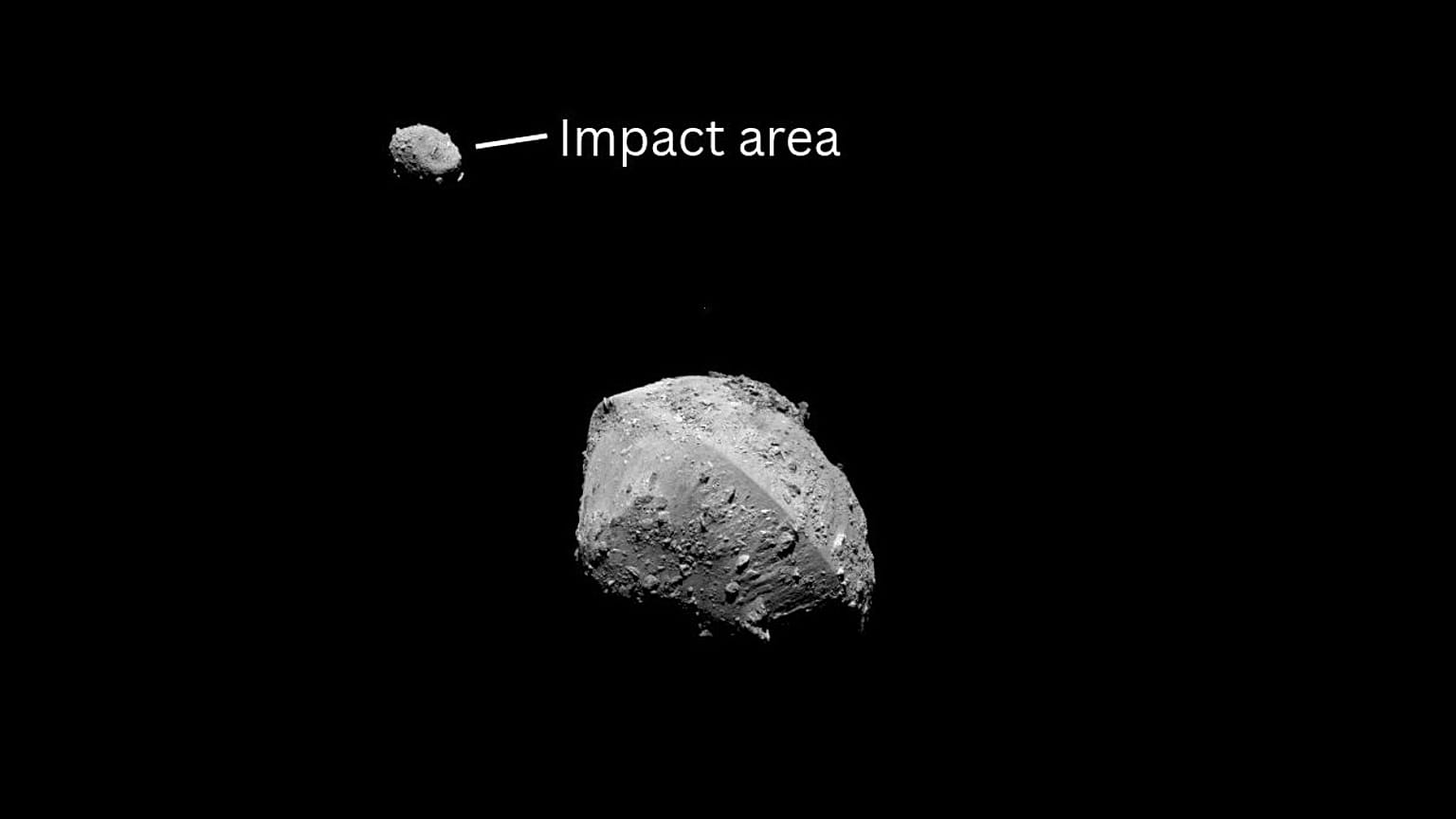













The European Space Agency's first images of the asteroid deliberately smashed by NASA's Dart mission show a huge impact zone with hundreds of rocks drifting near the surface. Is this how we should defend our planet?
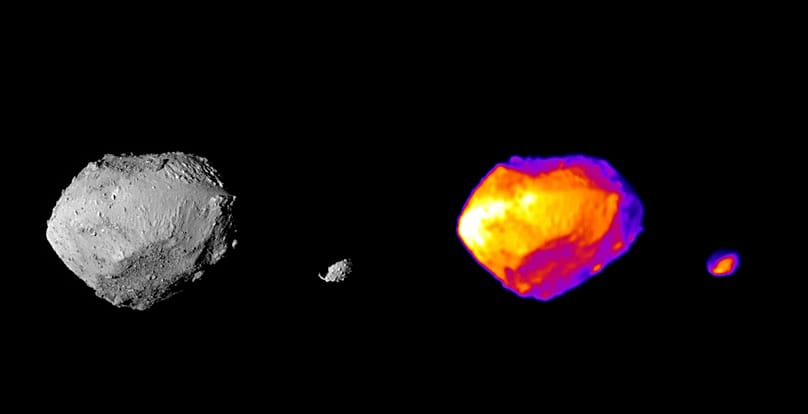
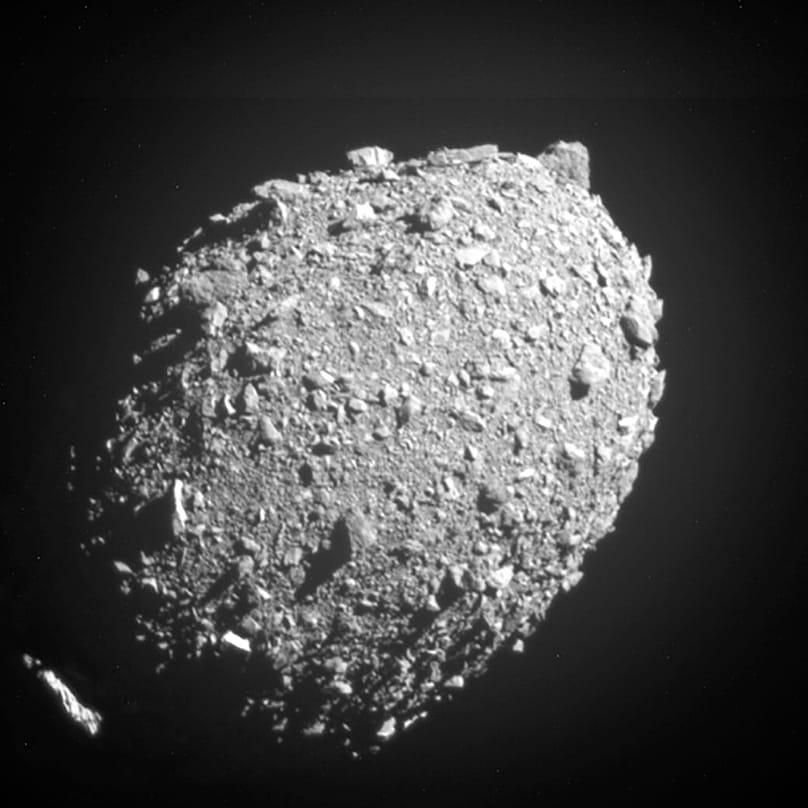
The images taken by the Hera mission show that the 151 metre diameter object, called Dimorphos, has one side that has been transformed by the impact of the American probe named DART.
 ADVERTISEMENT
Dimorphos orbits around a larger asteroid called Didymos, which is clearly visible in the foreground of the pictures, and the pair were chosen for investigation because they pose no threat to our planet.
The new images, with a resolution of 2.7 metres per pixel, show a massive impact zone that's unlike anything scientists have seen up close before.
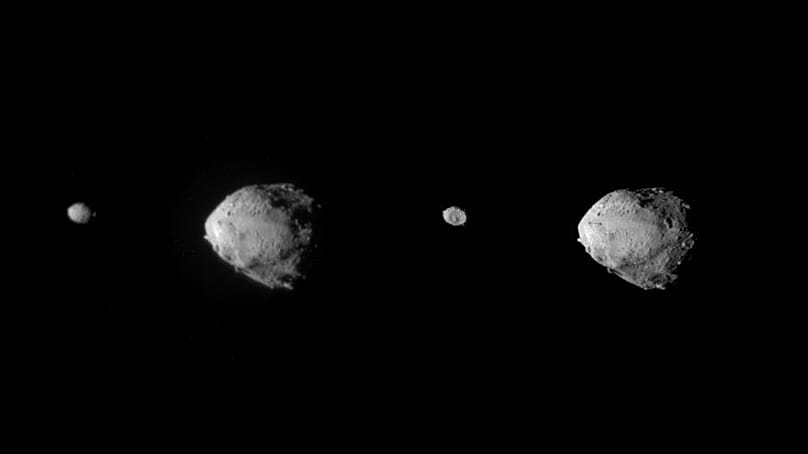
Patrick Michel, Principal Investigator on the European Space Agency (ESA) mission tells Euronews, "It's a huge crater, yet it didn't destroy the object, and there are things in the middle of it that we still don't understand."
Surprisingly, hundreds of lumps of debris of up to a metre in size are now floating around the asteroid, too. "It's complete chaos," Hera Project Manager Ian Carnelli tells Euronews. "It's completely different from what our brain would tell us rationally that these rocks should look like and behave."
This is the first time that a spacecraft made by humans has actually impacted an interplanetary body with the direct intention of altering its course.
Right now, Dimorphos appears to be reeling chaotically like a boxer after a powerful punch.
"Its rotation around its own axis is very chaotic and very unstable. It doesn't rotate around a single axis, sometimes, the crater on the side facing the direction of rotation is visible, and sometimes it shifts to the other side. So there has also been a significant destabilisation of its rotation," Michel says.
The next step will be to release two tiny cubesats from the Hera spacecraft, which itself will fly much closer than its current 30 kilometre distance, in order to study the asteroid's surface, density and interior structure.
Scientists are keen to understand why it didn't smash apart, and are wary of drawing rapid conclusions given how unearthly and strange these asteroids can be.
"We have six months of investigation ahead of us, with risky operations almost every month. So, it's a bit like an Indiana Jones adventure, full of suspense," says Michel, his voice buzzing with excitement.
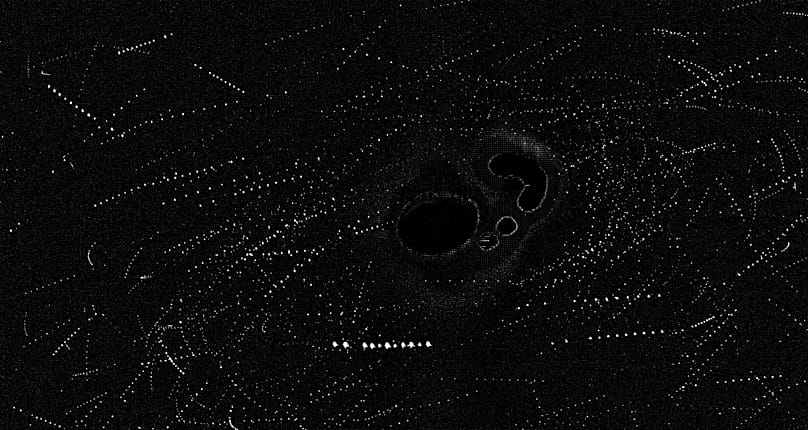
It's a sentiment echoed by Margherita Cardi: "It's a nightmare, there's a mix of excitement and panic," she laughs. She is managing the Milani CubeSat, which will now need to navigate its way through and around the boulders drifting above the asteroid, aiming to image and map the surface, and characterise the dust around it.
Why are space agencies deliberately smashing satellites into asteroids?
The images are the latest step in a long-running effort by the European, American and Japanese space agencies to understand how to deviate an asteroid from its path.
With the fate of the dinosaurs in mind, killed off when an asteroid struck 65 million years ago, they believe that humans need to master the skill of knocking space rocks off track, in order to be ready should a dangerous body be spotted on a collision course with planet Earth.
And it looks like we're learning how to do so very quickly. When NASA's DART probe hit Dimorphos back in 2022 it successfully shortened its orbit around Didymos by about 33 minutes.
Carnelli, who fought hard to secure funding for the mission for the past decade or more, says it's gratifying to see the progress they have made.
"I'm really proud to say that for once, space agencies, but also politicians and taxpayers, are taking a natural hazard very seriously. And we're doing something about it, for the good of humanity," he tells Euronews.
Hera is part of ESA's Space Safety Programme, and it will be followed by a new mission called Ramses, which will rendez-vous with an asteroid called Apophis as it passes by Earth in 2029.
In the meantime, Carnelli is preparing to request funding for a mission extension for Hera, given that the European probe still has plenty of propellant on board.
"The idea being that we leave in September and we go on a two year journey around the solar system. We visit two more asteroids - flybys - and then we come back to Didymos." he explains.
Returning to check on the battered space rock makes a great deal of sense scientifically, as the ESA team can observe if its orbit and rotation have changed over the years, and whether the structures on the surface have shifted or eroded since the impact.
Read more