












Some wonder if the solving of the famous Riemann Hypothesis by Anthropic’s Claude model is the beginning of advanced super intelligence.
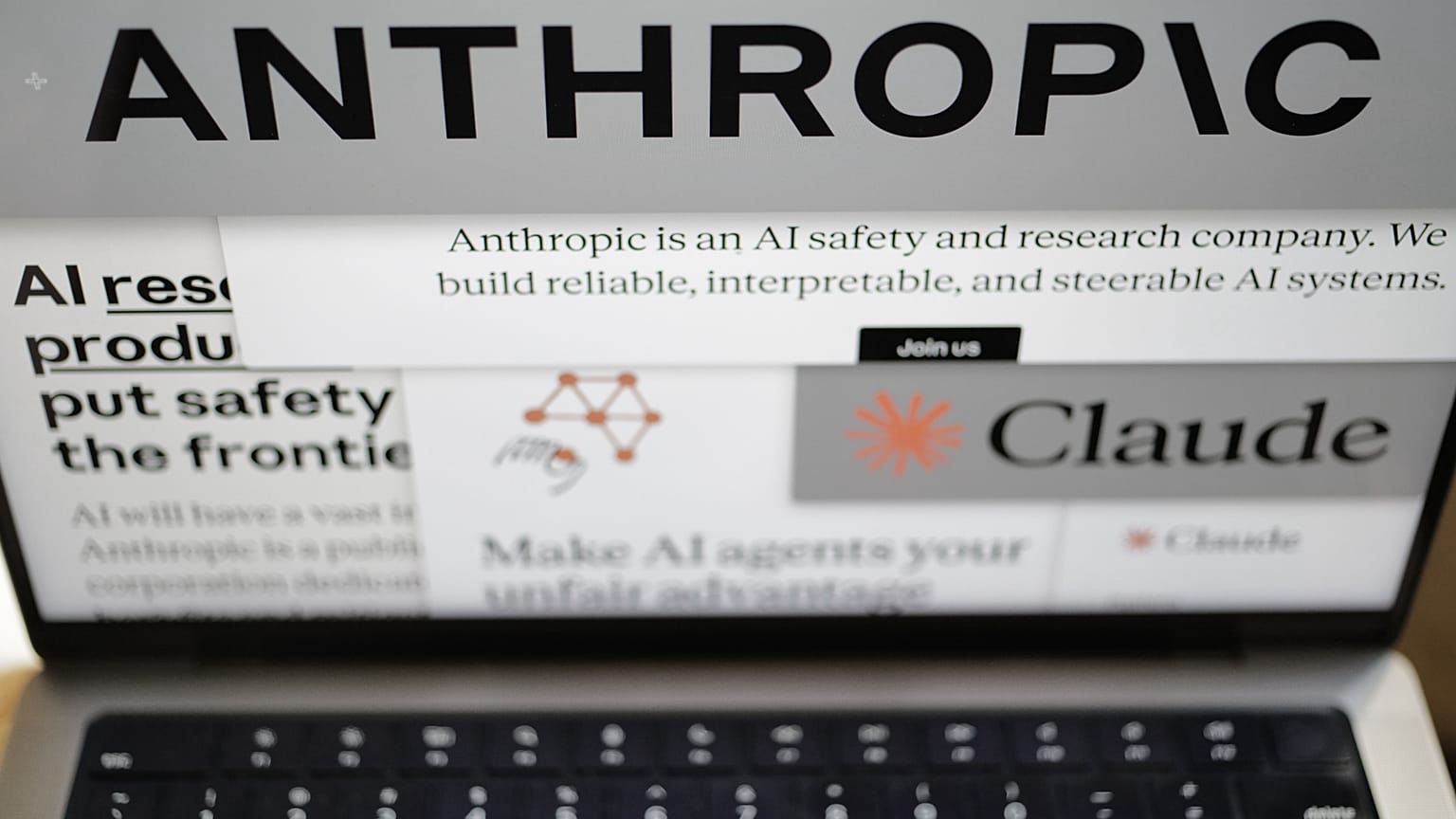
Anthropic’s announcement on Friday that its Claude artificial intelligence model had helped solve what many had called the ‘biggest maths problem of all time’ has been met by both awe and terror for what the future of AI has in store for humanity.
 ADVERTISEMENT
Anthropic researcher and mathematician Levent Alpöge used Claude to find a solution to the 167-year-old math problem known as the Riemann Hypothesis, one of six remaining unsolved Millennium Prize problems carrying a $1 million (€913,000) reward from the Clay Mathematics Institute.
First proposed in 1859, the hypothesis suggests that the seemingly random appearance of prime numbers — numbers divisible only by one and themselves — actually follows a hidden, strict pattern.
Solving the problem could eventually have enormous real-world consequences, by giving certainty to the way prime numbers are distributed, computer systems, for example, can run more quickly and leaner.
Alpöge worked with Claude for months, submitting a partial result in August. This is not the first time he has explored using AI to solve maths’ biggest problems.
In September, he submitted a partial result proof to the Navier-Stokes and Euler equations, which govern fluid dynamics.
The Anthropic researcher submitted both this and his latest proof to Lean, the open-source, interactive maths proof platform which automatically checks proofs.
The platform is designed to test mathematical proofs and allow independent checkers to verify them. Within 48 hours, MIT mathematician Andrew Sutherland and the Lean FRO/ Mathlib Initiative checked the proof and found zero errors.
His released proof spans 17,374,215 lines of Lean code spread across 175,187 separate files, backed by an unpublished, AI-generated text draft exceeding 250,000 pages.
The sheer scale of it means that humans have not yet had time to fully comprehend it, and even Alpöge was in awe of the ability of AI to solve the problem.
"Claude began to leave me in awe" and "far outpaced me near the finish line," adding that "Claude flew, and danced, and sparkled near that finish line."
Reaction
Many mathematicians have welcomed the proof.
Hector Pasten of the Pontifical Catholic University of Chile called it “something like a Rosetta Stone” that completes a dictionary between previously disconnected branches of math.
Oxford University’s James Maynard called it “something to be celebrated” because mathematicians finally know why it is true.
Independent Italian mathematician Alessandro Masullo, who released an incomplete, traditional human-written proof on the exact same day after 12 years of solo work, said he refused to use AI because he didn't trust it.
Some had expected that AI would take much longer to solve the problem, such as Australian American mathematician Terence Tao who predicted in October that AI would solve the Riemann Hypothesis by 2050. One month later, he was wrong.
Meta’s AI Chief Alexandr Wang took to X on Sunday warning that the achievement marked “the beginning of a significant change” that could usher in a “handover of society to AI”, arguing machines will soon supersede human capacity in every field.
Elon Musk meanwhile also saw it as a defining moment in the developing AI. He responded on social media platform X, “Unequivocal super intelligence has arrived. Welcome to the Singularity.”
Others have argued that the sheer length and scale of the proof, coming in at 250,000 pages long, makes it almost unreadable to humans, raising philosophical questions about whether mathematical truth matters if humans cannot comprehend it.
AI critics including Gary Marcus and godfather of AI Yann LeCun have pointed out that AI did not solve the problem by itself, rather it required months of human guidance and open-source infrastructure developed by mathematicians to find the solution, dismissing the finding as more hype than proof of a super intelligence.
What does it mean for society?
The solving of Riemann’s Hypothesis sets a major precedent for how science will be done in the future. By pairing human intuition with AI to solve complicated problems to create genuinely new insights that would normally be beyond human capacity.
In mathematics, hundreds of theorems that previously began with the caveat “assuming the Riemann Hypothesis is true…” are now officially proven facts. In computer science, it also confirms that certain algorithms used to process large prime numbers will always run reliably at high speeds.
It could also remove the need for code that previously treated the hypothesis as a theory, meaning computer systems can be learner and more efficient.
What it does not do is break internet encryption. If anything, the proof helps cybersecurity confirm that certain fast algorithms used to test whether a massive number is prime are 100% reliable.