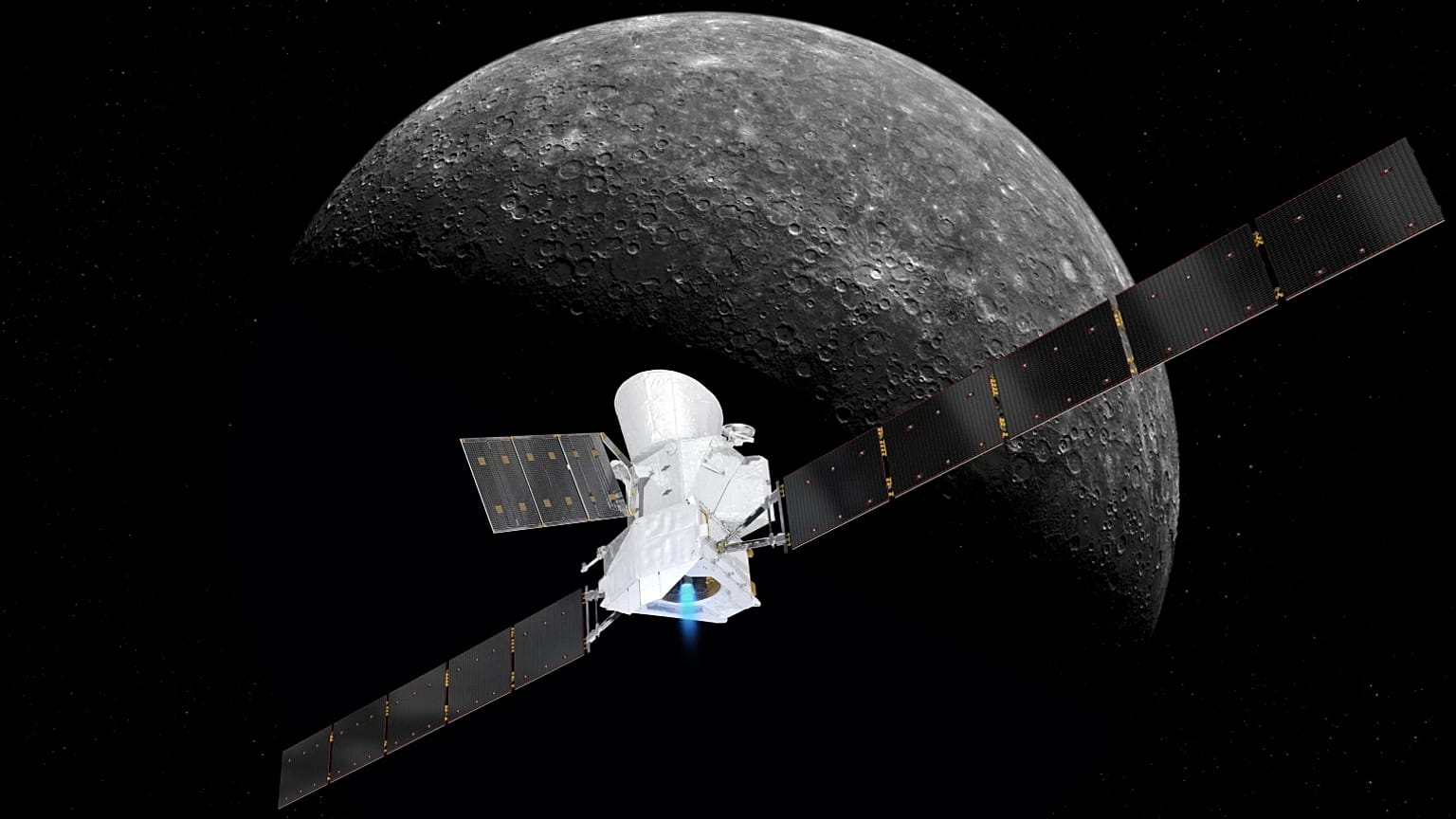













The mission aims to study all aspects of Mercury in the hopes of providing scientists with a better understanding of the planet and of the evolution of our solar system.
The BepiColombo probe has entered Mercury's orbit following an eight-year journey through outer space, the European Space Agency (ESA) said early on Sunday.
 ADVERTISEMENT
The BepiColombo mission is a joint venture between the ESA and the Japan Aerospace Exploration Agency (JAXA).
It launched in 2018 from French Guiana and aims to study all aspects of Mercury - the closest planet to the sun - in the hopes of providing scientists with a better understanding of the planet and of the evolution of our solar system.
"We've heard back from Bepi - the spacecraft is now in contact with Ground and the teams at ESOC are busy assessing the telemetry, but Flight Dynamics already has confirmed it achieved orbital capture around Mercury," the ESA announced in a post on X.
The agency added that it would share a fresh update early next week.
According to the mission plan, the European and Japanese orbiters are set to separate from each other on 9 to 10 December, while the mission’s science phase is scheduled to begin in April 2027.
"BepiColombo will be the second and most complex mission ever to orbit Mercury. Close to the Sun and more difficult for an orbiter to reach than Saturn, this small desert world is the least explored planet of the inner Solar System," the ESA says on its website.
The smallest planet in our solar system, Mercury also experiences extreme temperature fluctuations, reaching highs of 430°C and lows of -180°C.
NASA's Mariner 10 probe became the first spacecraft to visit Mercury after launching in 1973.
Read more