












What sounds like science fiction is becoming a concrete research project: the German Aerospace Center (DLR), NASA and Canada's CSA are developing a concept for lunar greenhouses.
How can you grow vegetables in a place that has no life-friendly atmosphere, no fertile soil and no readily available water?
 ADVERTISEMENT
This is precisely what the international Lunar Agriculture Module - Ground Test Demonstrator (LAM-GTD) project (source in German) is about.
The German Aerospace Center (DLR) is working with NASA and the Canadian space agency CSA on concepts for greenhouses on the Moon. They are initially intended to supply astronauts on future long-term missions with fresh food.
A greenhouse as life insurance in space
Temperatures on the Moon fluctuate extremely, its surface is almost airless, water is scarce and cosmic radiation poses a considerable danger. Simply planting crops in lunar soil is not an option. What is needed are controlled cultivation systems that work independently of natural environmental conditions.
The idea is to connect a greenhouse module directly to a simulated living and working area for astronauts. This will allow researchers not only to study plant growth but also to test how the greenhouse and habitat can supply each other.
The planned demonstrator will first be built entirely on Earth. By 2032 at the latest, the three partners want to decide whether and how it will actually be constructed.
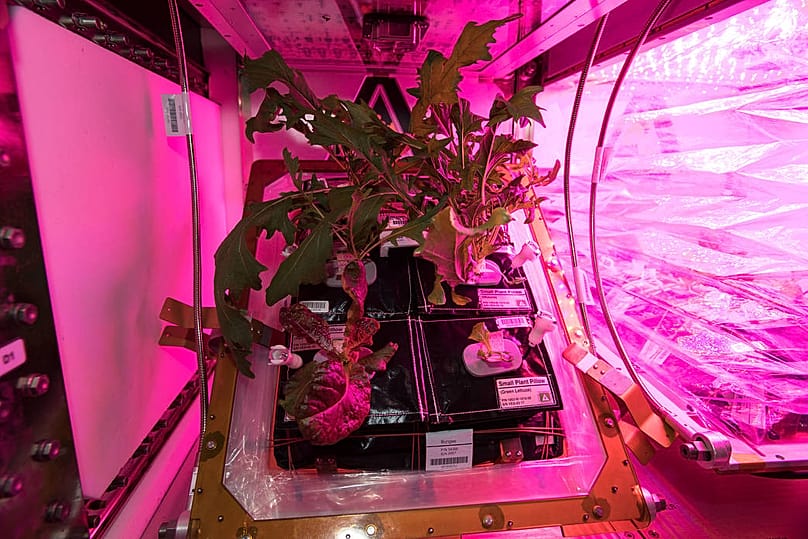
NASA in particular has already carried out numerous experiments of this kind on the International Space Station ISS. Among other things, lettuce, Chinese cabbage and chilli peppers have already been grown there.
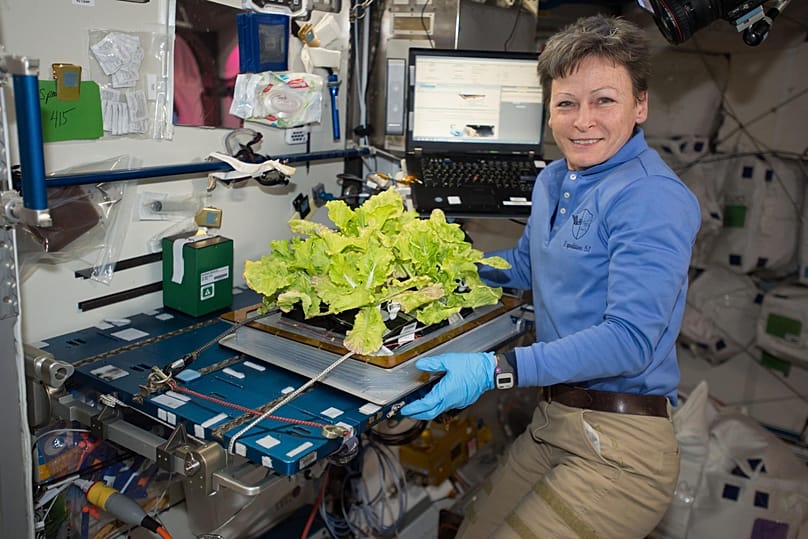
The next step is to move from small experimental systems on the ISS to significantly larger and more complex cultivation systems that could supply entire crews.
The German partner, DLR, can draw on experience from earlier projects, in particular the EDEN ISS greenhouse, which was operated in Antarctica for several years.
From 2018 to 2023, researchers operated a specially developed greenhouse in Antarctica, only a few hundred metres from the German research station Neumayer III. Under extreme conditions, they grew fresh vegetables there without soil and without natural sunlight. LED lamps, artificial nutrient solutions and a sophisticated irrigation system made it possible to harvest lettuce, tomatoes, cucumbers, radishes and even strawberries. In total, they produced around one tonne of fresh vegetables.
A project of international cooperation
Antarctica is not the Moon, but it does offer an important similarity: supplies are difficult, environmental conditions are demanding and mistakes can quickly become a problem.
The fact that Germany, the United States and Canada are working together on LAM-GTD is no coincidence. DLR contributes its knowledge from space research and previous greenhouse projects. NASA is working on the conditions for future lunar missions and a long-term human presence on the Moon. The Canadian space agency CSA adds its expertise in space research and in technologies for crewed missions to the collaboration.
One small step for lettuce, one giant leap for humankind
The research is not only of interest to astronauts, because there are also places on Earth where growing food is difficult, such as dry desert regions or areas with limited water resources.
Technologies that allow plants to grow with as little water, energy and space as possible could also help there. Controlled greenhouses could also help produce food more precisely and with less use of plant protection products.
Looking beyond Earth could therefore generate knowledge that helps us find new ways of doing things on our own planet.