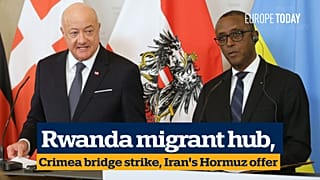














Five EU countries have agreed to a deal with Rwanda to send rejected asylum seekers there from 2027. The agreement is enabled by the EU's new return regulation, which stipulates that such deals can only be made with countries that respect human rights. Does Rwanda meet that standard?
Five EU countries have unveiled this week a deal to deport rejected asylum seekers to Rwanda.
 ADVERTISEMENT
Denmark, Austria, Germany, the Netherlands and Greece will kick off this plan in 2027, with around 100 single men who cannot be deported directly to their home countries being sent to Rwanda.
The agreement is enabled by the EU return regulation, which entered into force last month. This marks the first time a group of EU member states have used the framework to send irregular migrants to a so-called “return hub.”
Article 14 of this law says that deals to deport migrants can only be made with countries that respect human rights, and many have expressed doubts about whether that is the case for Rwanda.
Freedom House, a US-based organisation which measures freedom around the world, gives the country a score of 7 points out of 40 in political rights and 14 out of 60 in civil liberties. Overall, they label Rwanda as “not free.”
The country also received a score of 0 out of 4 on judicial independence, raising questions about whether migrants not receiving proper treatment in Rwanda would be able to challenge their situation in court freely.
The United Nations Human Rights Council has also said this year that Rwandan authorities “suppress opposition and dissent, prosecuting political opponents, journalists and human rights defenders.”
Meanwhile, Amnesty International notes that Rwanda may be implicated in war crimes because of its support of M23, an armed group in the Democratic Republic of the Congo that is allegedly responsible for summary killings and gang rape. War crimes are amongst the worst possible human rights violations.
The EU Parliament itself has proposed to suspend agreements with Rwanda because of these allegations.
Opponents also point to a precedent: a deal between the UK and Rwanda to send people there while their asylum requests were being processed (so not the same as the EU-Rwanda deal, but similar) was blocked by the UK Supreme Court because it found a real risk that Rwanda would send refugees back to the countries they had fled, which is forbidden by international law.
Rwanda’s government has pushed back and says that human rights are respected in the country and that an independent monitoring mechanism, to which the 5 EU countries have committed, will ensure that.
The parties also say that the UN Refugee Agency will have a role in making sure human rights are protected.