


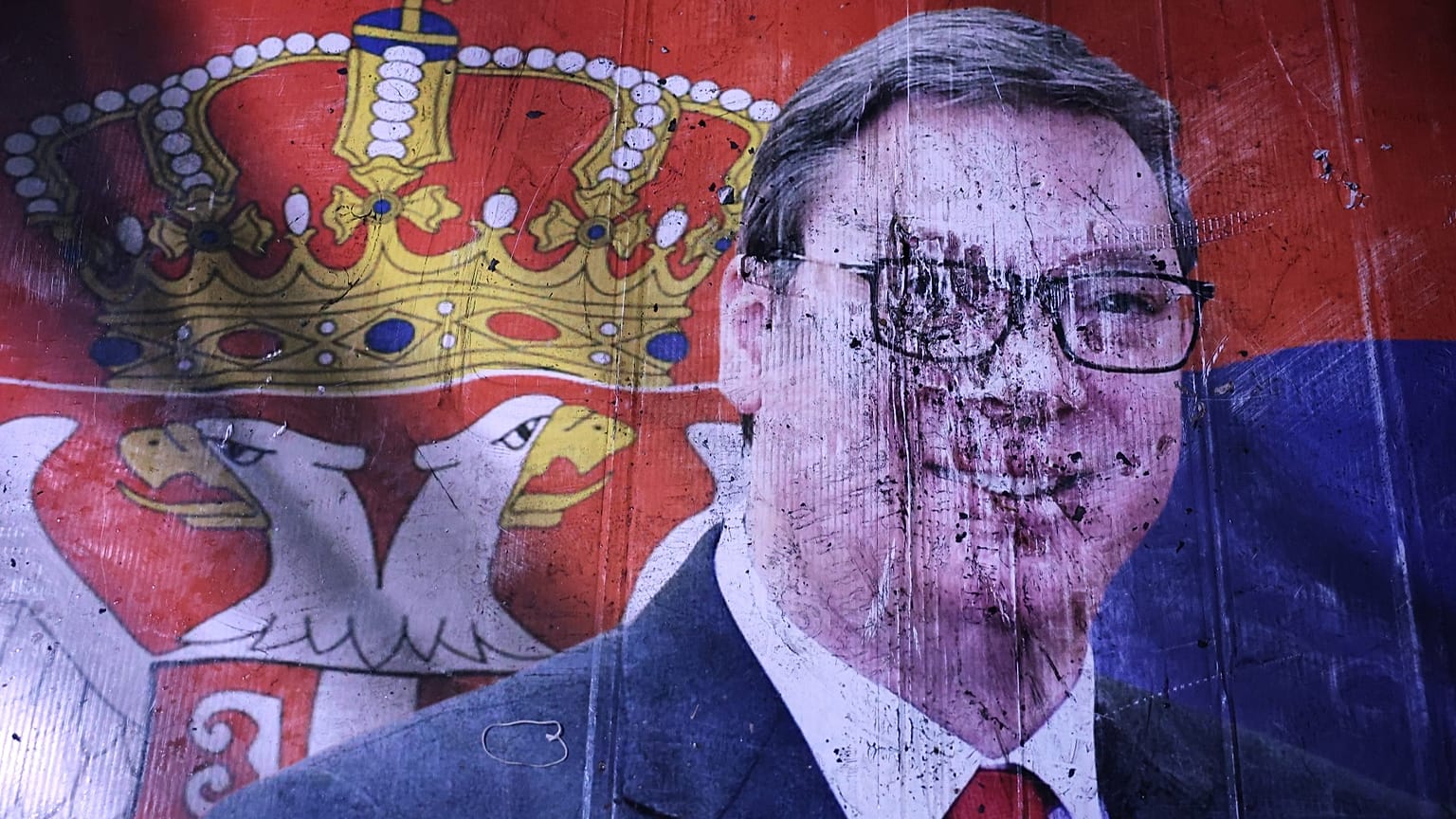


Good morning. It’s Angela Skujins holding the newsletter pen for the entire week. On Monday’s agenda: Serbian elections serve as a death knell for long-time leader Aleksandar Vučić and his political party, while French fury continues to manifest through violent protest and a presidential bid.
While you were sleeping: Serbia’s longtime conservative politician Aleksandar Vučić conceded defeat last night in a parliamentary election that pitted himself and his right-wing Serbian Progressive Party (SNS) against the left-wing Student List in the Western Balkan nation.
 ADVERTISEMENT
“It is clear that we have lost the election,” the former president of Serbia and prime minister hopeful said in a televised statement, with the votes paving the way for the student-backed political group to seize a minimum 135 parliamentary seats, while the SNS party is set to win around 105. The vote count, however, is not yet final.
Breath of fresh air: Bojan Vranic, a professor of political science at the University of Belgrade, just told Europe Today Student List’s victory is a “historic” moment for the country as it brings in a “new, fresh political elite”. Watch.
From the outside, it was expected the vote would impact Belgrade’s long-standing bid to join the European Union — a 14-year process that has been complicated by Vučić’s relationship with Russia and China, and his defiance against adopting certain foreign policy protocols.
Vranic believes, however, that the Student List movement is “very conservative” when it comes to inching Belgrade closer to joining the bloc, as the organisation is focussed on internal changes. “I would not be overly enthusiastic… of a miracle breakthrough in European integration,” he said. Watch.
Fourth time’s a charm: French political hopeful and far-right firebrand Marine Le Pen also officially launched her presidential candidacy on Sunday, at a campaign rally in the city of Orléans attended by thousands of Rassemblement National RN (National Rally) supporters. This is the fourth time she has attempted to snap-up the top job.
In a fiery speech, the dame of the ultra-conservatives promised the protection of public spaces so “that they can remain places full of life and mutual respect”. The pitch was in clear reference to the defiant protests that have transformed France over the last few weeks into a country gripped by looting, violence and thousands of arrests.
Anarchy in France: During her speech, Le Pen lamented the leadership of French President Emmanuel Macron during this period, stating that under his presidency, rule of law has become “too lenient”.
She also set out other major policies while at the podium, including her position on military conflict — vowing that France "will not send" its young people "to die in reckless or irresponsible military adventures, and even less in wars that are not ours" — as well as getting tougher on migration. The former will surely cause EU heads of state and allies in Kyiv a headache, but the latter could be a welcome reprieve from Macron’s centrist tendencies.
Election fever in Jerusalem: Former Israeli Prime Minister Ehud Olmert just said on Europe Today that the future of the country hinges on a crucial upcoming vote. Watch.
Olmert, a fierce critic of Israel’s incumbent head of state Benjamin Netanyahu, was speaking on the programme as just over seven million eligible Israelis will head to the polls on Tuesday to cast their vote in arguably the country’s most important vote in recent history.
It will be the first national election since the deadly 7 October attack by Hamas, and is seen as a referendum on the leadership of the country’s far-right nationalist leader and the last three years of war.
The election comes as the occupied West Bank continues to be squeezed by the Israeli Defence Force, with soldiers displacing hundreds of Palestinians from their homes. The activity follows a gun attack last week, with two Israeli soldiers killed and more injured.
News from Brussels: The European Commission is proposing a bundle of reforms to the EU’s major border force agency, Frontex, this week. As my colleague Vincenzo Genovese reports, the EU’s border agency will have more personnel to deploy at the bloc’s borders and a “quick response force" could be activated in case of sudden arrivals of a large volume of migrants.
This is according to an EU official with knowledge of the matter speaking to Euronews on condition of anonymity, who stated the reform is expected to be formally proposed on Tuesday by the EU executive.
‘Innovative solutions’: The proposal will also include an online surveillance unit to monitor social media and prevent large-scale movements. The goal is to avoid situations previously witnessed in the EU’s recent history, such as 80,000 migrants illegally entering the Spanish enclave of Ceuta via Morocco in July, prompting a political firestorm among EU leaders, and triggering a crisis of confidence in leadership.
To associate or not: The concept of “associate membership” is at risk of disappearing from the declaration of this week’s EU-Canada summit in Montreal as member states butt heads over its inclusion, Jorge Liboreiro writes.
Ambassadors will gather today to discuss the content of the declaration, with some countries still unclear about what “associate membership” is as it has no precedent. They want the European Commission to provide clear answers before the summit takes place on Thursday. In a declaration of intent, European Commission President Ursula von der Leyen will travel to Montreal with 10 Commissioners by her side.
Time to pay up: The summit in Montreal will give von der Leyen the perfect opportunity to gently press Canadian Prime Minister Mark Carney to increase Canada’s financial support to Ukraine. As previously reported, the EU has committed to addressing Kyiv’s massive €70 billion shortfall for next year.
Officials and diplomats in Brussels all agree that the bloc should continue to provide two-thirds of support, which, in this operation, would amount to €50 billion, with other allies covering the remaining third.
However, this division of labour hasn’t worked. According to an internal document seen by Jorge, the EU is slated to provide 80% of Ukraine’s military and financial aid next year, a share that vastly exceeds the agreed two-thirds. Brussels has ratcheted up pressure on allies to first, make good on what they have already promised and second, ramp up their contributions for 2027.
Fighting an uphill battle: As Sasha Vakulina reports, officials in Moscow have said Russia is ready to resume trilateral peace talks with Ukraine and the US but only after 4 November — Russia’s National Unity Day.
What might happen before talks resume? Sasha expects more Russian attacks on Ukraine. Just over the past week, Russia launched roughly 1,600 guided aerial bombs, 48 missiles and nearly 2,300 attack drones against Ukraine, according to Ukrainian President Volodymyr Zelenskyy.
Student List wins Serbian election in political earthquake as Vučić concedes defeat
Serbia has entered a new political era.
The Student List has won the country's parliamentary election, marking a dramatic breakthrough for a movement that emerged from months of student protests and rapidly transformed itself into the country's most important political force.
Immerse yourself further in this seismic story with in-depth reporting from Euronews Serbia and Ljubiša Ivanović.
More from our newsrooms
Brazil's Lula clinches election victory as Bolsonaro rejects results. The incumbent leader,Luiz Inácio Lula da Silva, triumph bucks a regional trend of victories for right-of-center presidential candidates allied with Trump. It also means Latin America’s largest economy will likely continue to defy Trump’s demands, despite the pressure of increased tariffs. Emma De Ruiter has the latest.
Storms batter northern Europe, cutting power to more than 150,000 homes and disrupting road and air transport. Storms Austen and Boelo caused major disruption over the weekend across northern Europe with temporary power cuts to 150,000 homes, people injured by falling trees, and flights and ferries cancelled in several countries from Scotland to Denmark. Anna Kirchheim has more.
'Having money is not enough': Why a job no longer guarantees access to housing in Spain. In the Mediterranean country house prices rose 84.6% between 2015 and 2025, against 27.85% for average wages. A lack of affordable housing, rent burdens and saving difficulties deepen the crisis as experts call for structural reform. Rafael Salido reports.
We’re also keeping an eye on
- EU foreign policy chief Kaja Kallas and European Commissioner for Defence Andrius Kubilius will attend the E5 Defence Ministers' meeting in Paris, France. Alliance members include France, Germany, Italy, Poland and the United Kingdom.
- Agriculture and fisheries ministers will convene in Luxembourg for a ministerial meeting.
- European Commissioner for the Economy Valdis Dombrovskis will receive President of the European Union Chamber of Commerce in China Jens Eskelund in Brussels.
- European Commissioner for Equality, Preparedness and Crisis Management Hadja Lahbib will meet with Canadian authorities in Ottawa to discuss health emergencies preparedness and response. This is a few days before the much hyped EU-Canada summit.
That’s it for today. Vincenzo Genovese, Jorge Liboreiro and Sasha Vakulina contributed to this newsletter.