































Ukrainian President Volodymyr Zelenskyy said social media had become less hostile following Kyiv's strikes on Russian technology giant Yandex's data centres, as web users report plummeting bot activity.
Ukrainian strikes on Russian technology giant Yandex's data centres have been followed by a dramatic decline in automated online activity, raising questions about whether the attacks may also have disrupted Moscow's influence operations abroad.
 ADVERTISEMENT
ADVERTISEMENT
ADVERTISEMENT
The sudden drop fuelled speculation in Europe and the United States about just how much of the political debate on social media might have been driven by Russian bots.
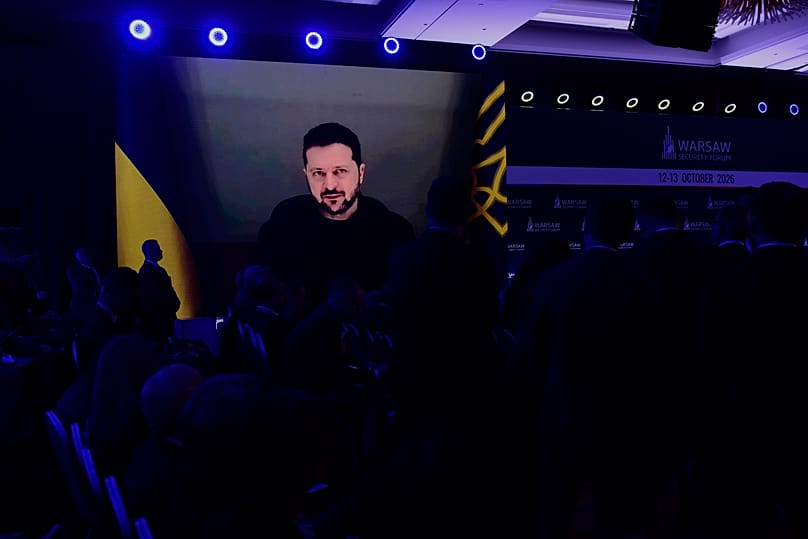
Ukrainian President Volodymyr Zelenskyy weighed in on Monday, saying social media platforms had become noticeably less hostile.
"When we started responding to Russia's operation against our data centres and when our strikes reached Yandex data centres, it suddenly became a little easier to breathe on many social media platforms," Zelenskyy said addressing the Warsaw Security Forum.
"A lot of people, a lot of people noticed it, and there was less hate, less division and fewer provocations because there were fewer bots."
"And it's pretty clear where those bots were coming from," he added.
"If they disappeared when Yandex went offline, this proves again and again that Europe is not the source of the problems."
"Europe is not the one making everything more difficult," he said.
Three data centres targeted
Three data centres operated by Yandex, often described as Russia's equivalent of Google, were hit by Ukrainian drone strikes over the past few days.
The facilities were located in Sasovo, in the Ryazan region, the Kaluga region, south-west of Moscow and the Vladimir region, east of the Russian capital, where the latest strike was reported on Sunday.
The attacks damaged the company's infrastructure and disrupted services. Yandex confirmed that operations at its Vladimir facility had been suspended following a drone strike.
"Following a drone attack, the infrastructure of the Vladimir data centre was damaged," the company said in a statement published on Telegram.
"Operations at the data centre have been completely suspended. The remaining infrastructure resources are unstable and the platform is down."
According to an analysis of Cloudflare Radar data, automated traffic originating from Yandex's network fell by approximately 94% on Sunday compared with its average levels in the second half of September.
However, the figures also include legitimate automated traffic, such as search-engine crawlers, and do not establish whether Kremlin-linked social media bots were affected.
Political repercussions across Europe and the US
In Germany, claims of a sharp decline in online activity surrounding the far-right Alternative for Germany (AfD) circulated widely following the attacks, although no independently verified figures have emerged.
Czech MEP Tomáš Zdechovský questioned the apparent coincidence between the disruption and the reported decline in activity around the party.
"If confirmed, this is telling: Russian data centres get hit, and online activity around AfD suddenly plummets," he wrote on X.
Similar claims emerged in Britain, where online activity associated with Reform UK was also reported to have declined following the attacks.
In the United States, social media users reported fewer apparently automated pro-conservative responses on X, the platform owned by Elon Musk.
The speculation has attracted attention from prominent political figures and commentators, including Laura Loomer, a right-wing activist and supporter of Donald Trump, Russian opposition figure and former world chess champion Garry Kasparov, and Michael McFaul, the former US ambassador to Russia.
The debate comes just weeks before the US congressional midterm elections in early November, amid longstanding concerns about foreign interference and the influence of automated accounts on political discourse.