
















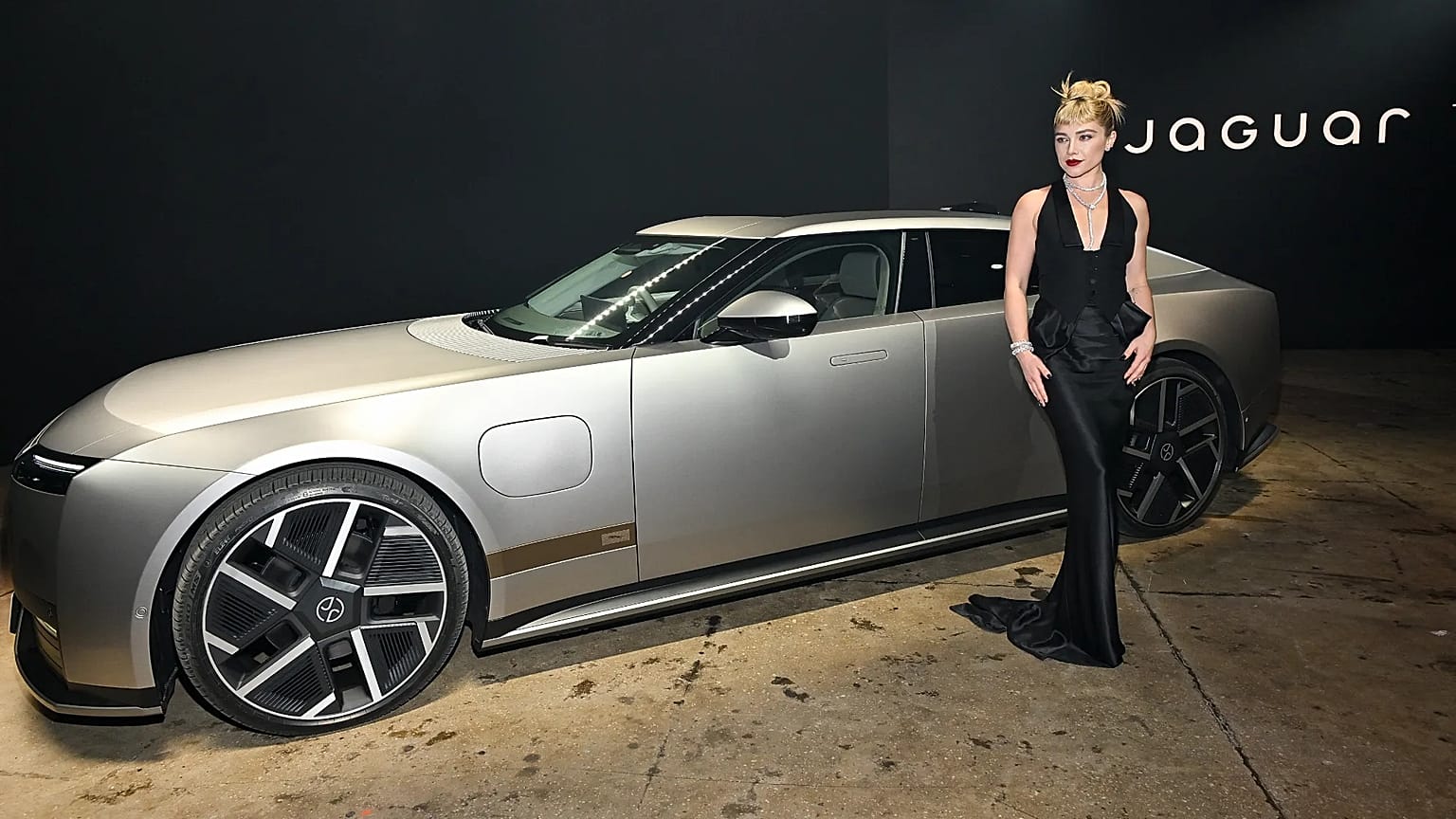













Hailed as the most technologically advanced and powerful Jaguar in the company’s history, it premiered in New York today, targeting a younger, wealthier and mostly American customer base.
Luxury car manufacturer Jaguar unveiled its first new model since its controversial rebrand two years ago at a flashy New York launch party attended by actress and new company ambassador Florence Pugh, in a bid to win over younger, richer and mostly American audience.
 ADVERTISEMENT
ADVERTISEMENT
ADVERTISEMENT
The luxury four-door GT Type01EV is Jaguar’s first foray in the electric vehicle (EV) market. Its ultra-modern, brutalist, sharp-edged design is a massive shift from its previously quintessential British elegance.
The radical design is an attempt by Jaguar’s hierarchy to shake off its previously antiquated albeit storied legacy that started as being a car for racing enthusiasts to one for the posh elite. They now have a newer, younger and richer demographic in their crosshairs.
Jaguar says the new model is the first production from its new Jaguar Electric Architecture (JEA), a dedicated platform for the next generation of Jaguar modes, as the company embraces its original motto “Copy Nothing” to create a vehicle they feel is unique.
It’s also gigantic.
Coming in at 5.2 metres long and 2 metres wide, it is longer than most SUVs and too long for most European carparks.
That makes it something of an awkward fit for Europe, where narrow roads are already struggling with the weight and size of today's monstrous vehicles. It would be far more at home on America's vast, endless highways.
But that has not stopped SUV numbers from exploding on EU roads in recent years.
The Type01EV is very low to the ground for its size, standing at only 1.4 metres tall, making it a particularly sleek looking vehicle.
It weighs in at a huge 2700 kilograms, significantly heavier than its competitors such as the Porsche Taycan Turbo GT (2,200kg) and a little more than the Mercedes-Benz EQS (2,585 kg) which shares a similar length.
The Type 01EV’s motor and battery are extraordinary too. Not only are they powerful, clocking in 1015 horsepower and taking it from 0 to 62 mph in 2.2 seconds, it boasts an impressive 478-mile (769km) range, way above most of its rivals, with only the Porsche Taycan marginally more powerful.
The battery also charges at 350kw, allowing it to charge 200 miles (321km) of range in just 13 minutes and go from 10% to 80% charge in just 22 minutes, making it even more appealing to drivers wishing to make the switch to an electric vehicle.
But it won’t be for everyone.
Base models will start at around €140,000 to €150,000 in Europe, with bespoke specifications and customisations taking it up beyond the €200,000 mark.
Jaguar’s rebranded new car does retain a sense of Britishness though, with the Type01EV designed, engineered and built in the UK, according to their website.
Orders are scheduled to open in early 2027, with the first delivers in Europe expected in the second half of 2027.
Jaguar is a British and global car icon known for models such as the Jaguar E-Type driven by Frank Sinatra, Steve McQueen and described by Enzo Ferrari as “the most beautiful car ever made”.
Before its rebrand in 2024, the company was facing a severe, multi-year identity and financial crisis caused by a failing business strategy that relied on an aging core audience and failed to win over younger consumers.
Jaguar was making cars that were not common enough to compete with BMW and Mercedes nor exclusive or “cool” enough to compete with Porsche or Bentley.
The car company took the plunge with a radical rebrand in 2024, releasing an advert that featured no car at all. Instead, models in brightly coloured clothing spouted slogans such as “live vivid”, “delete ordinary” and “be the jag you are”.
The campaign was criticised by many including political figures such as Donald Trump and Nigel Farage for “going woke,” with Elon Musk asking on social media platform X, “Do you sell cars?”
Jaguar defended the ad campaign, telling Sky News at the time that the company wanted “to be bold and disruptive".
The new model’s launch comes as parent company Jaguar Land Rover recovers from a cyberattack that forced the company to halt production last year. One month later, the company announced it would cut 4,000 jobs as part of a major cost-cutting drive.
Today’s unveiling is the culmination of a years-long strategy to reposition the car manufacturer.