
















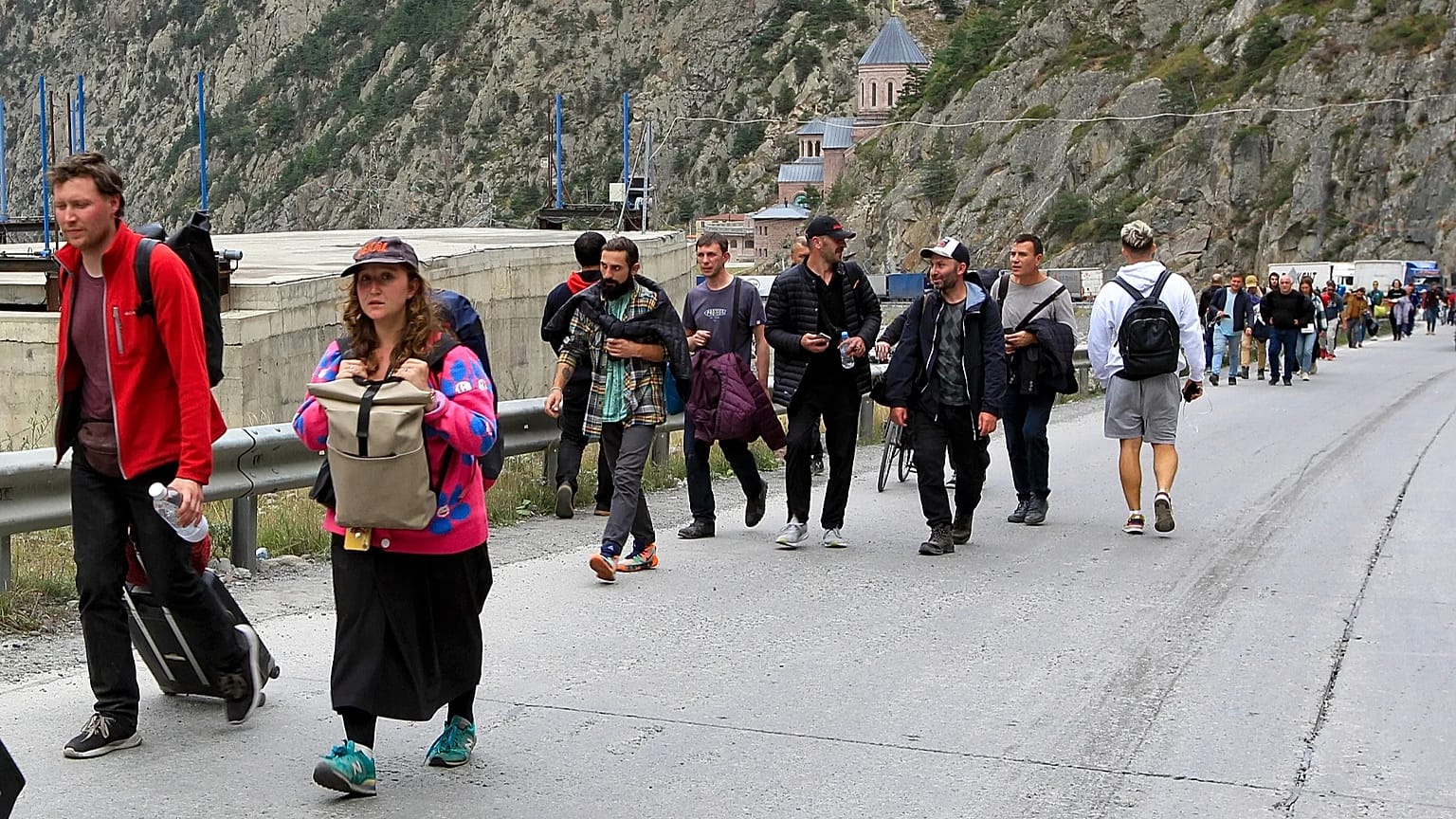













Requests for emergency emigration assistance from Russia have surged eightfold since July, with searches for "how to leave" and "mobilisation" at their highest since early 2023. An electronic summons register now automatically triggers an exit ban, documented cases show.
Russians fearing a new military mobilisation are leaving the country in advance of possible restrictions on departure, according to the anti-war project Ark, after requests for emergency assistance and emigration advice from Russia have nearly octupled since the start of the summer.
 ADVERTISEMENT
ADVERTISEMENT
ADVERTISEMENT
The surge coincides with Russia's State Duma elections, which began on Friday and run through Sunday.
Kremlin critics and several Western governments have accused Moscow of planning to announce a new call-up to beef up its troops in its ongoing all-out war in Ukraine after the vote concludes, allowing an unpopular measure to avoid affecting the election.
Russia's Vladimir Putin has dismissed mobilisation rumours as "utter nonsense," but independent Russian media have counted 17 official denials of an imminent draft since the summer.
Jan Slovitsky, a human rights activist and coordinator of the Ark project, said the current wave was driven by lessons learned from 2022.
"Since mid-July a wave of panic has been rising in Russia, linked to the risk of mobilisation, fuel shortages and lack of internet access," he told Ark's network from Yerevan, where he is assisting new arrivals.
"People are leaving in advance because they have seen what happened during previous waves. And Armenia is facing a migration crisis, if we are not already in the thick of it."
'How to leave' online search spikes
The number of daily requests for relocation assistance has risen from around 70 to 120 since July, according to organisations helping Russians move abroad.
Yandex and Google searches for "how to leave" and "mobilisation" reached their highest level since early 2023 during the summer and the first ten days of September, according to independent Russian media analysis.
Preparations for a possible call-up are already visible. Tens of thousands of people have received mobilisation notices setting out the steps required if called up, and an electronic register of summonses has been introduced under which an exit ban takes effect automatically when a notice is issued.
In early September, passport control officers in Krasnodar detained a 24-year-old resident of Rostov region who had completed his military service in 2024 and served him with a notice banning him from leaving the country, the first such case reported at that crossing.
Daniil Neonov, a former candidate for municipal deputy in the Moscow City Duma, described leaving at the last moment.
"If I had waited another day or two, they would most likely not have let me leave, because they would have blocked my exit," he said. "I received an electronic summons. But I still managed to get out."
Fear of mobilisation has also spread to members of the elite and draft office staff, according to international media reports claiming officials have begun opening foreign bank accounts and moving assets abroad.
In August, Ukrainian President Volodymyr Zelenskyy warned of the risk of mobilisation in Russia, citing intelligence data.
Kyiv described a Kremlin plan to rapidly call up several hundred thousand Russians by the end of the year, with at least as many again the following year. Moscow has not commented on those claims.
Neighbouring countries first
Arrivals are heading primarily to visa-free destinations: Armenia, Georgia and Kazakhstan. Yerevan said in recent days it was ready to assist Russians arriving in the country.
The exact scale of the current wave is unknown, but it is likely less intense than the exodus of 2022, when between 600,000 and 700,000 people left Russia within weeks of the partial mobilisation announcement, according to independent estimates.
That mobilisation has never been formally cancelled, and those called up then have not been demobilised.
"It is very sad to leave Russia," said a 28-year-old marketing specialist, whose name was withheld for security reasons.
"My family lives here, my elderly grandparents live here. My girlfriend is here too, she is still in her medical residency, and it is very hard for me to leave her behind."
Russia's Duma elections, running from 18 to 20 September, include only parties that back Moscow's war in Ukraine. Yabloko, whose platform called for an immediate ceasefire and peace talks, was barred from standing by the Supreme Court in August.