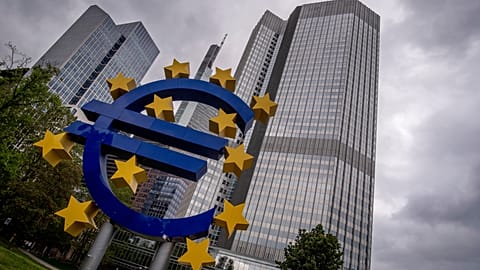













Italy suggests exempting smaller merchant fees for payments under €10, a measure backed by the central banking community, as final talks take place in Brussels over the rollout of the digital euro.
Italy has proposed introducing an exemption for digital euro transactions under €10 in a move that would favour small businesses, according to sources consulted and documents seen by Euronews
 ADVERTISEMENT
ADVERTISEMENT
ADVERTISEMENT
The move is viewed favourably by the central banking community, in particular by the European Central Bank (ECB), a source from the banking sector told Euronews.
The digital euro is a digital form of payment, expected to complement cash, with the ECB aiming to be ready for a potential first issuance in 2029, assuming the necessary regulation is adopted this year.
As Europe mainly relies on US-based payment schemes such as Visa and Mastercard, the EU is pushing for greater strategic autonomy in payments, with the digital euro seen as one potential solution.
It will have legal tender status, meaning merchants will generally be required to accept it, subject to certain exceptions. For this reason, legislators are negotiating how fees should be distributed among market participants, so that small merchants are not disadvantaged by the adoption of the new digital currency.
The distribution of fees among market participants, known as the "compensation model", is among the most delicate parts of the negotiations in Brussels, alongside the "holding limits", meaning the maximum amount of digital euro that can be held in a wallet.
"The proposal is a merchant service charge cap up to €0.02 for low value transactions, applicable especially to small merchants. But we're open to consider a net zero, as de facto this would be the result anyway," an EU diplomat told Euronews on condition of anonymity.
"Such a solution would also make the framework simpler," the diplomat added.
According to internal documents seen by Euronews in relation to the negotiations, the fee scheme will be temporary, allowing the ECB to gather sufficient data before proposing a new model, if appropriate. The need for better data on payment fees has also been highlighted by the European Court of Auditors. In a 2025 report, the ECA found that the European Commission lacked sufficient data on merchant service charges and costs to effectively monitor the impact of existing price interventions in the payments market.
Other negotiation documents indicate that small merchants typically pay higher fees than large companies because they have weaker bargaining power with international payment schemes. These schemes are difficult for merchants to refuse, particularly when they are widely used. According to an ECB analysis, small merchants can pay three to four times more in fees than larger merchants.
The matter will be analysed by member states, the European Parliament and the European Commission during the next round of negotiations in Brussels, according to an internal document seen by Euronews.
Negotiators will meet again in Brussels on Thursday, 10 September, for further discussions.