















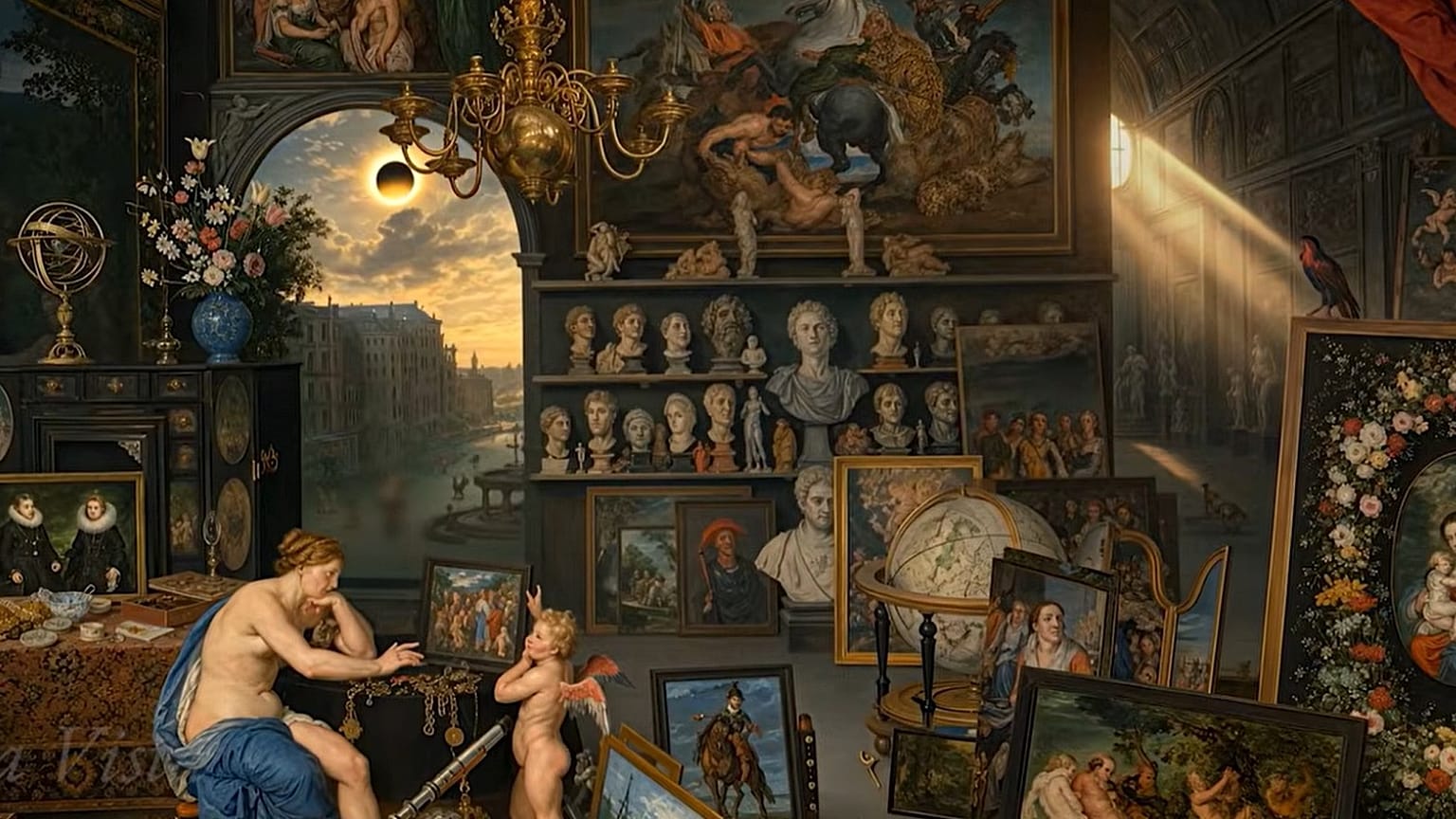













The Prado Museum in Madrid has unveiled "El Prado in the Light of the Eclipse", an audiovisual work using AI and digital art to show how an eclipse reshapes iconic paintings in its collection.
How would Velázquez's supreme masterpiece, "Las Meninas", look shrouded in the dim light of a solar eclipse? What happens to the colours, shadows and atmosphere in the works of the great masters of painting when the light changes in a radical and sudden way?
 ADVERTISEMENT
ADVERTISEMENT
ADVERTISEMENT
The Spanish National Prado Museum has answered these questions to mark this week's solar eclipse on Wednesday 12 August 2026 with a spectacular video that invites viewers to rediscover its collections from a completely new perspective.
A new look at the masterpieces
The project, entitled "The Prado in the light of the eclipse", proposes a progressive transformation of the lighting applied to some of the most iconic paintings in the celebrated gallery. Through this shift in light, the video shows how small variations in illumination can radically alter the perception of colours, shapes and the atmosphere of the paintings, revealing details and nuances that everyday light leaves hidden.
The proposal is not just an aesthetic exercise. The Prado also sees it as a tool for cultural outreach designed to bring its collections closer to new audiences, especially to people who do not usually visit museums, through an accessible and visually striking audiovisual format.
The works touched by the sun in the gallery's video are:
1. 'Las Meninas'. Diego Rodríguez de Silva y Velázquez
2. 'La Vista'. Pedro Pablo Rubens; Jan Brueghel el Viejo
3. 'El embarco de santa Paula Romana'. Claudio de Lorena
4. 'Autorretrato'. Alberto Durero
5. 'El quitasol'. Francisco de Goya y Lucientes
6. 'La Canal de Mancorbo en los Picos de Europa'. Carlos de Haes
7. 'La fragua de Vulcano'. Diego Rodríguez de Silva y Velázquez
8. 'La rendición de Bailén'. José Casado del Alisal
9. 'El sueño de Jacob'. José de Ribera
10. 'El nacimiento del Sol y el triunfo de Baco'. Corrado Giaquinto
11. 'La pradera de San Isidro'. Francisco de Goya y Luciente
Artificial intelligence in the service of art
The production has been developed by the studio AMB Piensa using a combination of artificial intelligence, digital creation and traditional graphic intervention. The technical process involved the use of video-generation models capable of recreating depth, simulating camera movements and able to also precisely reproduce the advance of the eclipse over the scenes depicted in each work.
The artificial intelligence tools made it possible to design and refine complex visual instructions: the gradual evolution of the light, the appearance of shadows and reflections, and the effect of progressive darkening on characters, landscapes and architectural elements.
The process, however, was not entirely automated. Each sequence was reviewed and manually adjusted to preserve the composition, the pictorial technique and the original character of the paintings, ensuring that the technological intervention did not distort the spirit of the works.
Art, technology and an astronomical phenomenon
This coming Wednesday, Spain will experience one of the most eagerly awaited astronomical events of recent years that's generated unprecedented national excitement: a solar eclipse that will be visible across much of the mainland.
The Spanish museum is thus joining the conversation with a proposal that goes beyond straightforward scientific outreach and seeks to create an artistic and emotional experience. The fundamental question underlying the project is, in fact, very old: How much of what we see in a work of art depends on the light in which we view it?
With this initiative, the museum reaffirms its commitment to innovation as a way of connecting with contemporary audiences, exploring the possibilities offered by new technologies to enrich the interpretation of artistic heritage without sacrificing rigour or respect for the original works.