





























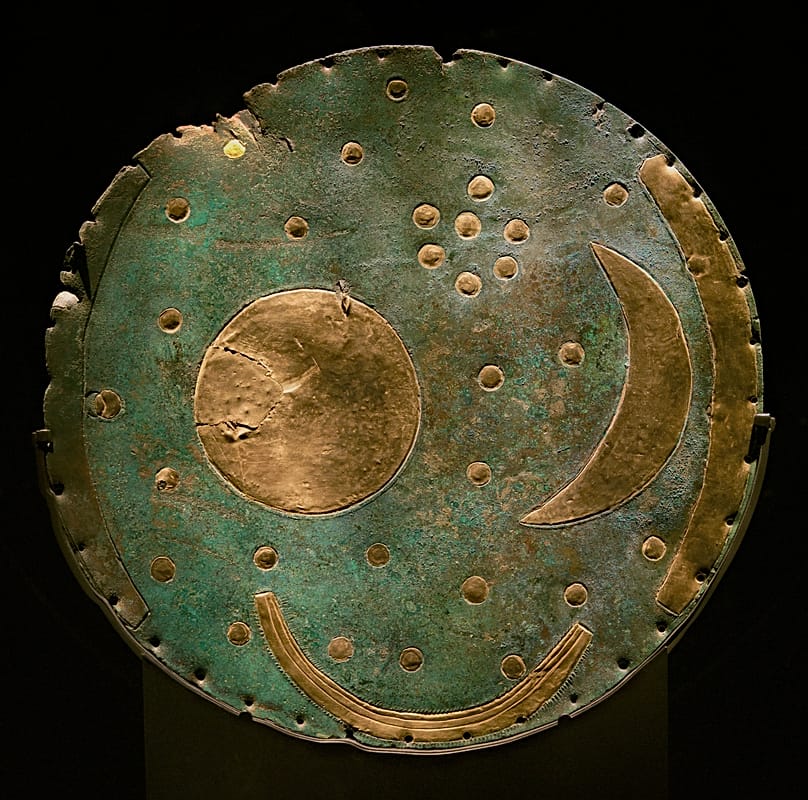
Nebra sky disc, Rubens, Ribera, Howard Russell Butler and Roy Lichtenstein's pop art all show solar eclipses in painting, between religion, science and aesthetic fascination over millennia.
On 12 August the Moon will once again cover the Sun over much of Spain, and for a few minutes there will be a total solar eclipse visible that day. It will be nowhere near the first time an eclipse has left humanity open-mouthed in amazement.
 ADVERTISEMENT
ADVERTISEMENT
ADVERTISEMENT
Nor will it be the first time someone has tried to capture it with a paintbrush. For centuries, painters, illuminators and engravers have tried to fix on canvas, fresco or copper plate something that in reality lasts only a few minutes.
When the sky darkened and the world trembled
Before astronomy existed as we understand it today, an eclipse was, quite simply, terrifying. The Nebra Sky Disc, a Bronze Age bronze object found near Halle in Germany, already shows the Sun, the Moon and the Pleiades together on a single artefact, although it does not actually depict an eclipse: it is rather the earliest known example of that obsession with putting an image to what happens in the sky.
Herodotus himself recorded how a solar eclipse interrupted a battle between the Medes and the Lydians in Asia Minor, an episode that both sides interpreted as a sign.
The Middle Ages turned the eclipse into the perfect narrative device for one very specific episode: the death of Christ. The Italian painter Taddeo Gaddi depicted, in a 1330 triptych now held by the New-York Historical Society, a Moon drawing close to the Sun above the cross. A century later an anonymous Valencian artist did the same in a panel (the painting is called 'Crucifixion') that now hangs in the Thyssen-Bornemisza, although the ochre-toned sun betrays the fact that its author had probably never witnessed a total eclipse and did not really know how to depict it.
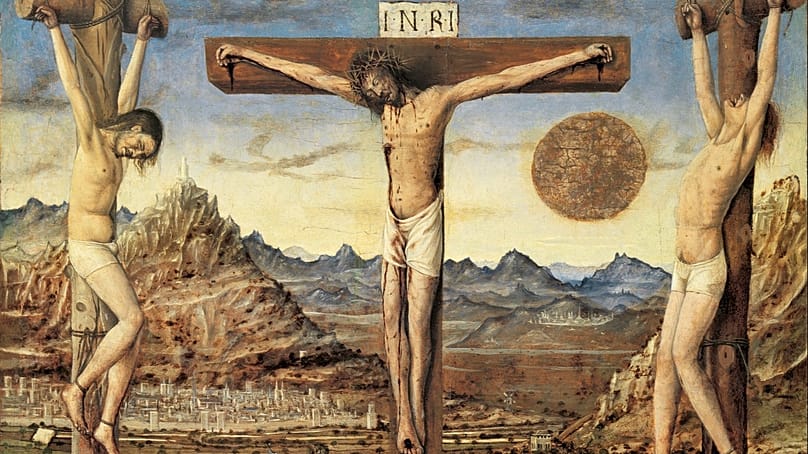
The phenomenon also appeared alongside other marvels: the Augsburg Book of Miracles, a mid-16th-century manuscript, depicts the total eclipse of 1483 accompanied by the locust plague that devastated Italy that same year.
The Baroque, between faith and emerging science
With the Baroque period, depictions of eclipses became more technically ambitious without losing their symbolic weight. José de Ribera painted in his 'Christ Crucified' of 1643, now in the Fine Arts Museum of Vitoria, an almost translucent lunar disc that lets the outline of the Sun behind be glimpsed, while Rubens went a step further in his triptych for Antwerp cathedral: in 'The Elevation of the Cross' (1610-1611) he captured the onset of a solar eclipse with striking realism, although he had to draw the entire outline of the Moon so that viewers could recognise both heavenly bodies.
Not all eclipse paintings of the period sprang from religious faith. Antoine Caron titled his 1570-1580 canvas, now in the Getty in Los Angeles, 'Dionysius the Areopagite Converting the Pagan Philosophers', although it is better known as 'Astronomers Observing a Solar Eclipse: A Celestial Globe, an Armillary Sphere and a Figure Making Geometrical Calculations', which shows that what really interested the painter was the astronomical phenomenon.
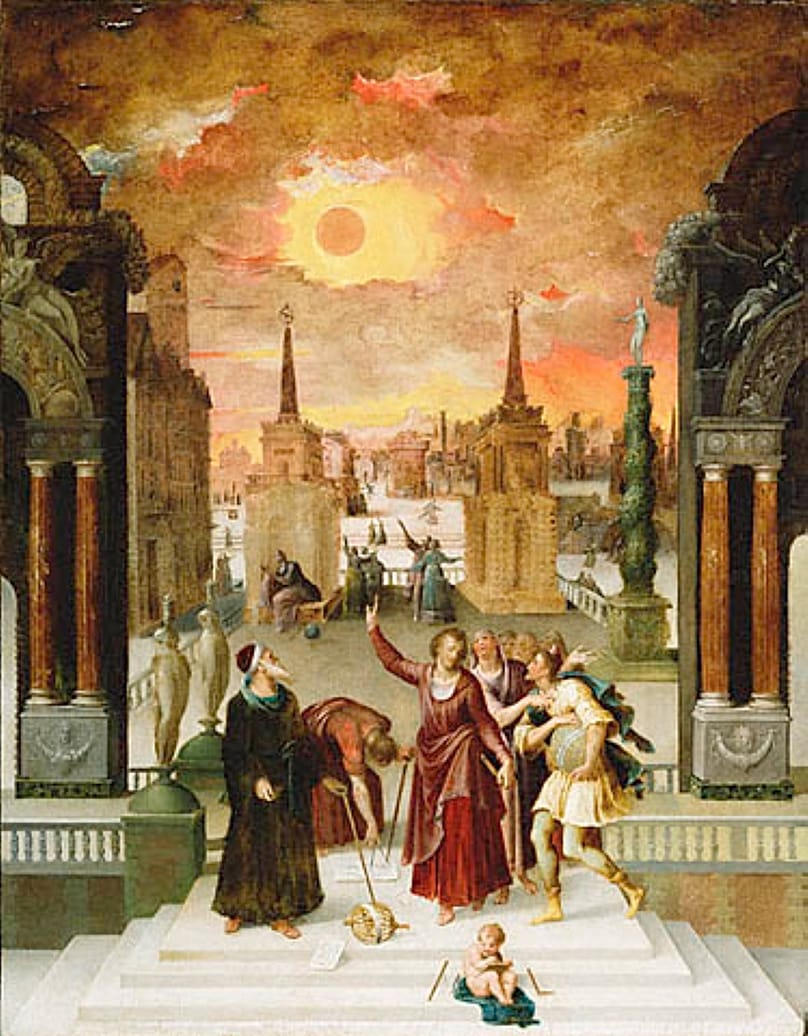
By the 18th century, Donato Creti had painted a series of oils on astronomical observations commissioned by Count Marsili, who presented them to Pope Clement XI to persuade him to finance an observatory in Bologna. And it worked, as the observatory was built shortly afterwards.
Romanticism and the taste for the sublime
The 19th century, with its fascination for the grand and the inexplicable, produced some of the genre's most picturesque scenes. Ippolito Caffi portrayed the eclipse of 8 July 1842 over Venice ('Solar Eclipse in Fondamenta Nove') from an aerial perspective, and the Russian painter Ivan Aivazovsky, better known for his seascapes, turned into a kind of half-night landscape the total eclipse he observed in 1851 from Feodosia ('Solar Eclipse in Feodosia').
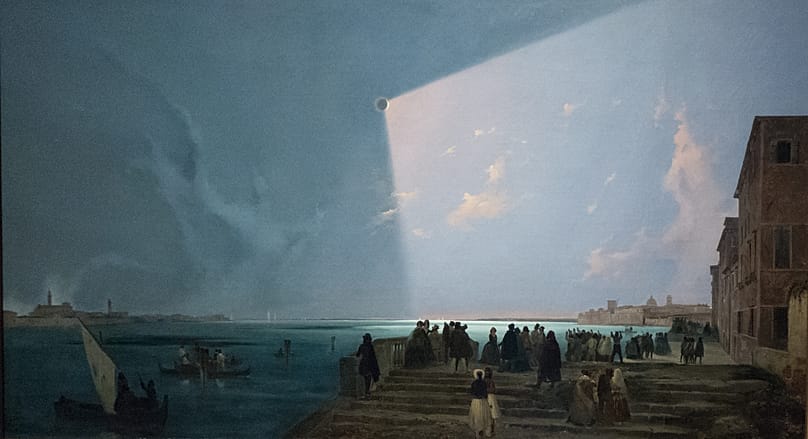
The phenomenon also lent itself to political satire: a French almanac from 1706 showed Louis XIV seated on his throne before the Sun, alluding to his nickname as Sun King, and included in one corner the eclipse of 12 May that year, which coincided with a French military defeat during the siege of Barcelona.
When the paintbrush was put at the service of science
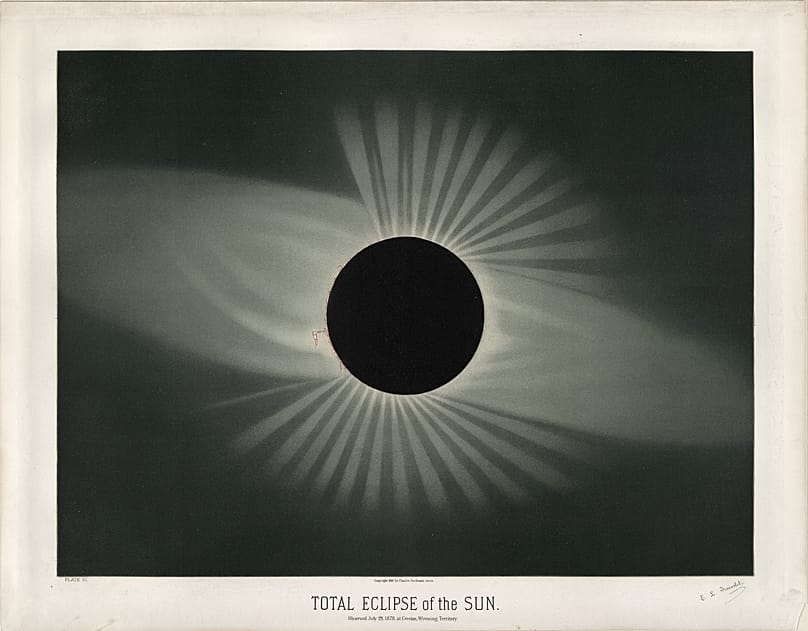
In the late 19th century, before photography could properly capture the solar corona, some artists turned their paintings into precision instruments. The Frenchman Étienne Léopold Trouvelot, better known today for having accidentally introduced the gypsy moth into the United States, found his true vocation in astronomical drawing and travelled with his son to Creston, in the Territory of Wyoming, to observe the total eclipse of 29 July 1878 ('Total Eclipse of the Sun').
That scene was later turned into a chromolithograph in a portfolio of 15 plates published in 1882. A few decades later, the American Howard Russell Butler took that documentary vocation even further.
A former physics student turned portraitist, he devised a shorthand system for noting shapes and colours that allowed him to work with barely two minutes of totality. Using those notes and a few photographic plates as support, he painted the 1918 eclipse in Oregon during an expedition by the US Naval Observatory, and repeated the feat with the eclipses of 1923 in California, 1925 in Connecticut and 1932 in Maine.
The resulting triptych was exhibited for years at the Hayden Planetarium of New York's American Museum of Natural History, and half-scale copies exist in Princeton, at the Franklin Institute in Philadelphia and at the Buffalo Museum of Science.
From Expressionism to pop art
The eclipse continued to provide inspiration in a purely artistic vein throughout the 20th century. Paul Klee dedicated a watercolour to it ('Solar Eclipse' ('Sonnenfinsternis')), and Roy Lichtenstein, towards the end of his career, translated the speed with which totality of an eclipse arrives and passes into a superimposition of circles and curves very much in the pop art style in his 1975 work 'Eclipse of the Sun'.
Since then, the phenomenon has never stopped appearing on the contemporary art market, whether as an almost scientific study or as a purely chromatic excuse for playing with the contrast between light and shadow.
On 12 August, when the Moon once again covers the Sun over Spain, thousands of people will take out their phones to photograph the event. For much of history, the only way to preserve it was precisely that, a paintbrush, a handful of minutes and the memory of whoever dared to look up.