





























Serbia's former prime minister tells Euronews how Belgrade has backed Ukraine since the war began and rejects claims of being pro-Russian, while voicing Serbs' frustration at EU accession double standards.
Serbia will host EXPO 2027, which already has 140 countries signed up to take part. Preparations – but above all the Serbian economy and EU accession talks – were the main topics of a conference held in Brussels.
 ADVERTISEMENT
ADVERTISEMENT
ADVERTISEMENT
It was attended by Serbia’s foreign minister, Marko Djurić, deputy prime minister and finance minister, Sinisa Mali, and the speaker of the National Assembly, former Serbian prime minister Ana Brnabić.
'Constant contact'
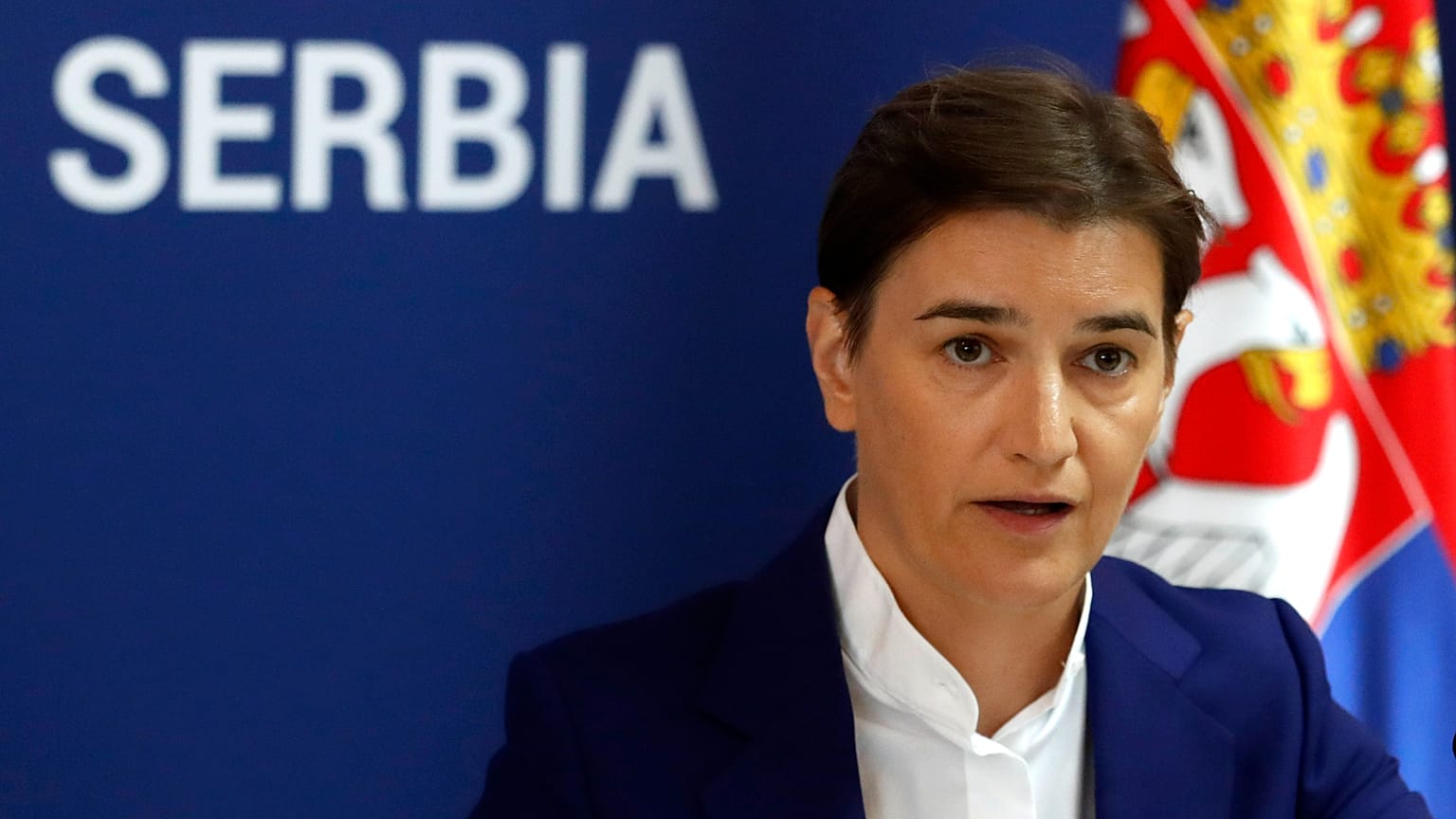
Euronews poke to Serbia's former prime minister Ana Brnabić about relations with Ukraine and Russia.
Brnabić addressed accusations of alleged lack of Serbian support for Ukraine in its conflict with Russia. She emphasised that since the outbreak of Russia’s war of aggression against Ukraine in February 2022, Serbia has allocated more than €60 million in aid to Ukraine, in the form of direct financial and humanitarian assistance, though not military support.
"We were the only country in the Western Balkans which, at the most difficult moments in the winter months, delivered electrical equipment to Ukraine – because we have similar power systems – as well as generators and spare parts. Even when these could not be bought on the market, we were sending them to Ukraine from our own reserves. In this way – and many people do not know this, especially in the European Union – a very close bond developed between Serbia and Ukraine," she noted.
"You have seen that communication between President Vučić and President Zelenskyy is exceptionally regular; they are in constant contact. My communication with the speaker of the Verkhovna Rada (parliament) of Ukraine, Ruslan Stefanchuk, looks similar," Brnabić added.
We are not 'little Russians'
Serbia is often described as Russia’s "Trojan horse" and one of Moscow’s closest allies in Europe, almost a Russian satellite. The former prime minister considers this perception exaggerated:
"We Serbs are not ‘little Russians’; Serbia is an autonomous, independent and sovereign country with nearly a thousand years of history. Yes, we have traditionally good relations with the Russian Federation (Russia was one of the few countries to condemn NATO’s air strikes on Serbia in 1999), and those ties still exist today. But it is not a relationship without friction – I must stress that the Russian Federation has often criticised Serbia for, for example, voting at the United Nations to condemn Russian aggression against Ukraine, and they have frequently criticised us for the aid and support we provide to Ukraine," says Ana Brnabić, adding that, in her view, people guided by stereotypes sometimes gloss over certain facts while magnifying others.
"Truth matters, and perhaps we should also be communicating it more effectively. Unfortunately, stereotypes are so strong and entrenched that even when we talk about what we are doing, people often ignore it or simply do not believe it. However, as our foreign minister has said, when it comes to Serbia’s relations with Ukraine and the scale of Serbian support for Ukraine, it is best to ask Ukraine itself," the former prime minister said.
Double standards
Both at the conference and in her interview with Euronews, Ana Brnabić also spoke about progress in talks with the European Union and the obstacles that arise along the way. She referred to the frustration felt by many Serbs over what they see as greater demands being placed on Serbia than on other candidate countries.
"I will give the example of implementing ODIHR recommendations (the Office for Democratic Institutions and Human Rights – ed.) on improving electoral conditions in the Republic of Serbia. In order to open cluster three, for which we have been technically ready since 2021, we are required to implement all ODIHR recommendations. But if you look at other candidate countries which also have ODIHR recommendations on improving electoral conditions, they are not required to implement even one of them, and they have already opened all their clusters. This is a double standard that is hard for us to explain to our citizens and it undermines the credibility of the European Union," she says, while stressing that the government in Belgrade believes Serbia’s place is in the EU.
"That is why we are not giving up; we will keep fighting, we will work even harder, but it is important that we present not only plans but also results. We understand that the European Union is a club, a family of countries that can set any standards it wants for those seeking to join that club or family, but it would be good if those standards were more uniform," the current speaker of the National Assembly said.