





























Unsightly for some, solar panels are now being disguised and designed as ancient Roman tiles to blend into historic city skylines. From Italy to Portugal, Pompeii and Évora are proving that heritage preservation and sustainability can go hand in hand.
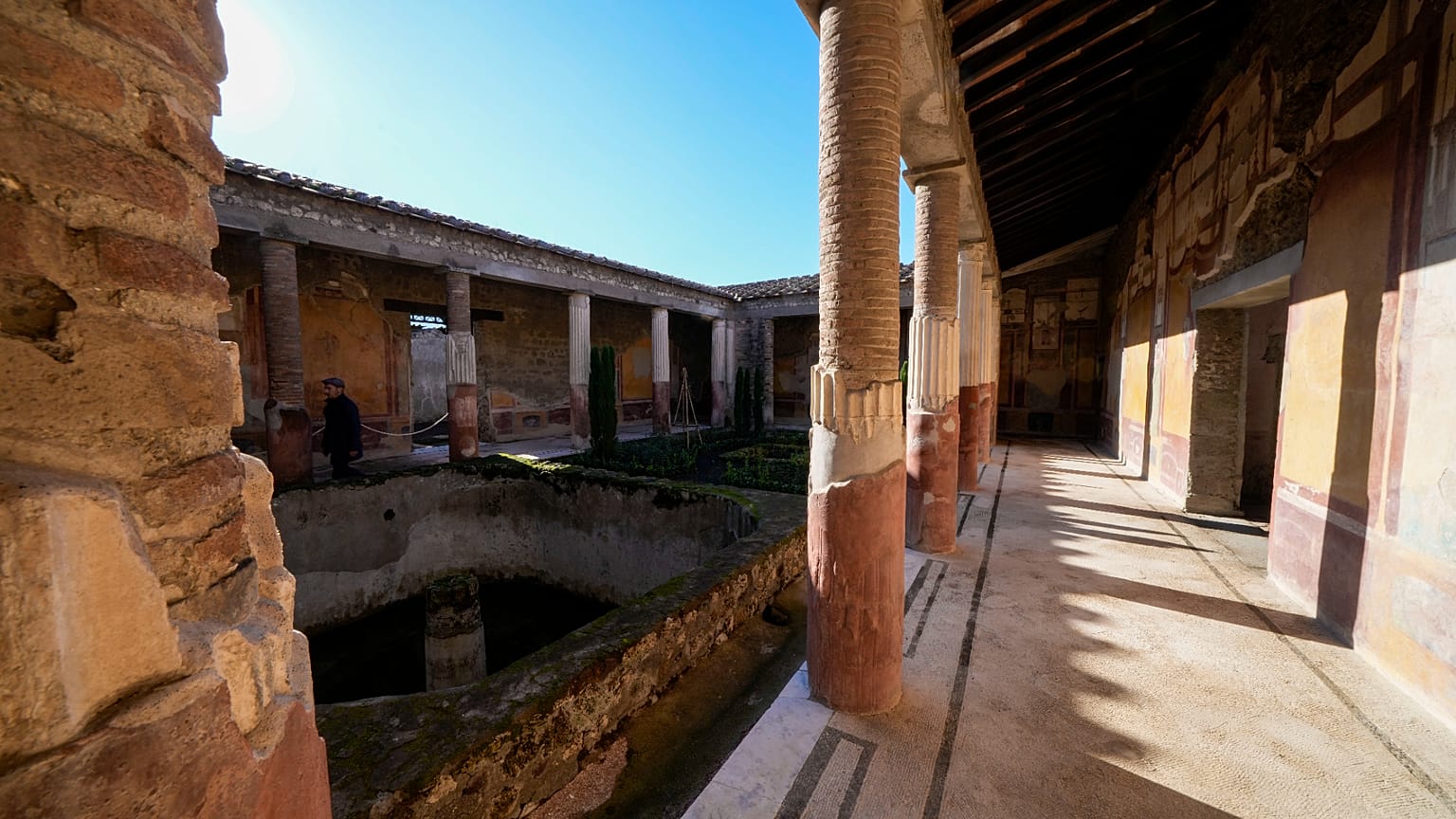
Each year, millions of tourists from around the world visit Pompeii. They admire the southern Italian city's frescoes and archaeological ruins, but few will likely ever notice the solar panels installed on the roof of the ancient Roman Villa of the Mysteries.
 ADVERTISEMENT
ADVERTISEMENT
ADVERTISEMENT
On one side, "it looks just like an ancient Roman tile. But if we look at it from behind, we can see that it is actually a small photovoltaic panel," explained Gabriel Zuchtriegel, Pompeii Archaeological Park Director.
"It generates electricity to illuminate this villa, and a large share of the energy needed here comes directly from the roof installation," he added. The work at Pompeii on Villa of the Mysteries was carried out by AHLUX ITALIA S.r.l. – VISEN division.
While Pompeii is considering extending this solution to other areas of its archaeological park that are far from the electricity grid, the Portuguese city of Évora, has also adopted similar technologies, avoiding the harsh visual impact of conventional black solar panels. On the rooftop of the City Hall, some shingles are slightly clearer.
"They are not normal shingles," said Humberto Queiroz, EDP R&D Centre and Project manager. "They are made of a semi-transparent epoxy material with solar cells embedded in the middle of it, which generates electricity for the self-consumption of this building."
The area has around 20 kWp (kilowatt peak) of PV shingles, designed to blend into the building's landscape architecture and protect the heritage aspect of Évora.
Since 1986, Évora's historic centre has been listed as a UNESCO World Heritage Site. PV shingles are among the solutions through which the European project POCITYF is helping the city reconcile heritage preservation with the modern challenges of sustainability.
"Évora is a World Heritage city and, like most historic cities across Europe, it has the responsibility to preserve its historic centre and safeguard its cultural heritage," analysed Nuno Bilo, EU project coordinator at Évora Municipality.
"However, it cannot remain frozen in time. We also need to move forward and find solutions that enable historic cities—and in this case Évora—to address one of today's greatest challenges: decarbonisation."
'If it can work here, it can work anywhere'
Among the solutions developed to make this possible is one created by a small family-owned company based in north-eastern Italy. Matteo Quagliato, who works for Dyaqua, explained the process.
"The tile is made from a resin compound that forms the first layer. We then take the photovoltaic cells, which have already been soldered beforehand, and place them inside. After that, a second layer is added, made from a specially formulated compound. The final step is lowering the mould and removing the finished product: a resin tile containing the photovoltaic cells."
Solutions like this one and the different technologies adopted in Pompeii send an encouraging message to the rest of the world.
“The lesson Pompeii offers is that if this technology can work here, in a place that is so delicate, so closely monitored, so fragile, and so vast, then it can work anywhere”, said Zuchtriegel.
Glass roofs integrating photovoltaic panels and solar canopies installed in the courtyards of schools in the historic centre are among the other solutions being tested in Évora. Together with Alkmaar in the Netherlands, the Portuguese city is assessing these innovations through the POCITYF project to evaluate their potential for replication across Europe.
Artikel aktualisiert mit Informationen von AHLUX ITALIA/VISEN