















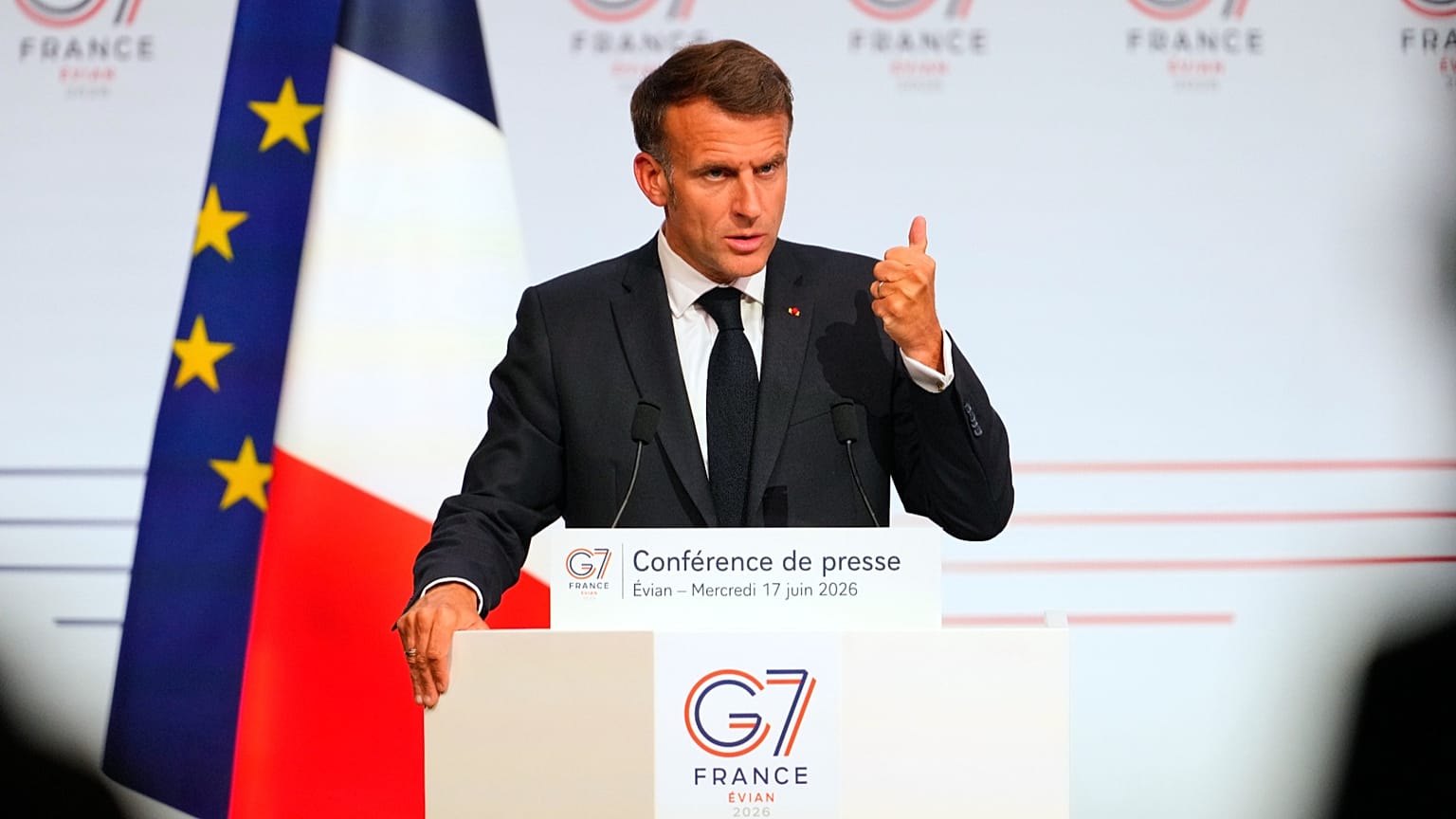














"There was a turning point, there was definitely an Évian moment regarding Ukraine," Emmanuel Macron said at the end of the G7 summit.
At the end of three days of talks in Évian, French President Emmanuel Macron hailed a "turning point" among allies regarding Russia's war on Ukraine.
 ADVERTISEMENT
ADVERTISEMENT
ADVERTISEMENT
Macron and his fellow leaders managed to convince US President Donald Trump, who has often outraged Europeans with his unilateral approach to the war, to sign a joint statement pledging to increase military aid to Kyiv and economic pressure on Russia.
"This is a real change compared to the last few months, not just on the part of the Europeans, but on the part of the G7 members and all those who support Ukraine," Macron said at the press conference concluding the G7 summit.
"This Évian summit represents a very profound shift in approach, a willingness on the part of the United States to work with the Europeans in support of Ukraine."
Here's how the day unfolded.

 ${title}
Live ended
Six takeaways from the G7 summit in Évian
The G7 summit in Évian, France, has come to an official close. And so has our live blog.
Thank you for reading us for these past three days.
While Macron and Trump enjoy their lavish dinner in Versailles, we leave you with our six takeaways.
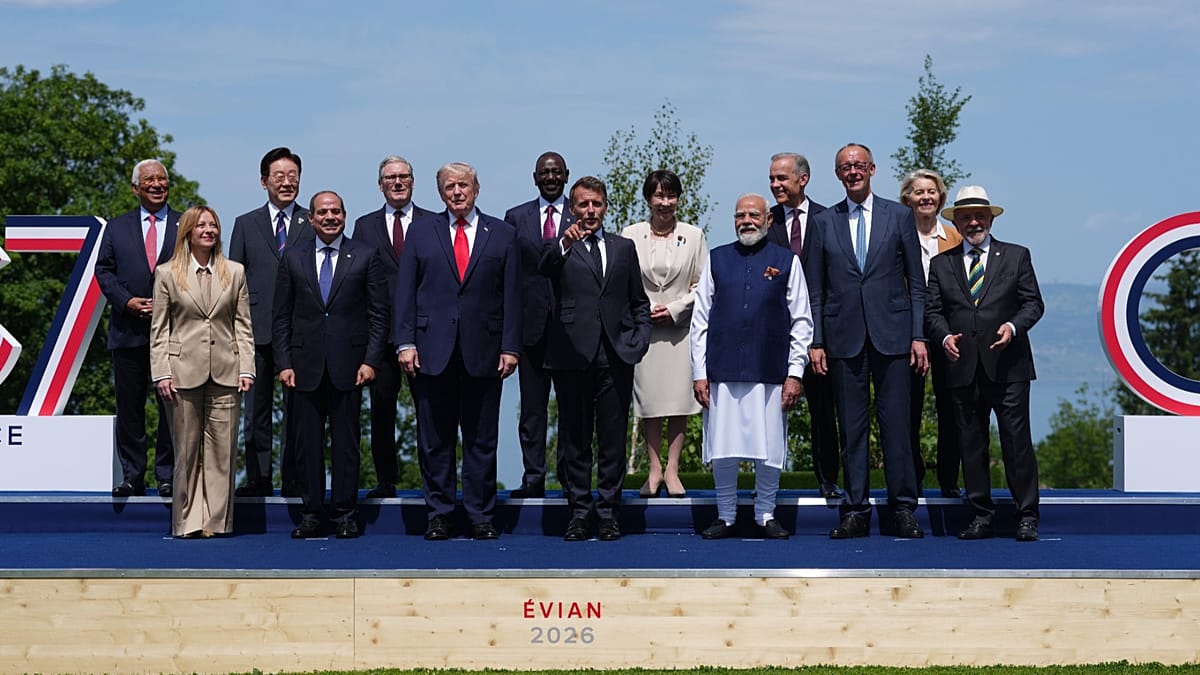
Six takeaways from the G7 summit in Évian
G7 leaders gathered in France for a high-stakes meeting over the last three days to discuss Ukraine, the Middle East and world challenges. Here is what you nee…
One hour of press conference and very little mention of Ukraine
Donald Trump has closed his press conference, which stretched for over an hour and had a distinct repetitive tone.
Unsurprisingly, the vast majority of his remarks focused on the memorandum of understanding with Iran, as well as the Strait of Hormuz, Israel, Lebanon and the Gulf countries.
Trump barely made any mention of the topic that his European allies considered central at the G7 summit: Russia's war on Ukraine. The US president simply said he had "very good" conversations with both Vladimir Putin and Volodymyr Zelenskyy.
"I think they both want to do something. They just don't know how to do it. They want to do it," he said, referring to both leaders.
Trump also took a moment to berate Europe, though with less aggressiveness than on previous occasions. "Europe is having a lot of hard times. They're doing some things very badly on energy and on immigration," he said.
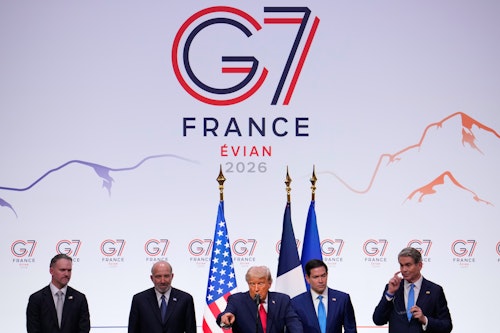
Credit: Associated Press
Bruno Le Maire: 'Iran is now stronger than it was before the war'
"Iran is now stronger than it was before the war."
— euronews (@euronews) June 17, 2026
Former French Economy Minister Bruno Le Maire with a sharp critique of US Iran policy.
Full interview on #SpecialReport with @mariatad https://t.co/5BDsjS0GNz pic.twitter.com/62CJ8MjkEf
US-Iran is a 'fake' deal, Le Maire tells Euronews
The US-Iran framework agreement reached over the weekend is a "fake" deal, France's former Minister of Economy Bruno Le Maire told Euronews.
For Le Maire, the deal was "much ado about nothing," since the US started the war but the deal would make Tehran stronger than before.
He pointed out that the technical commitments that would prevent Iran from accessing nuclear weapons will be key and there was still uncertainty on the Strait of Hormuz.
Le Maire also considered a strategic mistake not to include long-range balistic missiles in the agreement, since parts of sourthern Europe might be exposed to attack in the future.
E6 format would give new impetus to EU, Le Maire Tells Euronews
"The single lesson that all European leaders must draw from the past month, I would say the past two years, is that, if they want to be relevant and strong the need to be united. And they don't need to be united with EU 27 member states," France's former Minister of Economy Bruno Le Maire told Euronews.
For Le Maire, the E6 format with Europe's six largest economies should be the core format to give new impetus to the European project, aiming to deliver concrete results on the most pressing issues, be them Iran, Ukraine, building chip capacity or nuclear energy.
"Six countries instead of 27 countries is the best way of reinforcing Europe to get concrete results," he said. "We cannot accept anymore to be blackmailed by the US administration."
Israel-Lebanon is a ‘much smaller conflict’, Trump says
Asked during a press conference what leverage he has over Israel and Hezbollah to abide by the ceasefire with Iran, US President Donald Trump said Iran will now have to behave.
“That's a much smaller conflict. It's a conflict that should be able to be over with. I'm surprised it's taken so long. It's a much smaller conflict. But we have a lot of leverage," he said.
Trump added that the US has the world's greatest military and most powerful navy, as showed that the naval blockade against Iran proved more effective than the bombing.
Trump on bombing of Iran school: 'Mistakes are made and war is nasty'
Responding to a question by the New York Times about the ongoing probe into the bombing of an Iranian girls' school which left at least 120 students and more civilians dead, US President Trump has said that "mistakes are made and war is nasty".
He also confirmed that the incident was under investigation. Other external investigations have pinned responsibility directly on the US.
Former US officials have criticised the Pentagon for their silence following the school bombing, which happened in the opening days of the US and Israel's war on Iran, more than three months ago.
Trump thanks ‘neutral’ China and Russia for not intervening in Iran
Donald Trump said he appreciated that China and Russia stayed “neutral” in the US-Israel war on Iran.
“I want to thank China President XI, I was with him and he stayed neutral, totally neutral. And I appreciate it. And I want to thank Vladimir Putin. He was very neutral.”
Trump said the leaders of Russia and China “could have made it much more difficult for us.”
Trump also said that he asked Xi Jinping not to give or sell any weapons to Iran.
“For the most part, he didn't. So I just want to thank them because they made it a lot better.”
Trump praises Versailles ahead of dinner: 'That palace has a lot of gold'
Donald Trump says he is looking forward to the "very special dinner" tonight hosted by Emmanuel and Brigitte Macron after the G7 summit.
"I sort of like that palace has a lot of gold. I want to check it out. It's a beautiful palace, or maybe the most beautiful of all. I hope you're going to get to see it, the ones that are travelling with me. I hope you're going to get to see it, because it's amazing," Trump tells reporters.
"I guess that's the ultimate of its type. Louis XIV. Celebrating the 250th anniversary of America's founding and America's oldest alliance. And we're celebrating that a little bit tonight. They'll have the biggest people in Europe at the dinner. And those people love our country."
Both Zelenskyy and Putin want to do something, ‘they just don’t know how to do it’, Trump said
Donald Trump spoke briefly about Russia’s all-out war against Ukraine in his closing remarks, reiterating he had “good conversations” with both leaders over the past few days.
Trump said he believes Zelenskyy and Putin “both want to do something. They just don't know how to do it. They want to do it,” referring to bringing an end to Moscow’s invasion.
Trump again repeated that Kyiv and Moscow are losing “lots of people” as Russia’s war is now in its fifth year.
“Russia is losing more because they're the offensive ones. And when you're offensive in war, you lose more.”
Trump did not go into further details on what he is willing to do help push the diplomatic process forward.
Europe 'doing some things very badly', Trump says
Donald Trump has briefly criticised Europe, echoing his previous talking points against the continent.
"Hopefully, Europe is going to find its way. Europe is having a lot of hard times. They're doing some things very badly on energy and on immigration. They're doing things very badly," he says.
"And we'll be talking about that tonight," he added, referring to this dinner in Versailles later today.
Trump floats 'expansion' of the Abraham Accords
The US President has just said the US is hoping to secure the "expansion" of the landmark Abraham Accords -- a set of agreements which aim to normalise diplomatic ties between Israel and Arab states as part of the peace agreement with Iran and wider efforts to bring stability in the Middle East.
"I think Saudi Arabia, if they lead the way, they'd be doing themselves a big favour," Trump explained.
The Abraham Accords were brokered by the US in 2020 and led to establishing formal ties between Israel and the United Arab Emirates, Bahrain and Morocco. Yolaine De Korcheve has more on the Accords in the article below.
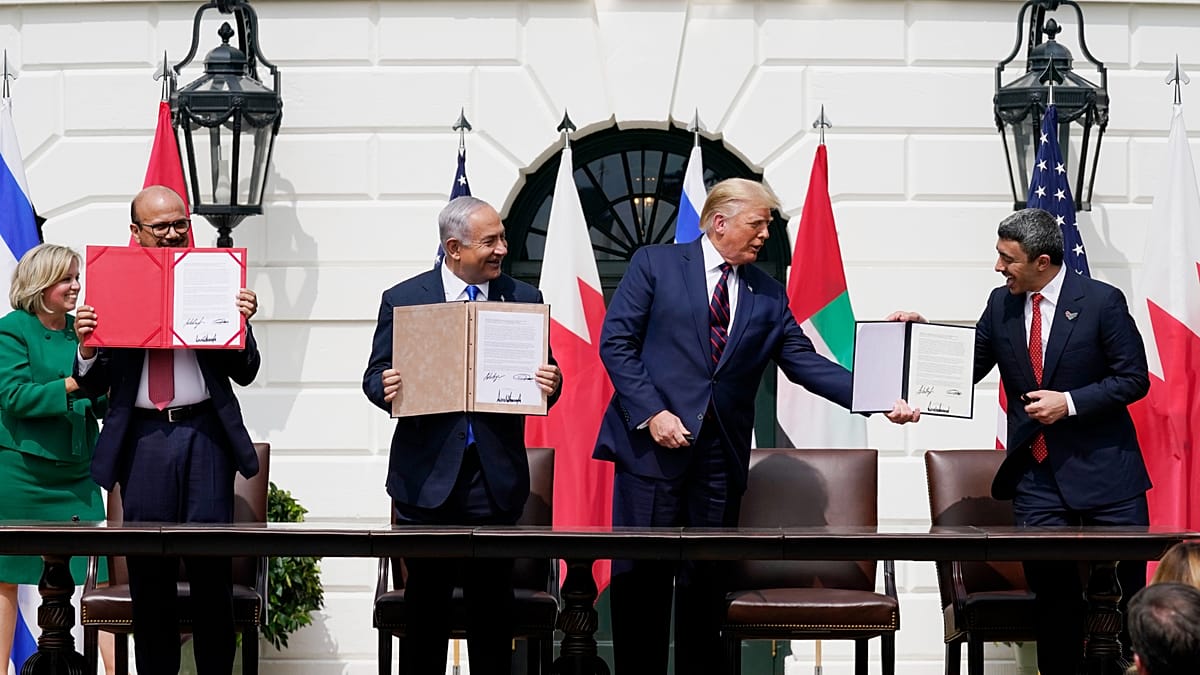
What are the Abraham Accords — and why is Trump pushing to expand them?
US President Donald Trump is calling for more Muslim-majority countries to join the Abraham Accords, the diplomatic agreements normalising ties between Israel…
AI 'is both great and could be bad,' Trump said
US President Donald Trump said that there were excellent meetings on the economy and AI at the G7.
"It's amazing what's going on with that. It's going to be the biggest thing ever. We have to be very careful though. It's both great and could be bad. We have to be careful with it," he said at the concluding press conference.
Trump stressed that the US is leading the world's technological race to build the disruptive technology, including China.
US did up to $2 trillion worth of damage in Iran, Trump says
The US caused up to $2 trillion worth of damage during the war with Iran, US President Donald Trump said at his press conference at the end of the G7 summit in Evan.
"They need investments because we did $1.5, maybe $2 trillion worth of damage. So somebody's going to have to help them out," Trump said, denying previous reports that the US-Iran framework agreement would include a $300 billion reconstruction fund.
"There's no guarantee about helping them out. It could be their neighbours will help them out a little bit. I don't know, but it's a lot of money. Almost nobody has that kind of money. That's the kind of damage that was done," he added.
“You can do a little softer touch, Bibi”, Trump told Netanyahu
“Israel would have been blown away,” if the US and Israel did not start their war on Iran, Donald Trump said at the G7 summit is wrapping up in Evian.
Trump praised Benjamin Netanyahu, calling him a “good man” and an “amazing prime minister.”
“Bibi Netanyahu happens to be a good man, gets a little excited sometimes,” Trump said, admitting though he does not fully agree with Netanyahu’s stance on Lebanon.
“I say you can do a little softer touch, Bibi. You don't have to knock down a building every time somebody walks into it.”
Israel 'could do a better job' in Lebanon
Once again, Donald Trump criticises Israeli military action against Hezbollah, the Iran-backed militia that operates in Lebanon.
Israel has "been a good partner. Again, I think they could do better with respect to Hezbollah. I'm not saying they shouldn't protect themselves. I'm saying when two drones are shot into the desert and drop harmlessly, you don't have to knock down buildings in Beirut. They could behave better. And frankly, they could do a better job," Trump says.
"I love them as a partner. They were terrific. But they could do a much better job with Hezbollah on that. I don't think they're doing well," he adds, stressing his criticism.
"And I feel very bad for Lebanon. Lebanon (...) was a great culture. It was great. They had the professors, the doctors, the lawyers. It was an incredible culture, maybe the highest in the Middle East for years and years, centuries. And for the last 50, 60 years, they have been just trashed. They have been living in hell."
Trump repeats threat to bomb Iran if negotiations fail
Donald Trump has repeated his threat to resume airstrikes on Iran if the 60-day period of negotiations fails to produce a satisfactory peace deal for him. Trump also promised to release the memorandum of understanding, details of which have been widely leaked to the press.
"Just in case you have any questions, we'll be giving this out so you can read it and you can see, and it's a memorandum of understanding," Trump said in his press conference.
"If it doesn't get done in 60 days, it's all right. We go back to bombing. You know, I don't want to do that because it's so good. But we might have to because we're never going to let them have a nuclear weapon. But they've agreed not to. And you'll see that very clearly in the agreement."
Iran can never have nuclear weapon, Trump says
Donald Trump begins his press conference talking about the framework deal between the United States and Iran, which dominated talks at the G7 summit.
"Iran cannot have a nuclear weapon. They can't develop it. They can never have a nuclear weapon," he says.
"The stock market has surged to record highs, picking up thousands of points over the last short period of time. Thousands of points. And oil is dropping like it has never dropped before," he goes on.
"But if we didn't do this deal, we could have dropped more bombs for another three weeks. Two weeks, four weeks, two years. You would never have the Harmon Strait open. You would never have success."
Trump begins press conference
Donald Trump has begun his press conference.
Stay tuned for updates.
Zelenskyy will be at NATO on Thursday before the EU summit
Volodymyr Zelenskyy is set to attend NATO on Thursday before participating later the same day in the EU summit, Euronews sources have confirmed.
Ukraine’s president is expected to take part in the meeting of the Ukraine Defence Contact Group, scheduled for the afternoon.
Zelenskyy will travel to Brussels from the G7 summit in Évian-les-Bains, where the G7 leaders have adopted a joint statement committing to increased deliveries of weapons, including air defence systems and long-range capabilities, while signalling the "right moment" has come to tighten the screws on Russia's energy sector.
Macron: Israel must stop bombing Lebanon,
Emmanuel Macron called on Israel to stop striking Lebanon in the aftermath of the deal between the US and Iran, while also urging Hezbollah to end its attacks.
"Hezbollah must stop launching activities on or from Lebanese soil against Israel. Israel must stop reacting immediately. So this is a call for calm from everyone to stop the strikes and anything affecting the civilian population. A ceasefire," Macron said during his nearly hour-long closing press conference.
"These bombings absolutely must stop."
Macron expressed support for the Lebanese armed forces in reasserting their authority across the country and breaking Hezbollah's grip.
"Iran, obviously, has a paramount responsibility. Iran must ensure that neither itself nor Hezbollah degrades the situation," Macron said.
"And Israel also has a responsibility to respect this ceasefire as far as it is concerned. And I know that this has also been the subject of much discussion between President Trump and Prime Minister Netanyahu. President Trump has been very clear on this point, with our full support."
Macron at his last G7
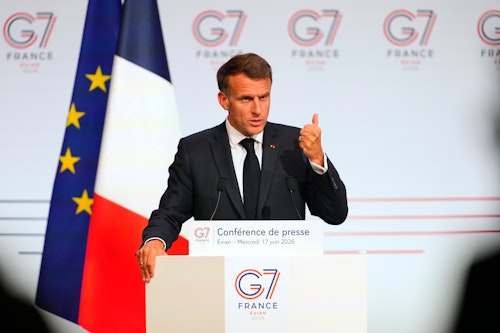
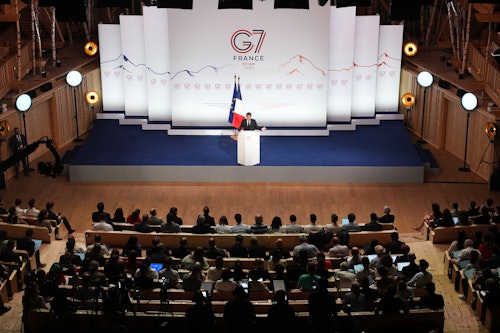
Credit: Associated Press
Social media ban might be easy to circumvent, Meloni warns
Italian Prime Minister Giorgia Meloni has urged caution over proposals to ban minors from social media, warning that such restrictions could be easily circumvented.
Several European countries like France, the UK and Spain are considering a ban for social media use of minors, while a similar bill is also under discussion in the Italian parliament.
Meloni said she was not opposed to such measures, but argued that the priority should be ensuring digital platforms are held accountable.
"This type of bans can be easily circumvented. The risk is that the burden then falls on the families," she said.
Macron defends decision to invite Trump for dinner in Versailles
Emmanuel Macron strongly defended his decision to host Donald Trump for a lavish dinner at the Palace of Versailles on Wednesday, saying diplomacy requires engagement even with leaders with whom one disagrees. The invitation was widely seen as an effort to ensure the US president remained until the end of the G7 summit — which he did.
While acknowledging differences with Trump on European security, Macron said foreign policy could not be conducted solely through "tweets and press releases".
"Let's not be ashamed of who we are. Versailles is a diplomatic instrument and an instrument of power," Macron said.
"By maintaining a firm stance or by re-engaging and offering a warm welcome, I defend the interests of my country. That's what matters. And when I defend the interests of our country, of France, I make it a point to do so by welcoming many people, by ensuring they are kind to us and that, ultimately, they make the right decisions for us. I believe that's what the French people expect of me."
Trump signals possible US weapons manufacturing licence for Ukraine
Donald Trump said his administration would consider allowing Ukraine to manufacture anti-ballistic interceptor missiles under licence.
“They would like to be able to do that. We’ll take a look at it. They have asked about that.”
Trump added that he had held “very good talks with President Zelenskyy and with President Putin”, apparently referring to his phone call with the Russian leader on Sunday.
Asked whether he believed Vladimir Putin bore greater responsibility for the war, Trump declined to answer.
“I don’t want to comment on that because I’m trying to get it settled, and that doesn’t make it easy," he said.
Peace in the Middle East is 'always fragile,' Italy's Meloni warned
Italian Prime Minister Giorgia Meloni warned that peace in the Middle Eastern region is "always fragile," and must be nurtured and protected.
She referenced in particular to the need to see how Iran was sincere in buring the hatch, and the ongoing national debate in Israel, where the tones might be exasperated because of the upcoming national elections.
She singled out Itamar Ben-Gvir, the ultra-nationalist leader and minister for national security, who said Israel should not feel compelled by the US-Iran framework deal.
At the same time, Meloni said that, while the situation in the Gulf might be fragile, the peace process might actually lead to a much more stable situation in the future.
Macron hails 'Évian moment' on Ukraine
Emmanuel Macron has hailed what he calls the "Évian moment" that brought Donald Trump together with Western allies to express support for Ukraine's resistance against Russia.
"President Trump, like all of us, has simply acknowledged that there is no serious willingness on Russia's part today to discuss peace," Macron said in the closing press conference.
"What I can tell you is that there was a turning point, there was definitely an Évian moment regarding Ukraine, and that moment was when everyone listened to President Zelensky's assessment of the situation with great respect, when everyone realised that Ukraine was resisting much better than some had thought, and that Russia was in a difficult position," he went on.
"This is a real change compared to the last few months, not just on the part of the Europeans, but on the part of the G7 members and all those who support Ukraine. So, yes, I firmly believe that this Évian summit represents a profound shift in approach, a willingness on the part of the United States to work with the Europeans in support of Ukraine."
Too early to ask parliament's authorisation for naval mission in Hormuz, Meloni said
Italian Prime Minister Giorgia Meloni said it was too early to ask parliament to authorise participation in a multinational naval mission to secure the Strait of Hormuz once hostilities between the US and Iran end.
She said significant technical work remained before a peace agreement between Washington and Tehran could be finalised, but added that lawmakers would have time to debate any Italian contribution if the proposal moved forward.
"We still have not defined the framework [of the peace agreement], and what the Italian commitment would be in that framework," Meloni said.
Earlier, Foreign Minister Antonio Tajani signalled Rome's openness to joining a French- and British-led naval mission aimed at restoring freedom of navigation through the strategic waterway.
Relationship with Trump is unchanged, Italy's Meloni said
Italian Prime Minister Giorgia Meloni denied her relationship with US President Donald Trump had changed. The two leaders had appeared to reconcile exchanging informally at the margins of the G7 in Evan, after weeks of public fallout caused by the war in Iran.
"We have strong personalities, we defend our national interests strongly," she said, arguing that that meant there was no need to clarify anything nor recriminations, since the two understood each other.
Meloni also said that, while she had been spotted in jokingly exchanges, the discussions that had taken place with Trump had been on serious topics, notably Ukraine, Iran and migration. On all these topics she said there was "convergence" on the substance with the US President.
"There was willingness to work together, which is what matters. And cannot be taken for granted," she added, pointing out that she was already thinking about the next G7, which will be chaired by Washington.
EU peace envoy can't come from large member state, Meloni says
Italian Prime Minister Giorgia Meloni said she does not believe the EU’s peace envoy tasked with negotiating an end to hostilities with Russia over the war in Ukraine should come from a large member state, but rather from a "middle power."
Asked at the press conference concluding the G7 in Evian whether she raised the proposal to appoint someone to represent the bloc in the peace negotiation process, Meloni said she thought that was a matter to be handled in the context of the European Council.
Meloni added that the proliferation of formats does not help, as "none has the authority to speak for Europe as a whole." While not mentioning it explicitly, the reference seems to be to the E3, which recently saw an effort from the UK, France and Germany to spearhead negotiations with Moscow.
"We will put it [the peace envoy proposal] on the table to see if there is convergence on the topic," the Italian PM said, as EU leaders are due to flock to Brussels on Thursday and Friday, with Ukraine looming large on the agenda.
China must curb its subsidies, Macron says
Emmanuel Macron has called on China to tackle the global problems caused by its industrial overcapacity, subsidies and sluggish internal demand.
"The Europeans need to invest more and modernise and simplify their economies, and the United States needs to address the issue of twin deficits. A consensus has emerged around these points in the lead-up to this G7 summit," Macron said.
G7 unity on Russia sanctions is 'extremely important', Macron says
The G7 statement that talks about increasing sanctions on Russia is "extremely important", Emmanuel Macron says in the closing press conference.
"It's the first time we've had such convergence at a G7 and brought such clear conclusions," Macron said.
"For me, this is true progress and is a condition for our collective effectiveness to guarantee the success of the Ukrainian people in this war of resistance."
Antonio Costa initiated diplomatic contacts with Russia
European Council President António Costa has quietly initiated diplomatic contacts with Russia to “open communication channels,” although no substantive issues have been discussed, a senior EU diplomat told Euronews' Maria Tadeo.
According to the diplomat, only "brief contacts" have taken place in recent weeks as the EU prepares to safeguard its interests in any future diplomatic process.
The diplomat added that Costa has been “coordinating closely with European leaders on possible engagement with Russia and the issues to be discussed when the right moment comes.”
The outreach comes amid ongoing discussions in EU capitals about the possible resumption of dialogue with Russia as efforts to end the war in Ukraine continue.
Ukrainian President Volodymyr Zelenskyy has worked to build international backing for negotiations with the Kremlin, while several European figures have been informally mentioned as possible special envoys.
Costa was among the names casually floated as well as Finnish President Alexander Stubb and former German Chancellor Angela Merkel.
"The EU is not a mediator," the official said, stressing that the bloc's role is to support Ukraine's pursuit of a just and lasting peace.
The diplomatic maneuvering comes despite continued obstacles to negotiations, with Russian President Vladimir Putin earlier this month rejecting Zelenskyy's proposal for a face-to-face meeting.
G7 leaders criticise China's 'distortive practices' – without mentioning China
We now have the joint statement dedicated to a "more balanced, durable and resilient growth" endorsed by the G7 leaders.
The text speaks at length about economic imbalances without mentioning the country that Western allies consider the main culprit behind the phenomenon: China. Instead, there are several subtle yet unmissable references to Beijing's state-led, subsidy-intensive model, which is at the root of the ballooning deficit.
"Global imbalances can have adverse economic impacts, especially on the poorest countries, although most of them do not contribute to imbalances," the statement says. "We further acknowledge the importance of coordinated action to reduce growing and persistent global imbalances. Reducing global imbalances could facilitate achieving more durable and balanced growth."
The text calls for "coordinated action" and "specific policies" aimed at addressing these imbalances but does not spell them out. It also urges "countries with large and persistent external surpluses" (meaning China) to strengthen "domestic sources of growth" and avoid "distortive policies with negative spillovers" (meaning subsidies).
AI working lunch is over
The G7's working lunch on AI has finally ended, marking the last session of the three-day summit.
The leaders are now expected to hold press conferences, starting with the host, French President Emmanuel Macron.
G7 calls on 'reliable energy trade' and 'constructive talks'
G7 leaders have urged countries to avoid arbitrary export restrictions and keep trade flowing, particularly in energy markets during periods of geopolitical and economic uncertainty.
To bolster resilience, they pledged to work with the International Energy Agency (IEA) and the Partnership on Wide Energy and Resources Resilience Asia to diversify supply chains, strengthen energy security and coordinate responses to disruptions.
The leaders also encouraged countries to maintain strategic oil reserves equivalent to at least 90 days of imports to help manage future crises and stabilise markets.
"We call for constructive discussions to drive its meaningful reform," the G7 statement said.
G7 leaders announce new critical minerals alliance to tackle China dependencies
In response to China’s dominance of critical raw materials, G7 countries are pursuing a significant overhaul of their critical minerals strategy by launching the Critical Minerals Resilience and Production Alliance.
The alliance aims to support mining, processing, recycling, stockpiling and investment projects in a more diversified and reliable global minerals market, a G7 statement said.
Concerns over concentrated supply chains, export restrictions and economic coercion prompted G7 members to pledge to diversify critical minerals sourcing, strengthen resilience and reduce reliance on any single supplier.
A key target is to reduce dependence on a single external supplier for rare earths and permanent magnets to below 60% by 2030, with the ambition of reaching 50% "as soon as possible".
"We express our grave concerns regarding the use of non-market policies and practices and economic coercion, including arbitrary export restrictions and retaliatory measures on critical minerals and their related dual-use items, all of which undermine economic security and resilience," the statement said.
The goal, the G7 said, is to build more secure supply chains for the technologies that power the digital and energy transitions.
G7, partners call to put children's safety first in online services
The members of the G7, together with Brazil, Egypt, India, Kenya and South Korea endorsed a joint statement asking tech companies to develop and apply age assurance mechanisms and ensure that children's physical and mental safety remains a central consideration in the design of digital services.
"We call on digital service providers to develop and apply technology and systems that ensure safe, secure and age-appropriate experiences including through effective and innovative age assurance mechanisms," the statement reads.
The initiative comes as several jurisdictions like Australia, the UK, France and Spain have enacted or are working on legislation that would introduce a ban on social media usage for minors, with the EU also considering to propose a ban by this summer.
The statement points also to the risks of AI for children, in particular in relation to conversational chatbots and the synthetic generation of child sexual abuse material. The latter is set to be banned in the EU with a soon to be passed revision of the AI Act, the bloc's flagship law.
Iran pledges no nuclear weapons as US commits $300bn, leaked deal draft shows
Iran has pledged never to produce nuclear weapons and to immediately begin reopening the Strait of Hormuz, while the US agreed to a set of financial incentives, including lifting of sanctions and a reconstruction fund worth $300 billion (€258.5bn), according to a 14-point document that appears to lay out the full terms of the US-Iran framework deal.
The draft's veracity, made public by Arabic-language media in parallel, has not yet been officially confirmed by either Washington or Tehran. It also remains unclear whether the draft that circulated at G7 meetings will be the version formalised at a ceremony on Friday.
US President Donald Trump appeared irritated by the leaks, telling reporters on the margins of the G7 that "no one knows what it (the deal) is, but it will be very strong". He also warned that if Iran does not comply with the terms, the US would get "back to bombing."
Sources speaking to Euronews said that the US delegation shared the contents of the memorandum of understanding with the other G7 leaders. One diplomat described it as a roughly two-page document that could serve as the basis for a deal.
At the G7, Trump reiterated that the reopening of the strait would take place on Friday, coinciding with the ceremony in Lucerne, Switzerland. US Vice President JD Vance, rather than Trump, is expected to attend.
G7 leaders insisted in a joint declaration that full freedom of navigation must be restored.
Read the full story by Maria Tadeo.
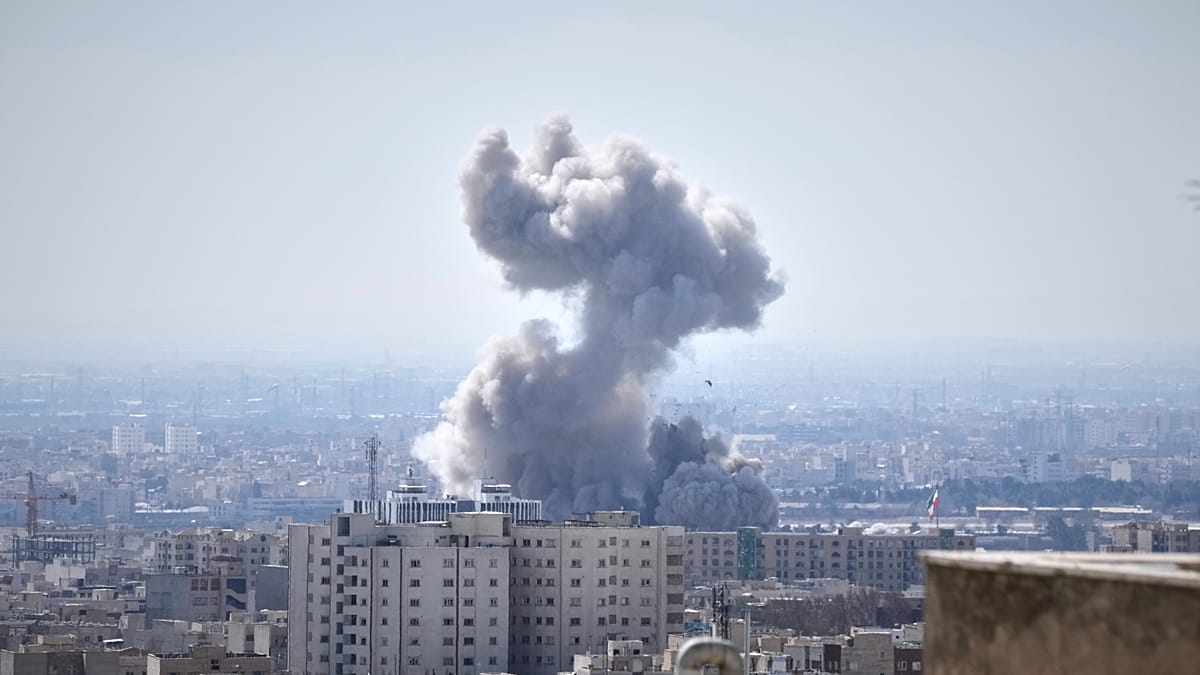
Iran pledges no nuclear weapons as US commits $300bn, deal draft shows
The full US-Iran framework deal to end the war, as circulated during the G7 summit, would see Iran abandon its pursuit of a nuclear weapon in exchange for fina…
Trump-Zelenskyy bilateral hangs in the balance
Euronews is reporting live from the G7 summit in Evian, which is winding-up on its final day. One of the biggest questions hanging over today – and, arguably, the entire three days – is whether US President Donald Trump will meet Ukrainian President Volodymyr Zelenskyy for a one-on-one meeting.
While US political sources we spoke to have sounded a cautious note over this, nothing has been yet been ruled out. With hours still left of the summit before leaders leave in their helicopters and motorcades, there remains uncertainty over the bilateral meeting.
Von der Leyen calls to 'deepen' relationship with the US on AI
European Commission President Ursula von der Leyen called for the EU and US to "deepen" their relationship on AI during a working lunch at the G7, saying the two blocs have "complementary strengths."
"Frontier models developed by the US have unprecedented capabilities and the EU is developing a vibrant innovators ecosystem and becoming a leading market for the adoption of industrial AI," she said.
Von der Leyen said that "the US and EU need to be strong partners in AI," adding, "it is in our mutual interest."
The remarks come after the US government last week issued an export control directive banning foreign nationals from accessing Anthropic's most advanced AI models, citing national security concerns.
NATO commended allies for increasing contributions, Rutte says
Speaking at a press conference in Brussels ahead of a meeting of NATO defense ministers, Mark Rutte welcomed the decision by several alliance members to increase their defense contributions after the United States scaled back its defense expenditure.
“Some areas will require more work, but the overall picture is looking good," Rutte said.
US kill switch looms large on G7 AI talks
The Trump administration's decision to cut off all foreign nationals from Anthropic's most advanced models is set to cast a gloomy shadow over the G7's discussion on artificial intelligence.
The export controls appear to confirm Europeans' worst fear: that American technology comes with a "kill switch" Washington can flip overnight, shutting out enemies and allies alike.
The European Commission, while acknowledging the challenge posed by the disruptive technology, has called for restrictive measures not to discriminate against "trusted partners," a call likely to be echoed by other G7 members.
The episode is set to give fresh momentum to the EU's tech sovereignty agenda, as Brussels confronts a stark reality: dependence on American technology means accepting that access can be revoked at Washington's discretion.

Western fears over Trump’s AI ‘kill switch’ become reality at G7
Western allies arrived at the G7 AI summit unsettled after the Trump administration cut off foreign access to Anthropic’s most powerful models, confirming Euro…
G7 leaders start working launch on AI with top execs
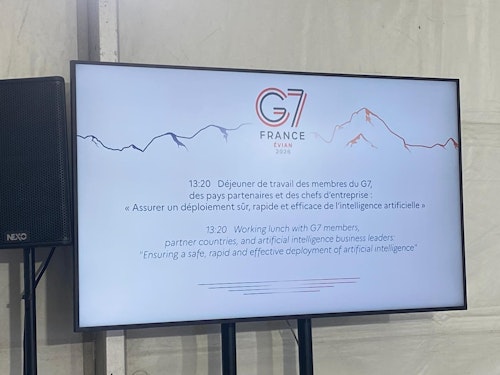
G7 leaders have begun a working lunch on "ensuring a safe, rapid and effective deployment of artificial intelligence."
The lunch includes business leaders from leading AI companies, namely:
US: Sam Altman (OpenAI), Demis Hassabis (Google DeepMind), Dario Amodei (Anthropic), Alex Wang (Meta), Marc Benioff (Salesforce)
France: Arthur Mensch (Mistral AI)
UK: Victor Riparbelli (Synthesia)
Canada: Aidan Gomez (Cohere)
Germany: Robin Rombach (Black Forest Labs),
India: Pratyush Kumar (Sarvam AI)
Japan: Ren Ito (Sakana AI).
Italy: Uljan Sharka (domyn)
NATO backs EU naval mission to restore free navigation in Strait of Hormuz, Rutte says
NATO secretary general Mark Rutte welcomed the US-Iran agreement aimed at ending the war in Iran, saying the expected reopening of the Strait of Hormuz was a "massive" step forward.
“The restoration of free passage through the Strait of Hormuz will be a massive step forward, and I know that many allies, through the initiative led by France and the United Kingdom, are ready to support,” Rutte told a press conference in Brussels.
Delays mount at the final day of the G7 summit
Euronews is on the ground for the final day of the Evian G7 summit, where our news teams are waiting for those final press conferences from French President Emmanuel Macron and US President Donald Trump, among others.
But before that, we are anticipating the start of what was supposed to be a 12:30 p.m. working lunch focussed on artificial intelligence. At the time of writing, this meeting has been delayed by at least an hour, with the informational television screens still not updated.
Euronews has asked around in the international media tent for insights as to why these meetings cannot run on time. Asked why Trump was an hour late to this morning's first sessions, US journalists have shrugged.
Final G7 press conferences likely to be delayed
French President Emmanuel Macron's 3pm press conference is likely to be pushed back by an hour due to the overall delayed schedule, officials have said.
It is also expected to push US President Donald Trump's scheduled 4pm press conference to 5pm.
'France has done a fantastic job,' Trump pats Macron over G7 summit
US President Donald Trump praised the organisation of the G7 summit in Évian-les-Bains during a joint press appearance with Egypt's President Abdel Fattah el-Sisi.
"It's been a great summit. France has done a fantastic job. President Macron has really done a great job," Trump said.
The remarks came on the final day of the three-day gathering of G7 leaders — the last such summit Macron will host before France's G7 presidency rotates to another member state.
Trump hails 'very successful trip' at the G7
Donald Trump just told reporters that he had a "very successful trip" at the G7.
"It's been a great summit," he said, beaming.
Ahead of the G7 meeting, some onlookers had expressed concern that splits would flare during the three-day summit, as sessions spanned Russia's invasion of Ukraine, the fighting in Iran, as well as artificial intelligence.
At the press conference, Trump said he would head to Paris later on Wednesday, where he is expected to be hosted by G7 summit host French President Emmanuel Macron, before a visit to the Palace of Versailles to commemorate the US' 250th birthday.
US will bomb Iran again 'if I don't like' final deal, Trump says
Donald Trump has said the memorandum of understanding with Iran is not a "final deal" and that air strikes will resume if the eventual text falls short of his liking.
"No, it's not final. It's a memorandum of understanding. And if I don't like it, we'll go back to shooting at them, dropping bombs on their heads," Trump said during a bilateral meeting with Egyptian President Abdel-Fattah El-Sisi.
"If I don't like it, if they don't behave, we'll go right back to dropping bombs right smack in the middle of their head, okay? Because they misbehaved for 47 years. All right?"
Trump said the final deal would ensure that Iran "never" obtains nuclear weapons, and "that's very strong".
"Most people seem to be very happy, but who's really happy is the market because the market's gone up thousands of points," Trump said. "The Strait [of Hormuz] is going to be opening. It's already partially opened. It's going to be opening up soon, in full over the next day or two."
Trump added that only "stupid people" wanted to have a "worldwide depression" caused by a prolonged blockade of the waterway.
Trump says 'I’m the boss’ as he enters G7 chamber
Donald Trump quipped, "I'm the boss," as he walked in late to the G7 summit in Evian. The other leaders, already seated and waiting, laughed, while French President Emmanuel Macron, chairing the session, stood up to greet him.
Trump also joked with press photographers before the start of the session, asking them, "Would you like to stay for the meeting?"
Trump has a reputation for arriving late at G7 summits and has, at least twice in the past, quit the meetings early.
"I'm the boss"
— euronews (@euronews) June 17, 2026
US President Trump jokes he's 'the boss' on arrival for first meeting of final day at G7 summit pic.twitter.com/m5402VIeSo
Trump and Meloni reconcile after weeks of public spats
US President Donald Trump and Italian Prime Minister Giorgia Meloni have been seen in friendly exchanges following weeks of public sparring that had strained relations between the two allies.
The two leaders had a public fallout as the Iran war triggered an economic shock across Europe, with Italy one of the countries hardest hit by soaring energy prices.
"You're friends again," European Council President António Costa was overheard saying in a hot mic moment. "We have always been friends," Meloni replied. The two leaders had earlier spoken on the sidelines of the G7 to clear the air.
Rome is also reportedly preparing to buy more US liquefied natural gas (LNG) and join the international mission to secure the Strait of Hormuz, while seeking stronger American support for Ukraine.
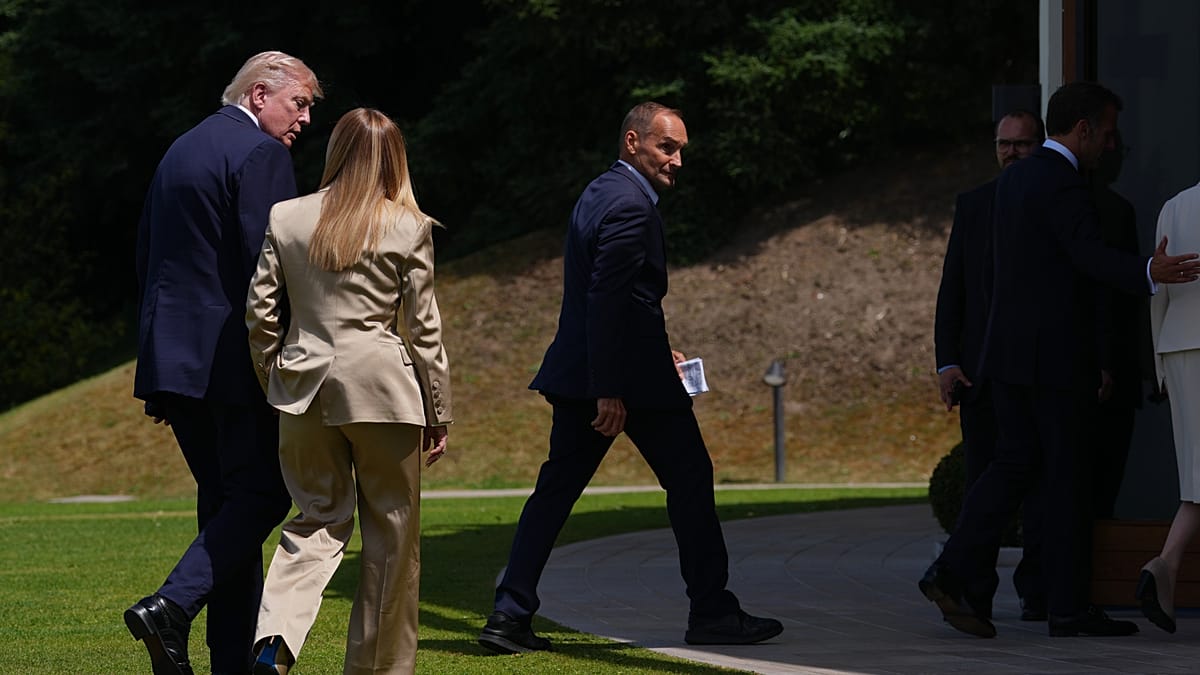
‘We have always been friends’: Trump and Meloni make amends at G7
Trump and Meloni made amends at the G7 in Evian, joking about their recent spat over the Iran war. “We have always been friends,” Meloni said. #EuropeNews
Brussels welcomes Trump's sanctions U-turn
Officials and diplomats in Brussels have welcomed Donald Trump's indication that the US will "soon" reinstate sanctions on Russia oil once the deal with Iran is signed and the Strait of Hormuz reopens.
The White House has so far issued three consecutive sanctions waivers, causing outrage among Ukrainians and Europeans.
"It is the moment to continue putting pressure on Russia and that's what we're working towards," a spokesperson for the European Commission said on Wednesday afternoon, citing the G7 joint statement.
A senior diplomat also celebrated Trump's U-turn and urged the US to align its price cap on Russian oil ($60 per barrel) with that of Europeans ($44 per barrel). The cap is a G7 initiative.
"If the US wants to put the price cap lower, that would very good. The lower the better, so that the economic noose around Russian neck is tighter and tighter," the diplomat said.
US growth outperforms G7 partners despite trade policy overhaul
The April forecast of the International Monetary Fund shows that US GDP growth is expected to outpace that of the other G7 countries in 2026, with growth projected at 2.3% for the United States, compared with 1.5% for Canada, 0.9% for France, 0.8% for Germany and the UK, 0.7% for Japan, and 0.5% for Italy.
These figures come despite the US protectionist trade policy introduced after Donald Trump's return to power in 2025. According to analysts, US companies did not accept lower margins resulting from taxes on foreign components and instead increased investment.
Changes in the US energy market also help explain this growth trajectory, as US shale production has shielded the American economy from the effects of the Middle East crisis.
Meanwhile, EU countries were much more affected by the supply shock triggered by the Iran war and its economic consequences for the Gulf countries.
G7 statement includes line on Taiwan
Let's take another look at the joint statement on geopolitical issues that G7 leaders agreed on overnight.
Towards the end, the text includes one paragraph that touches upon Taiwan: "We highlight the importance of a free and open Indo-Pacific based on the rule of law. We reaffirm our opposition to any unilateral attempts to change the status quo, in particular by force or coercion, in the East and South China Seas and across the Taiwan Strait, which should only be resolved peacefully through dialogue."
This is significant at this moment. Last month, Donald Trump made several comments about Taiwan, a self-ruling island that Beijing claims as part of its territory, that raised speculation about a potential change in Washington's One China policy, which has been a matter of bipartisan consensus since the 1970s. The US acknowledges but doesn't recognise China's claim over Taiwan, leaving the status of the island deliberately undefined. This has often been described as a "strategic ambiguity".
Despite Xi Jinping's attempts to extract new wording from Trump during their bilateral summit in May, the G7 statement indicates continuation with the long-standing stance of Western allies.
Will Europeans turn hawkish on China?
Europe is among the regions hardest hit by Chinese overcapacity among the G7 economies.
The US protectionist trade measures have prompted China to reroute exports to the EU, which is being flooded with low-cost products from the Asian giant. Its trade deficit with China has reached a record €1 billion a day.
Shortly after the G7, EU leaders will gather in Brussels for a summit that will partly focus on China. Some officials are urging tougher action against what they describe as China’s unfair trade practices, including the dumping of heavily subsidised goods.
In a non-paper published at the end of May, France, Italy, Spain, the Netherlands, Poland and Lithuania called on the EU to strengthen its trade defence instruments.
"We're not naive anymore. China's five-year plan is an attack on our market," said a senior diplomat. "We have to be firm in our reaction. The cost of action will be less than the cost of inaction."
However, EU member states are not united in taking a hardline stance. Germany has maintained an ambivalent position, even as its trade deficit with China widened, according to data released last December. Spain—another major economy keen to attract Chinese investment—stated after the publication of the non-paper that it did not back it politically.
Trump's tardy arrival
US President Donald Trump has just turned up at the final day of the G7 talks.
The Republican leader made his Wednesday debut at the Hôtel Royal an hour later than intended, with the working session on "promoting balanced, shared and sustainable economic growth" kicking off at 10:30 a.m. instead of the 9:30 a.m. scheduled start.
Before his arrival, the other G7 leaders and guests could be seen sitting around the table, eagerly waiting.
Trump has a reputation for not totally adhering to the strict timings of the G7 summits, and has, at least twice in the last six years representing Washington, departed the meetings early.
G7 works on economic imbalances amid Chinese overcapacity concerns
The G7 leaders are working this morning on economic growth under the theme "Promoting balanced, shared and sustainable economic growth", alongside participants from the IMF and the OECD.
China remains the primary concern. Its impact on global growth is growing as Beijing’s export-driven economy, which depends more on external demand than domestic consumption, contributes to global imbalances. China is also accused of unfair trade practices, with the OECD writing in a recent report that it subsidises its products up to eight times more than OECD countries.
Last week, the G7 held a video conference with China to discuss those issues. Participants in the call concluded that some countries produce or export too much, others consume too much and produce too little, while still others save too much without producing enough.
“We need to rebalance all of this, and we must do so because we share the view that these macroeconomic imbalances are dangerous,” an Elysée source said.
After the G7, work should continue on this issue within the G20, which includes China, and with the assistance of the IMF.
China will also be on the agenda of EU leaders during a summit at the end of this week, as the EU’s trade deficit with China has reaches a record €1 billion a day.
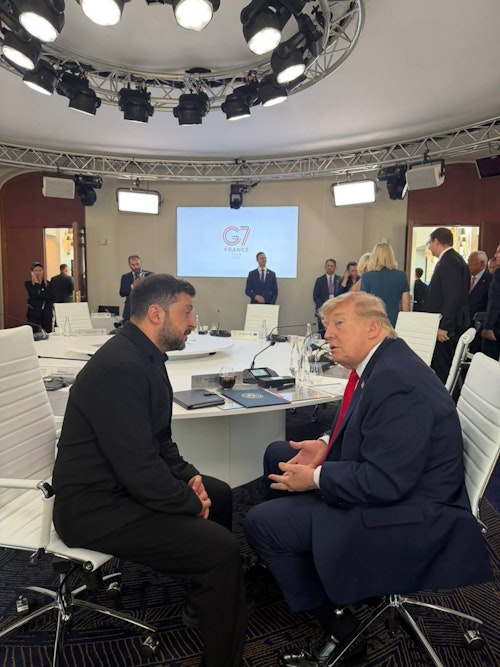
Is Zelenskyy-Trump meeting possible today?
As the G7 leaders endorsed a joint statement expressing "unwavering support for Ukraine in defending its freedom, sovereignty, and territorial integrity,” the question remains if Volodymyr Zelenskyy and Donald Trump will have a bilateral meeting in Évian-les-Bains on the final day of the summit.
There were expectations that the two leaders might meet on Tuesday, but apart from a brief exchange during a working session on Ukraine, no meeting appeared to take place.
Zelenskyy said the conversation was constructive, while Trump for the first time stated that Russia - and not Ukraine - should make a deal.
Ukraine’s state broadcaster, Suspilne, reported that a meeting between the two presidents could take place on Wednesday.
Regarding his agenda, Trump is expected to attend a dinner hosted by Emmanuel Macron at Palace of Versailles on Wednesday evening marking the 250th anniversary of the United States.
Meanwhile, Zelenskyy’s next scheduled engagement appears to be the EU summit in Brussels on Thursday.
German and Ukrainian defence companies to develop anti-ballistic air defence systems
The German defence company HENSOLDT and Ukrainian Fire Point have signed a memorandum of understanding to develop a ground-based air defence system capable of detecting and intercepting ballistic missiles.
According to HENSOLDT's announcement, the German company is responsible for the production, testing and supply of radar systems for the missile defence system and will oversee their integration into the system.
Ukrainian company Fire Point will act as the prime contractor and take responsibility for the design of the missile defence system. Fire Point will test and supply its FP-7 missiles, including launchers and system control equipment.
For months Volodymyr Zelenskyy has been calling on European countries to produce their own anti-ballistic missiles. He insisted that Ukraine could produce anti-ballistic missiles for the whole of Europe, but that the delay was currently due to a lack of licences from the US.
Iran to renounce to nukes in exchange for lifting sanctions, deal with US shows
Iran agreed to never produce nuclear weapons in exchange for the lifting of all kinds of sanctions, according to points underpinning the framework agreement with the United States circulated at the margins of the G7.
The points are part of a memorandum of understanding the Washington and Tehran are expected to sign in Switzerland on Friday, and that will need to be finalised with a peace deal within a 60-day window, extendable by mutual consent.
The signature of the memorandum entails an immediate and permanent end to the war on all fronts, including Lebanon, where Israel's intervention against Iran's proxy Hezbolla is still ongoing. The US and Iran would commit to respect each other's sovereignty, reinstate the freedom of navigation in the Strait of Hormuz, remove all types of sanctions currently facing Iran and unfreeze its assets.
The UN Security Council would have to green light the final agreement with a binding resolution.
China is on the agenda today. Will G7 leaders manage to build a common front?
After last night's joint statement, G7 unity will face a new test today.
The first working session of the third and last day of the G7 summit is a much-anticipated discussion on economic imbalances, with a particular focus on the country that Western allies consider the main culprit behind the crippling phenomenon: China.
Ursula von der Leyen, the president of the European Commission, has warned of a "new China shock" triggered by the glut of low-cost, highly subsidised goods coming from Beijing's state-led economy, which has turned heavily to global exports. Fears of de-industrialisation have gone from abstract to tangible in a short span of time.
While officials admit the grim diagnosis of the problem is widely shared around the table, the prescribed medicine is still under discussion. Europeans will keep an anxious eye on US President Donald Trump, whose stance on Beijing has considerably softened since his much-publicised summit with Xi Jinping in May.
Russia attacked Ukraine overnight with 119 drones
As G7 leaders and Volodymyr Zelenskyy met in Evian to discuss efforts to push Russia toward negotiations, Moscow carried out new strikes on Ukraine.
Russian forces launched at least 119 drones against Ukrainian cities overnight, and 97 UAV’s were intercepted by Ukraine’s air defence forces.
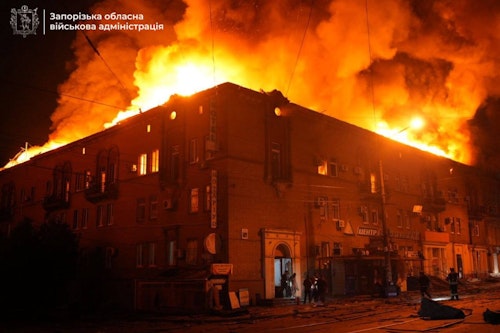
Late on Tuesday night Moscow also attacked the Southeastern city of Zaporizhzhia, killing one person and injuring at least seven others, regional authorities said.
Regional police said Russian forces directed dozens of Shahed drones toward residential areas of the city.
The attack damaged civilian sites, including homes and part of Zaporizhzhia's National University, according to authorities.
Kyiv welcomes ‘new steps to support Ukraine and increase pressure on Russia’
Ukraine’s foreign minister Andrii Sybiha said Kyiv welcomes “the strong G7 statement with new steps to support Ukraine and increase pressure on Russia.”
“G7 once again proves that the world’s strongest democracies stand united with Ukraine and are committed to restoring comprehensive, just and lasting peace for Ukraine.”
In a post on X he also pointed out at the G7 leaders’ readiness to “take concrete steps toward strengthening Ukraine’s defence capabilities, air defence, and energy resilience, as well as tightening sanctions against Russia.”
“While Russia shows no willingness to engage in good-faith diplomacy, the available leverage needs to be used to finally bring it to the negotiating table.”
Following President @ZelenskyyUA’s work at the summit in Evian yesterday, we welcome the strong G7 statement with new steps to support Ukraine and increase pre…
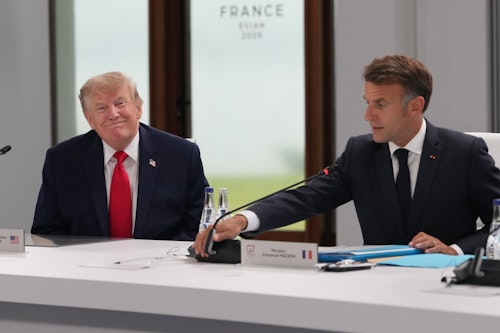
Joint statement is a diplomatic victory for Macron at his last G7 summit
Ahead of this G7 summit, European officials sounded pessimistic about the prospect of releasing a joint statement addressing the wars in Ukraine and Iran, two contentious issues that have often divided the allies, with the United States on one side and the others (the G6) on the other. Last year in Canada, disagreements prevented agreement on common wording for geopolitical matters.
However, momentum began building throughout Tuesday, and negotiators aptly seized the momentum to release a three-page statement on "geopolitical issues" overnight, as we've just reported.
For Europeans, having Donald Trump sign up to a text that promises to increase support for Ukraine and sanctions on Russia is, in and of itself, a major diplomatic victory. The win is particularly sweet for the host, French President Emmanuel Macron, who is taking part in his last G7 summit before leaving office next year.
Credit: Associated Press
G7 leaders 'ready to consider' extending military production licenses to Ukraine
G7 leaders are "ready to consider" issuing military production licenses to Ukraine and have agreed to increase arms deliveries, according to a joint statement released yesterday evening.
"We commend Ukraine for its resilience and progress on the battlefield in recent months and emphasise there is now a new momentum. To support and accelerate this new momentum, we agree to increase the delivery of air defence capacities, additional systems and interceptors, and long-range capabilities," the statement said.
"We are also ready to consider extending to Ukraine the benefit of licenses to allow for an increase in Ukraine’s military production."
Kyiv wants to be able to manufacture interceptors for anti-ballistic Patriot systems in Ukraine and Zelenskyy confirmed on Tuesday that he had once again raised the issue with US president Donald Trump at the G7 summit.
The Patriot air defence system remains the only surface-to-air missile system in Ukraine's arsenal capable of countering Moscow's ballistic missile threat. Produced in the United States by Raytheon and Lockheed Martin, Patriot missile systems have become a cornerstone of air defence for many US allies, particularly in the Gulf region, as well as for Ukraine.
G7 leaders agree on weapons for Ukraine, ramp up pressure on Russian economy
G7 leaders adopted a joint statement last night expressing "unwavering support for Ukraine in defending its freedom, sovereignty, and territorial integrity."
The leaders praised Kyiv for the new momentum it has built on the battlefield, and pledged to back it with increased deliveries of air defence systems, additional interceptors, and long-range capabilities.
The recent US-Iran framework deal has added momentum to efforts aimed at constraining Russia’s war-financing capabilities, with leaders pledging tougher sanctions on its energy sector.
The statement commits the G7 economies to backing Ukraine through the coming winter, when Russia has typically targeted the country's energy infrastructure during periods of extreme cold.
Welcome back to our G7 live blog
It's the third and final day of the G7 summit in Évian, France.
The agenda is lighter today, with just three main events:
- A working session in the morning focused on "Promoting balanced, shared and sustainable economic growth"
- A working lunch about "Ensuring a safe, rapid and effective deployment of artificial intelligence"
- A press conference with the summit's host, French President Emmanuel Macron, in the afternoon
Stay tuned for updates on our live blog!