




























Spain confirms one new hantavirus case amongst evacuees as passengers remain under watch across Europe.
There is "no sign" of a larger hantavirus outbreak following the evacuation of the last passengers from a disease-stricken cruise ship, the director of the World Health Organization (WHO) said on a press conference on Tuesday.
 ADVERTISEMENT
ADVERTISEMENT
ADVERTISEMENT
As of Tuesday, 12 May, the WHO has identified 11 cases, nine of them confirmed, and three deaths, all among passengers of the cruise.
The last case is among the Spanish passengers quarantined in the Gómez Ulla Central Defence Hospital in Madrid, the Spanish Health Ministry confirmed on Tuesday.
"Yesterday, the patient presented with low-grade fever and mild respiratory symptoms; however, they are currently stable with no evident clinical deterioration," the Ministry confirmed on a post on X.
The other 13 Spanish passengers have tested negative for hantavirus.
The United States announced on Monday, following the evacuation from the ship, that one passenger is currently experiencing mild symptoms and another passenger tested mildly PCR positive for the Andes virus.
In a second test on Tuesday, the US passenger tested negative, the Spanish Health Ministry added.
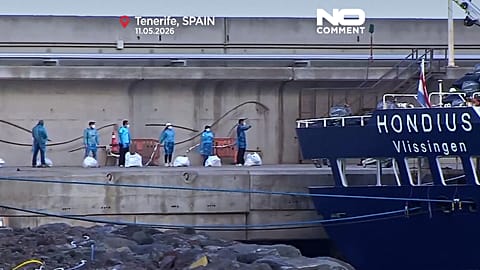
Spain's Prime Minister Pedro Sánchez on Tuesday defended his administration's handling of the hantavirus outbreak detected on the MV Hondius cruise ship, which on Monday was forced to dock in the port of Granadilla, in Tenerife.
Sánchez called the operation a "success" during a press conference he attended together with the director general of the World Health Organization (WHO), Tedros Adhanom Ghebreyesus.
The WHO chief thanked the Spanish leader "not only" for having complied with "Spain's legal obligations under international law", but also for "exercising his moral duty". His moral duty to show solidarity with the boat's passengers".
The head of the WHO stressed the difficult situation for both the passengers and the crew of the cruise ship, who had been locked aboard the vessel for days, and assured that, while he understood "the concern" of the Canary Island people, not to have allowed them to evacuate would have been "inhumane".
A 'successful' operation
"It is a source of pride to be Spanish," Sánchez said, who stressed that the response to the outbreak was part of both a legal responsibility and a moral obligation.
Tedros thanked Spain and Prime Minister Pedro Sanchez for the leadership and coordination.
"I know this is a model, and I hope other countries also learn from this. Not just the obligation part, but the compassion and solidarity that Spain has shown," he added.
The director general insisted that the priority continues to be health surveillance, and avoided entering into a new confrontation with the president of the Canary Islands, Fernando Clavijo.
In this regard, he stressed that the government will remain "attentive to the development of the disease" and defended the protocol applied, based, he said, on successive PCR tests on passengers and crew members, as a guarantee to "protect the health of Spaniards".
Nothing indicates a 'major outbreak'
There have not been any registered deaths since 2 May, when the WHO was notified of the outbreak, Tedros said.
“There is nothing that indicates that there will be a major outbreak,” WHO President Tedros Adhanom Ghebreyesus said in a press conference in Spain on Tuesday.
He explained, however, that the situation can change, and due to the long incubation period of the hantavirus, more cases may arise in the coming weeks.
“All suspected and confirmed cases have been isolated and managed under strict medical supervision, minimising the risk of further transmission,” he said.
The WHO's recommendations include strict supervision at home or in a quarantine facility for 42 days, starting to count from 10 May.
However, Tedros added that each country has the sovereignty to adapt these recommendations to its national context.
This story has been updated with the latest case numbers from Spain.