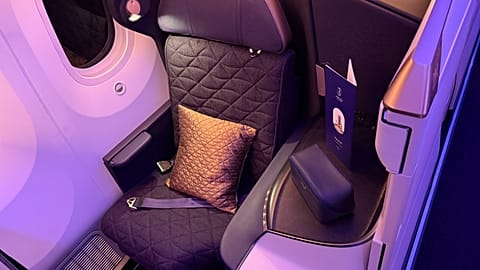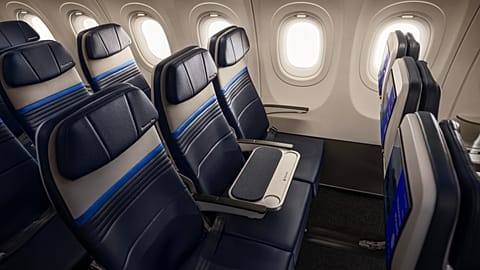






























A look at some of the proposed in-flight concepts and technologies that could soon take the air travel experience to new heights.
Let’s be honest, flying is not as fun as it used to be. Thanks to the airport queues, departure delays and ticket prices, travelling by aircraft brings more stress than excitement ahead of a well-deserved trip.
 ADVERTISEMENT
ADVERTISEMENT
ADVERTISEMENT
While the short-term future of flying is up in the air right now, due to ongoing jet fuel and border control issues, in the long-term passengers can look forward to new in-flight concepts that are set to improve the overall experience.
From wraparound entertainment screens to work pods and economy beds, Euronews Travel looks at some of the airline innovations that are set to take off in air travel.
Immersive in-seat entertainment
One of the most futuristic airline seat concepts recently unveiled was the “Origin” by RAVE Aerospace and Safran Seats at the Aircraft Interiors Expo in Hamburg.
Offering a glimpse at how premium cabins could evolve, the “Origin” concept centres on a wraparound U-shaped micro-LED screen that turns the suite into an immersive entertainment and wellness space, with passengers able to tailor digital landscapes, lighting and mood onboard.
The design also includes headset-free audio, climate-controlled seating and adaptive cushions aimed at improving comfort on long-haul flights.
Double-level aircraft seats
Spanish startup Chaise Longue’s latest double-level aircraft seat concept aims to bring a more premium-style experience to economy, using vertical cabin space to increase personal room rather than add density.
Unveiled at the Aircraft Interiors Expo, the design offers generous recline, expanded legroom for lower-level passengers and greater privacy through staggered seating.
Creator Alejandro Núñez Vicente says the concept has evolved toward premium economy, with testing suggesting strong passenger interest in a layout designed to mimic some of business class’ comfort.
Work from a ‘phone booth’ pod
Boeing’s new “phone booth” pod imagines a new kind of shared in-flight space, turning underused cabin areas into private mini work lounges.
Unveiled as part of Boeing’s E-Lounge concept at the Aircraft Interiors Expo, the enclosed pods are designed for video calls, focused work or quiet breaks away from the seat, with sound-dampening walls, integrated lighting, charging ports and compact desk space.
Boeing says the concept responds to the rise of high-speed onboard connectivity, offering airlines a potential “third space” between seat and galley as cabins evolve beyond traditional layouts.
First class suites with private bathrooms
Emirates is looking to up the comfort in ultra-luxury air travel with plans for first class suites featuring private en-suite bathrooms, a concept teased by airline president Sir Tim Clark as part of its ongoing premium cabin evolution.
Few details have been revealed, but if realised, it could mark a commercial aviation first at scale, building on Emirates’ onboard shower spas and fully enclosed suites.
Neighbour-free seats
Maybe it’s me, but hearing the “all passengers have now boarded” announcement and seeing that middle seat with no one in it might just be one of travel’s best “wins”.
Having that extra seat gives you the room to spread out and get comfy, and airlines are listening to their passengers by offering the service as an extra.
Earlier this year, Hungarian low-cost carrier Wizz Air launched “Wizz Class”, which offers premium passengers add-ons including a neighbour-free seat.
Passengers who choose to purchase Wizz Class are assigned an aisle or window seat and can block off the middle seat (either B or E) beside it. Other perks include extra leg room seats, priority boarding, two items of cabin baggage, and a snack and non-alcoholic drink on board.
Another European carrier offering a similar scheme is Air France with its “Empty Seat - My Extra Space” option, which allows passengers to privatise up to three adjacent seats.

United’s ‘relax rows’
In March, United Airlines became the latest carrier to appeal to economy class customers who will pay extra for comfort but aren’t willing to upgrade to business or first.
With the launch of its “Relax Row”, from 2027 passengers will be able to book out three adjacent economy seats, each of which comes with a leg rest that can be raised to create a lie-flat space.
You’ll then be given a mattress pad to convert the area into a bed, alongside a blanket and two pillows (plus a plushie, if you’re travelling with kids).
Long-haul ‘bunk beds’
Air New Zealand is taking long-haul economy comfort further with the launch of “Skynest”, a world-first sleep concept featuring six bunk-style pods that passengers can book in four-hour slots.
Set to debut on ultra-long-haul flights between Auckland and New York from November, the lie-flat pods build on the airline’s pioneering "Skycouch" concept.
Designed for economy and premium economy travellers, Skynest reflects growing airline interest in adding wellness-focused spaces beyond the traditional seat.
Bookings for the Skynest will open from 18 May, with a four-hour session priced from NZ$495 (€248).

Stretch out with extra legroom
Extra room to stretch out is another much-wanted flying perk and easyJet recently announced new lighter seats that should offer up to two inches of additional legroom.
The British low-cost carrier, which is the second biggest in Europe, will be rolling out Kestrel economy seats across its future Airbus A320neo and A321neo fleet from 2028.
According to the manufacturer, Mirus Aircraft Seating, the “ergonomic design allows passengers to enjoy improved legroom without changing seat pitch itself”. The seat is “pre-reclined”, meaning you get extra knee and shin clearance.
In-flight WiFi
With many airlines introducing Starlink’s satellite internet to their aircraft, passengers can stay connected for the duration of their journey, should they choose to.
While in-flight calls may be taking connectivity levels to the extreme, the introduction of speedy WiFi means that high quality entertainment, internet browsing and social media doomscrolling remains at our fingertips. Or you could hit that dreaded deadline and do some work while on the go.
Latvian airline airBaltic became the first to introduce the Starlink service in Europe, starting from February 2025, followed by Air France and SAS later that year.
Lufthansa Group, which includes the flag carriers for Austria, Belgium, Germany, Italy and Switzerland, plans to roll out Starlink across its fleet from the second half of 2026.