

















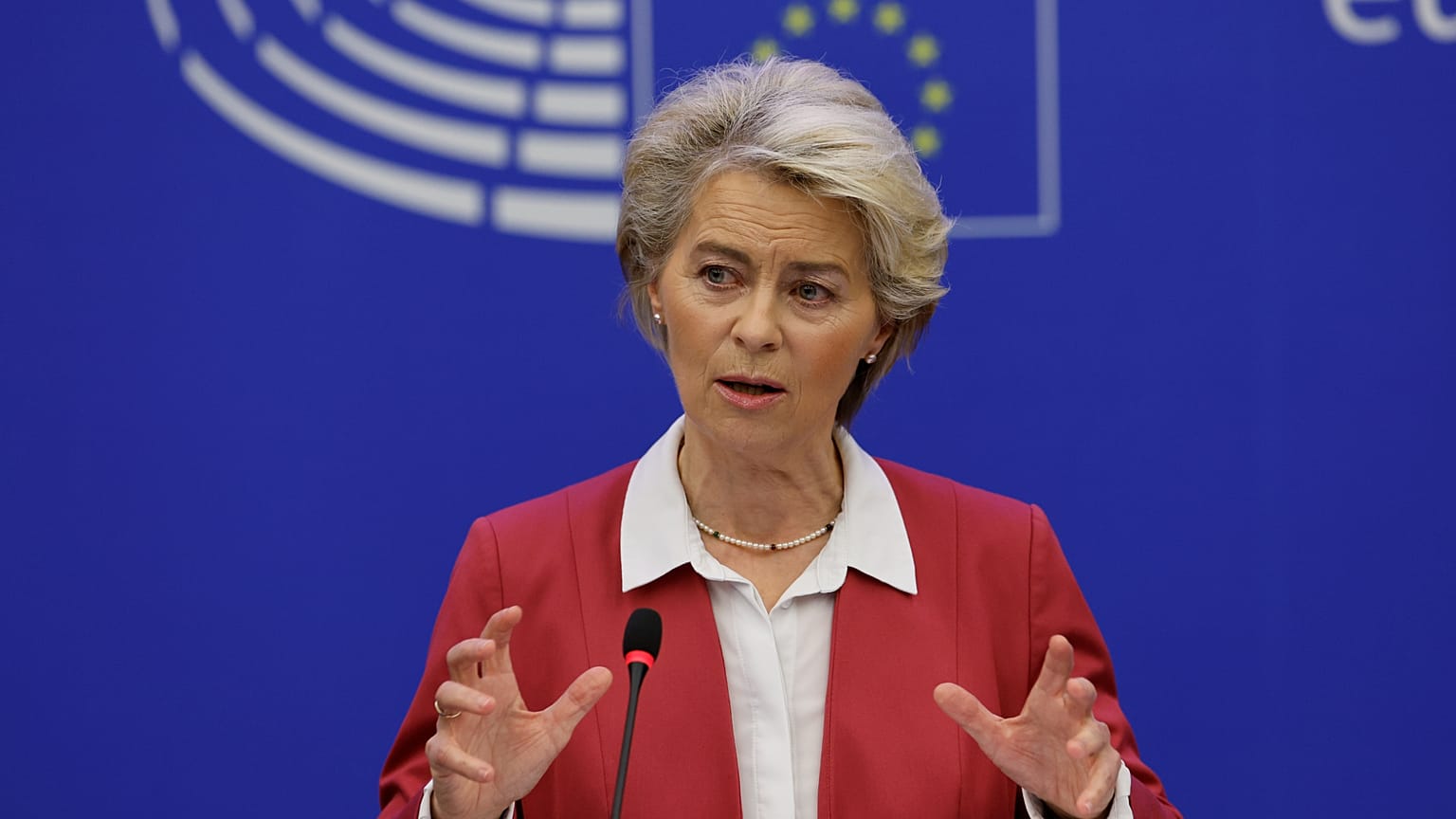













The European Commission unveils new rules known as 'the 28th Regime' or 'EU Inc.' to make Europe more attractive for business and better able to compete globally with powers like China and the US.
The European Commission presented a long-awaited set of digital rules on Wednesday, aimed at facilitating the establishment and operation of businesses in Europe by streamlining procedures, reducing costs, and expediting processes.
 ADVERTISEMENT
ADVERTISEMENT
ADVERTISEMENT
“With EU Inc., we are making it drastically easier to start and grow a business all across Europe", European Commission President Ursula von der Leyen said in a statement on Wednesday.
For the time being, the rules remain optional but could serve to incentivise companies who might have previously moved abroad or based their operations outside the EU.
According to the initial proposal, individuals would be able to start a company in any of the 27 member states in less than 48 hours, fully online and with less than €100.
Von der Leyen highlighted that companies face “more than 60 national company forms,” when attempting to launch a company.
Europe is widely perceived as being less business-friendly due to the fragmentation of its legal framework and complex bureaucracy, with experts regularly warning of the immense administrative barriers for companies to grow.
According to an estimate by the International Monetary Fund (IMF), the barriers in the EU single market represent the equivalent of a 110% tariff on services.
Many years in the waiting
The harmonisation of rules for businesses at the EU level is a long-standing issue.
The 28th regime is not the first attempt by the EU to create a new law for businesses.
"Major reforms that were tried in the past didn’t really work in terms of incentivising enough companies to apply. The system proposed was quite a complex system and in practice, only large companies could really deal with it", Bruegel senior fellow Reinhilde Veugelers told Euronews.
Veugelers refers to the European Company law known with its latin name "Societas Europaea" that entered into force in 2004 with the aim to reduce administrative costs, offers a cross-border legal structure, and helps companies navigate the EU’s different legal systems.
"It completely missed the target in terms of ensuring that we get a much more innovative and competitive European economy, with new companies being able to grow to critical scale sufficiently fast”, the expert said.
Most of the issues regarding corporate laws are connected with member state's reluctance to give up sovereign core issues such as bankruptcies, taxation and employment laws.
For this reason, the 28th regime will not be a legislation replacing national frameworks, but rather an additional regime, the 28th, to provide founders an easier way to open a business.
Wrong target?
In the current proposal all companies, including already existing businesses in Europe, can be eligible for the new regime.
Veugelers assessed this approach as too broad, saying that the legislation should target only new, young companies.
“The target should be young companies with bright new ideas that can truly satisfy the competitiveness of Europe in the longer term, and be able to scale up sufficiently fast", he continued.
Veugelers argues that not limiting it to young innovative companies can overload the system, making it eventually less attractive.
Next steps
The law will be now discussed by the co-legislators, namely the European Parliament and the Council of the EU.
Once they adopt their own position on the file, the three institutions will negotiate a common position, to then publish it as law in the EU’s official gazette.
The Commission has asked the European Parliament and the Council to approve their position on the file by the end of 2026. This is in line with the Commission's goal to have an overall reform of the single market, which they call "one Europe, one market", by 2028.