




























Follow our live blog as we bring you updates for three days of talks on global security, war in Ukraine and the future of transatlantic relations.
World leaders are gathering for the second day of the Munich Security Conference with talks on Ukraine and the future of transatlantic relations high on the agenda.
 ADVERTISEMENT
ADVERTISEMENT
ADVERTISEMENT
In his eagerly-anticipated speech, Marco Rubio said the US wants to "revitalise" its relationship with Europe and that the two blocs should fix what he described as a "broken" status quo together.
But he still stuck to US government lines that the rules-based international order birthed after WWII infringed on sovereignty and led to mass migration, de-industrialisaton and decline which in turn has destabilised Western countries.
His address came after key speeches from European leaders on Friday.
Germany's Chancellor Friedrich Merz painted a stark picture of a world order that "no longer exists" in which the US may have already lost its leadership position, while French President Emmanuel Macron insisted Europe will have to redesign its security framework for a new world and teased a common European nuclear deterrence.
Our Euronews reporters are on the ground in Munich to bring you the latest updates, follow our live blog below.

 ${title}
'I was very much reassured' by Rubio's speech - von der Leyen
Asked what she thought of the speech delivered earlier by US Secretary of State Marco Rubio, the European Commission chief said she was "very much reassured".
She described Rubio as "a good friend, a strong ally" and that she understands that "in the (US) administration some have a harsher tone on this topic, but the Secretary of State was very clear: we want a strong Europe in the alliance and this is what we are working for intensively in the EU
Starmer: Change in EU-UK relations is of 'some urgency'
Starmer says the need to restart the UK's relationship with the EU a decade on from the UK's referendum is of "some urgency" in the context of the Ukraine war.
“This is of some urgency, because I think that on defence and security, until Ukraine conflict we didn’t really wake up the reality that we’re facing,” he says.
Starmer opens door to selective alignment with EU single market
Starmer has gone on to suggest the UK needs to work more closely with the EU, including looking at moving closer to the bloc's single market in selected sectors.
The UK wants deeper cooperation on defence technology and AI to "drive greater coherence and coordination across Europe." He singled out Germany, France, Italy and Poland alongside Norway, Canada and Turkey.
He also picks up on Macron's comments from yesterday about a common European nuclear deterrence.
“For decades, the United Kingdom has been the only nuclear power in Europe to commit its deterrent to protect all Nato members."
"Any adversary must know that in a crisis, they could be confronted by our combined strength,” he said.
'We are not the Britain of the Brexit years anymore,' Starmer says
British Prime Minister Keir Starmer has delivered a message of unity between the UK and Europe, telling the audience that the "Brexit years" are over and that the UK will work primarily with Europe to ensure security.
"In a dangerous world, we would not take control by turning inward; we would not take control by turning inward; we would surrender it and I won't let that happen."
Starmer has been seeing rapprochement between London and Brussels since he took office, with talks on deeper trade, customs and defence accelerating on the 10th anniversary of the referendum that thrust the UK's role in the European Union into turmoil.
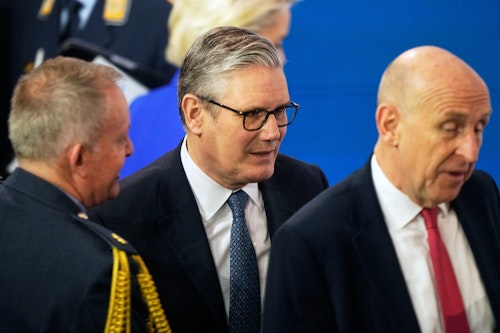
Credit- AP
EU must use qualified majority and partnerships with third countries for its defence - VDL
But the head of the EU executive also stressed that in order to truly be ready to be in position to defend itself, the EU "must make decisions faster".
"And this may mean relying on the result of a qualified majority rather than unanimity. We do not need to change the Treaty for this. We need to use the one we have," Ursula von der Leyen said.
She also called for the bloc to be "creative", notably through partnership with other partners, citing the UK-led Joint Expeditionary Force and the Coalition of the Willing for Ukraine.
"What we need to do now, is formalise the ad hoc beginnings of new security collaborations. This starts by working of course with our closest partners, like the UK, Norway, Iceland or Canada," she said.
"We want to increase our offer to many of these vital partners. This means, in this acutely volatile time, Europe and in particular the UK should come closer together – on security, on economy or on defending our democracies."
Europe's mutual defence clause must be brought 'to life' - VDL
Ursula von der Leyen is now talking defence saying Europe is "delivering" with spending in Europe up by nearly 80% since before the war in Ukraine.
"By 2028, defence investment in Europe is even projected to exceed the amount the US spent on such equipment last year. This is a true European awakening," she added.
But Europe must go beyond just spending, the Commission chief said, and "no taboo can go unchallenged".
"I believe the time has come to bring Europe’s mutual defence clause to life. Mutual defence is not optional for the EU. It is an obligation within our own Treaty – Article 42(7). For good reason. It is our collective commitment to stand by each other in case of aggression. Or in simple terms, one for all and all for one.
"This is Europe’s meaning. But this commitment only carries weight if it is built on trust and capability," she said.
'Europe must become more independent' - Ursula von der Leyen
European Commission President Ursula von der Leyen has now taken to the stage, starting with a simple message: "Europe must become more independent – there is no other choice."
"The European way of life – our democratic foundation and the trust of our citizens – is being challenged in new ways. On everything from territories to tariffs or tech regulations," she said, in a thinly-veiled reference to the US, but also citing Russia's ongoing aggression against Ukraine.
This independence must be wide-ranging and cover areas including "Defence and energy. Economy and trade. Raw materials and digital tech," she said
"Some may say the word ‘independence’ runs counter to our transatlantic bond. But the opposite is true. An independent Europe is a strong Europe. And a strong Europe makes for a stronger transatlantic alliance," she also said.
Rubio on Ukraine
Onto a Q&A, Rubio answers a question on Ukraine.
The Secretary of State skipped an informal meeting on the conflict yesterday which was attended by multiple European leaders.
According to Rubio, the issues between Russia and Ukraine have "narrowed" but "the hardest questions to answer" remain. He pushes back on the idea Moscow is not interested in negotiations.
The US and Europe should continue to take steps to pressure Russia into negotiations, Rubio says, insisting the US has "made progress" in talks.
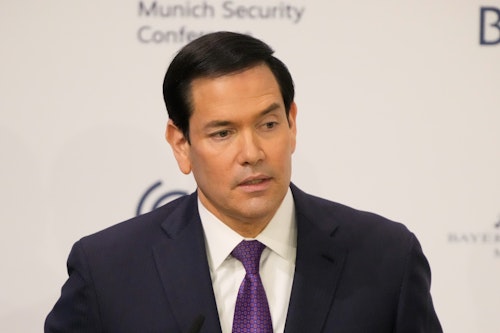
Credit- AP
US wants to 'fix' the status quo, Rubio says
Rubio goes on to offer a brief message of reassurance for European allies, insisting the US does not want to "separate" but to "revitalise" an old friendship.
“In a time of headlines heralding the end of the transatlantic era, let it be known and clear to all that this is neither our goal nor our wish, because for us Americans, our home may be in the western hemisphere, but we will always be a child of Europe.”
He also references NATO troops, saying the US has "bled and died side by side." As a reminder, US President Donald Trump sparked anger in January when he undermined the role of NATO troops in Afghanistan, claiming they "stayed a little off the frontlines."
Rubio: Decline is a choice
Rubio has evoked a parallel between what he says was "decline" rejected after 1945 and should be rejected now as well.
“We do not want our allies to be weak, because that makes us weaker. We want allies who can defend themselves, so that no adversary will ever be tempted to test our collective strength. This is why we do not want our allies to be shackled by guilt and shame."
"We want allies who are proud of their culture and of their heritage, who understand that we are heirs to the same great and noble civilization, and who, together with us, are willing and able to defend it, and this is why we do not want allies to rationalise the broken status quo rather than reckon with what is necessary to fix it."
UN needs urgent reform, Rubio says
According to Rubio, international organisation such as the UN need to be rebuilt and urgently reformed.
The UN, he says, has proven itself "powerless" during key wars in Gaza and Ukraine.
“In a perfect world, all of these problems and more would be solved by diplomats and strongly worded resolutions. But we do not live in a perfect world, and we cannot continue to allow those who blatantly and openly threaten our citizens and endanger our global stability to shield themselves behind abstractions of international law which they themselves routinely violate.”
Rubio: US 'cares deeply' about Europe
Marco Rubio has dedicated some of his speech to underline the close links between Europe and the US, such as "“shared history, Christian faith, culture, heritage, language, ancestry and past sacrifices.”
He lists a number of famous Europeans such as Mozart, Shakespeare and The Beatles as reasons why Europe is special.
He goes on to say, "So this is why we Americans may sometimes come off as a little direct and urgent in our counsel. … The reason why, my friends, is because we care deeply."
"We care deeply about your future and ours, and if at times we disagree, our disagreements come from our profound sense of concern about a Europe with which we are connected, not just economically, not just militarily, we are connected spiritually and we are connected culturally.”
Snap analysis: Rubio's speech
Marco Rubio was supposed to be a nicer, more polite version of J.D. Vance. But so far, his Munich speech reiterates the same points made by the US vice president last year.
In his speech, he is lambasting the outsourcing sovereignty to multinational institutions, a “climate cult” impoverishing people and mass immigration that is a threat to the cohesion of society.
Post-war delusion made by Europe and US, Rubio says
In a speech heavy on history, Rubio continues with explaining that Europe and the US created a "post-war delusion."
“We increasingly outsourced our sovereignty to international institutions, while many nations invested in massive welfare states at the cost of maintaining the ability to defend themselves,” he says, whilst calling a "dogmatic vision of free and unfettered trade," a delusion.
“In a pursuit of a world without borders, we opened our doors to an unprecedented wave of mass migration that threatens the cohesion of our societies, the continuity of our culture and the future of our people,” Rubio says.
Rubio has started his speech referencing the history of the Munich Security Conference.
“We gather here today as members of a historic alliance, an alliance that saved and changed the world. When this conference began in 1963 it was in a nation, actually, it was on a continent that was divided against itself. The line between communism and freedom ran through the heart of Germany."
“At that time, victory was far from certain, but we were driven by a common purpose. We were unified not just by what we were fighting against, we were unified by what we were fighting for,” Rubio says.
“The euphoria of this triumph led us to a dangerous delusion that we entered ‘the end of history’ and every nation would now be a liberal democracy, that the ties formed by trade and by commerce alone would now replace nationhood, that the rules based global order, an overused term, would now replace the national interest, and that we would now live in a world without borders, where everyone became a citizen of the world.”
"This was a foolish idea."
Rubio is speaking
US Secretary of State Marco Rubio has taken the floor. Stay tuned.
Rubio skips Berlin Format talks on Ukraine in Munich
Peace efforts in Ukraine are top of the agenda at this year's conference but at a Berlin Format meeting, attended by leaders from a dozen European countries, US Secretary of State Marco Rubio was a no-show.
My colleague Johanna Urbancik has more.
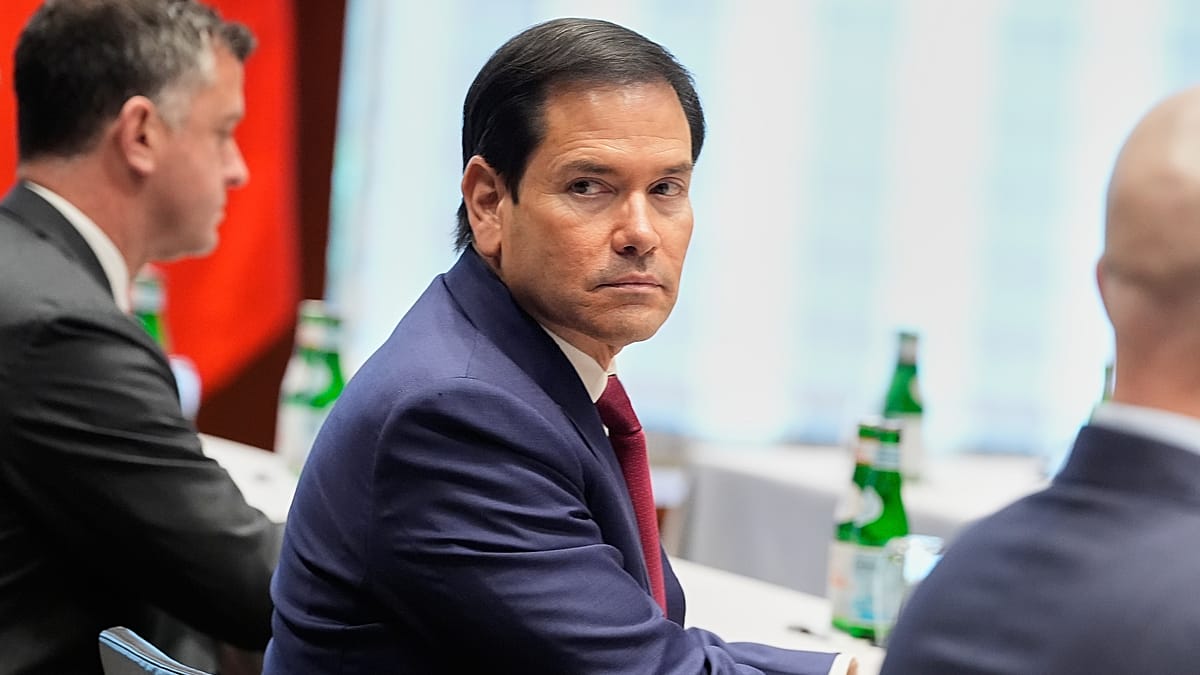
Rubio skips Berlin Format talks on Ukraine in Munich
Russia’s war on Ukraine is at the top of this year’s agenda at the Munich Security Conference, with European leaders trying to keep the United States involved…
Good morning
Good morning and welcome to our live blog on the second day of talks between the world's top security leaders.
Here's a quick recap of what stood out yesterday:
- Germany's Chancellor Merz delivered a dramatic speech which set the tone for the next three days. In it, he said the world order as it has stood for decades "no longer exists" and that a new world order of "power politics" puts even the strongest nations in danger. He dubbed the tension between the EU and the US an "inconvenient truth", said there was a "divide" between the continents and that "freedom could no longer be taken for granted" against the ongoing threat from Moscow.
- Elsewhere, US Ambassador to the UN Mike Waltz and the EU's Foreign Policy Chief Kaja Kallas sparred on spending with Waltz noting that continued payments for international organisations, such as the UN, have become hard to justify to US voters. Kallas told Waltz that "when America goes to wars, then a lot of us go with you, and we lose our people on the way. You also need us."
- Finally, French President Emmanuel Macron praised Europe in a speech that set out a positive view of what the continent could achieve. He mentioned planning "coexistence" with Russia, a new European nuclear sharing programme and pushed back on the notion that Europe was over-regulating its social media platforms.
First up is US Secretary of State Marco Rubio, who is set to deliver a speech one year after Vice President J.D.Vance stunned the same conference with a blistering attack on European countries. Stay tuned —we'll deliver the main lines as we get them.