




























Launched in 2017, this year’s AI for Good summit has set a new visitor record.
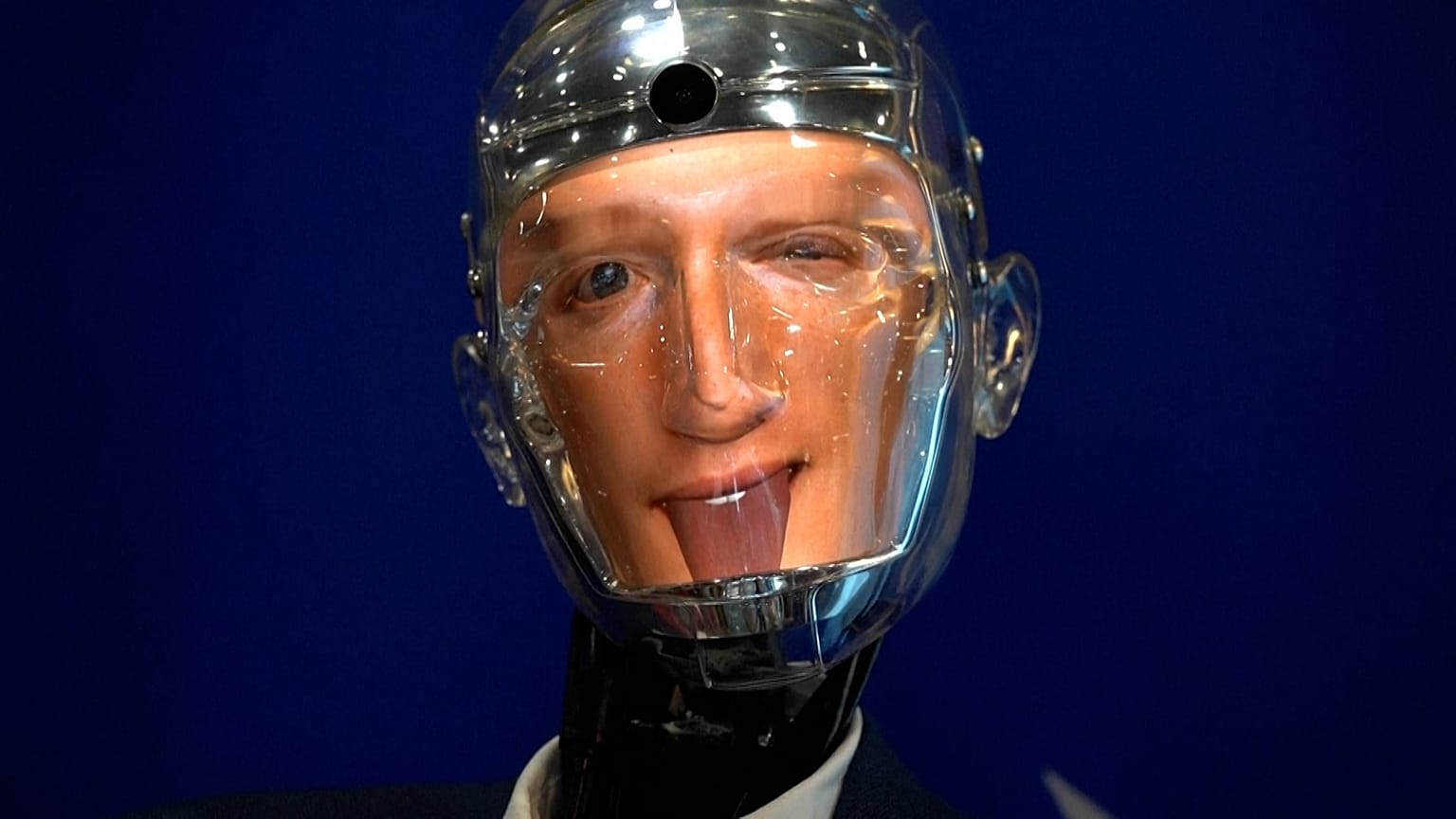
A robot wearing Mark Zuckerberg’s face winks at the crowd. Seconds later, it shifts into the image of Barack Obama.
 ADVERTISEMENT
ADVERTISEMENT
ADVERTISEMENT
This is one of the many displays filling a convention centre in Geneva, where more than 12,000 participants from 170 countries have gathered for this year’s AI for Good summit.
Launched in 2017, the summit set a new visitor record this year, reflecting the growing urgency around artificial intelligence (AI) as governments and industries try to keep pace with a technology moving faster than many regulatory systems can respond.
The summit is taking place as Geneva hosts a wider United Nations (UN) push on AI governance, with delegates from 193 countries meeting to discuss the first UN Global Dialogue on AI Governance.
Across the venue, humanoids, robotic prosthetics and other AI technologies offer a glimpse of where the field is heading.
One of them is Robert, a robot built by Geneva-based RB Labs. A few metres away is Ling Xi, a robotic guide dog controlled by mobile phone.
China Mobile says it has been designed to help blind people live more independently. Each unit costs $4,000 (about €3,506).
Organisers say the summit has drawn growing attention as people try to understand what rapid advances in large language models and autonomous systems could mean for the future.
"We created AI for Good in 2017, and if you think about it, that's an eternity in terms of AI years, right, because AI is moving so fast," said Fred Werner, Head of Strategic Engagement at the International Telecommunication Union.
"I think we're now entering what I would call a zero-click world, where AI agents are not waiting for our prompts, but they're actually acting on our behalf, autonomously. And then looking at the more physical manifestation of AI, in the form of advanced robotics, autonomous mobility, brain-computer interfaces, and even space computing,” Werner added.
When AI leaves the screen
That shift from software to the physical world is visible across the exhibition floor.
Swiss firm Ability Neurotech says its brain-computer interface could give back the "capacity to communicate, to speak, or to move" to people who have lost it.
Their implant sits on the surface of the brain, reading neural signals that remain intact in patients with conditions such as amyotrophic lateral sclerosis (ALS), stroke or spinal cord injuries. The data is then sent to a processor, which decodes it in real time.
The company says the system is edging closer to natural speech.
"We speak at 140 words per minute, more or less. And what we do, we reconstruct the capacity of 70 or 80 words per minute, in real time, for patients that cannot do that today," said Rotem Kopel, the company’s CEO.
At the KAIST stand from South Korea, a wearable hip brace is designed to support people with limited mobility.
"We use AI to customise and optimise the control algorithms, especially for people with gait disabilities," said Kim Jongwon, a postdoctoral student at KAIST.
A few stands along is a prototype wheelchair that can be controlled by voice and simple hand gestures using camera sensors and microphones.
Keeping that data off the cloud was a deliberate choice, according to its developer Adwait Shinde, who teaches mechatronics at the University of the West of England.
"Since this is a medical device, we do not want the user data to go to the cloud or online.
That's why we are using a local AI model, which runs locally on a Jetson board," Shinde added.
Meanwhile, in the youth zone, teams are preparing to compete in the Robotics for Good Youth Challenge.
Some 250 children are taking part in this year’s competition. Students as young as ten have built robots from scratch, using whatever materials they can find locally, to address this year’s theme: food security.
A Lithuanian team scores points with its robot, one of 50 national teams hoping to reach the closing ceremony, where American musician Will.i.am will hand out the top prize.