





























The platform was born out of curiosity. Swedish founders Mikael Robertsson and Olov Lindberg, who ran a flight price comparison site, bought two receivers and put an antenna on a Stockholm rooftop.
When tensions flare or disasters strike, millions of people turn to one app to watch it unfold in real time: Flightradar24.
 ADVERTISEMENT
ADVERTISEMENT
ADVERTISEMENT
The flight tracking platform lets anyone follow aircraft movements live on a digital map, displaying altitude, speed, route, and aircraft type.
Behind it sits a global network of around 58,000 receivers — many hosted by volunteers — that pick up ADS-B signals continuously broadcast by commercial aircraft. Satellite data fills in the gaps over oceans and remote areas.
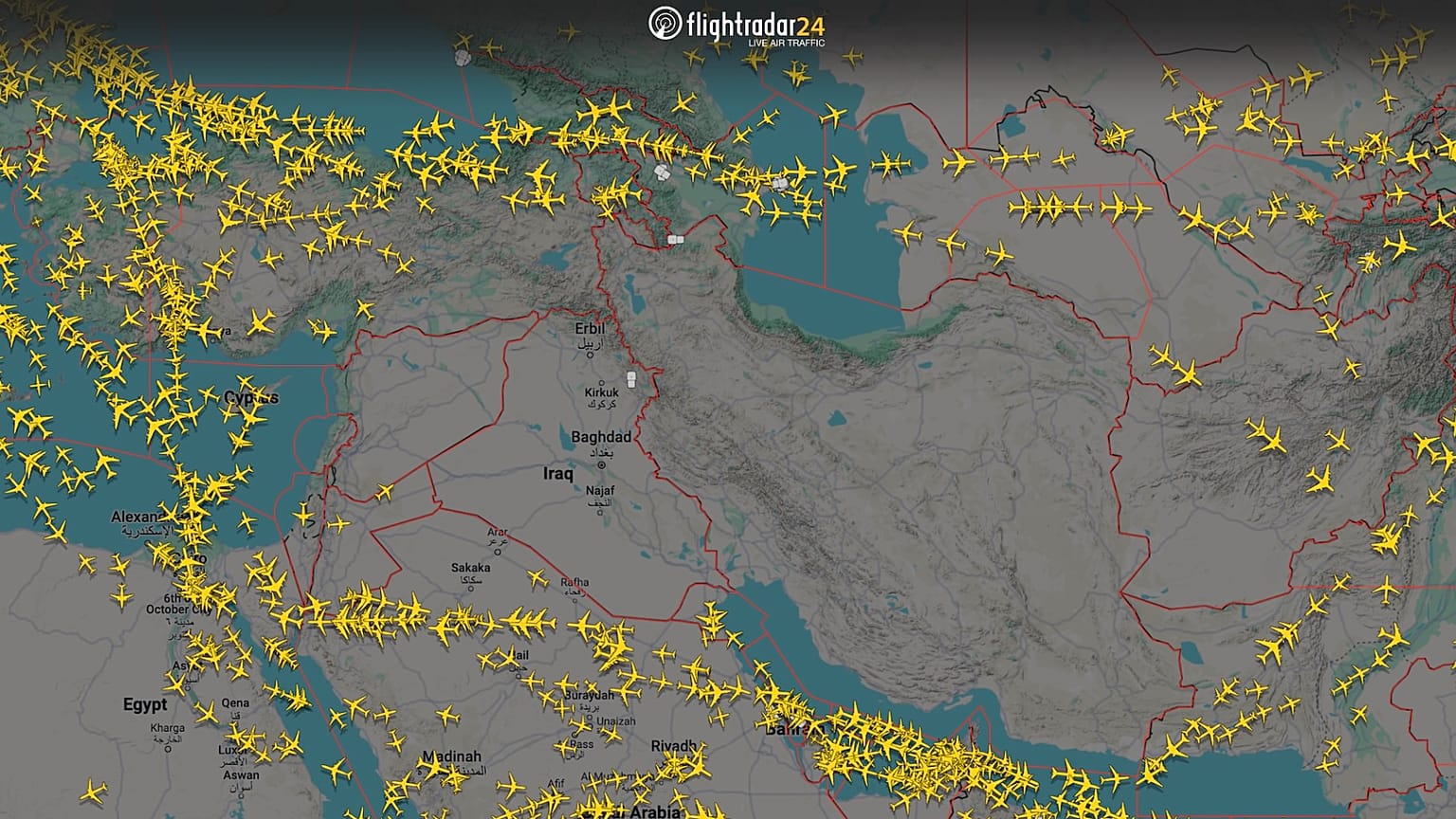
During recent military tensions in the Middle East, the service saw traffic surge as airspace closures and rerouted flights reshaped some of the world’s busiest aviation corridors.
For aviation professionals like commercial pilot Chris Lomas, it's become indispensable. "I don't think I know anyone in the operational side of aviation who doesn't use it," he said. "It's so intrinsic to what we do."
The platform was born out of curiosity. Swedish founders Mikael Robertsson and Olov Lindberg, who ran a flight price comparison site, bought two receivers and put an antenna on a Stockholm rooftop — and quickly found their flight tracker was far more popular than their original business.
The platform shows planes moving across a digital map in real time, displaying information such as altitude, speed, route and aircraft type.
Lomas says tools like this have become common across the aviation industry.
A commercial pilot and flight tracking app user, Lomas says the platform is widely used by aviation professionals.
“From experience, I don’t think I know anyone who works in the aviation industry at least on the operational side of it that doesn’t use Flightradar24 in some way," he said.
He says the app helps build what pilots call situational awareness.
“As an aviation professional and now as a pilot, I find it most useful as a situational awareness tool. And situational awareness in general is a key competency for pilots and for aircrew. Any kind of additional tools we can use that help us get a better idea of what’s going on out there are incredibly helpful," Lomas said.
"So a great example would be if your aircraft is running late, you’re waiting for your aircraft to arrive, we can see roughly where it is. That gives us an indication of what our delay’s gonna be like. Similarly, if we are operating to an airport where the wind is changing, the runway is changing. We can have a quick look on Flightradar24 and get an indication of what runway is being used at the moment.”
Behind the app is a global network of receivers that collect signals broadcast by aircraft.
Most modern commercial aircraft continuously transmit their position using a system called ADS-B, short for Automatic Dependent Surveillance Broadcast.
The transponder sends out data including the aircraft’s location, altitude, speed, and identification.
Those signals can be picked up by ground-based receivers, typically within a range of about 300 kilometres.
Flightradar24 aggregates this data from around 58,000 receivers worldwide, many of them hosted by volunteers who install antennas at their homes or workplaces.
Robertsson says the company receives a few hundred applications every day from people who want to host a receiver and contribute to the network.
Combined with satellite data, the system creates a live global picture of air traffic.
The company supplements its network by purchasing data from a satellite provider operating 66 satellites, helping extend coverage across oceans, deserts and other remote areas where ground receivers are scarce.
Flightradar24 also maintains a database of roughly 1.2 million aircraft worldwide, including details such as manufacturer, age of the aircraft and serial number.
The company was founded in Sweden by Mikael Robertsson and Olov Lindberg, who originally ran a flight price comparison website.
Out of curiosity, they bought two receivers and installed an antenna in Stockholm to see if they could track aircraft themselves.
The receivers picked up ADS-B signals from planes flying nearby. Robertsson says the results were immediate and surprising.
Soon, their flight tracking page proved more popular than the original price comparison service.
Today, the platform is used by aviation professionals, journalists and the public and during major events, interest surges.
When the United States and Israel launched strikes on Iranian targets on 28 February 2026, triggering retaliatory missile and drone attacks by Iran and prompting several countries to impose temporary airspace restrictions, airlines rapidly rerouted or cancelled flights across the region.
Flights were halted or diverted across Iran, Iraq, Israel and surrounding countries as airlines sought to avoid potential danger zones.
Traffic to the Flightradar24 website, according to the company, quadrupled to about 20 million visits in a single day, compared with the around 5 million visitors the site typically receives daily.
Mikael Robertsson, co-founder of Flightradar24, says the conflict dramatically reshaped flight routes between Europe and Asia.
“If we look at what’s happening now, with the conflict in the Middle East, in Iran, I think one very interesting thing is the corridor that goes over Turkey, Georgia, Azerbaijan and Armenia," he said.
"It’s really narrow because before there used to be flights over Iran and Iraq that can’t take place now. So this is the main corridor for flights between Europe and Asia, and it’s just getting smaller and smaller and smaller and smaller.”
The platform has also played a role in understanding aviation tragedies.
Flightradar24 has since played a key role in major aviation events. When MH370 vanished in 2014, tracking data helped redirect the search from China to the sea between Malaysia and Vietnam. The following year, altitude data from the Germanwings crash revealed the aircraft's chilling, steady descent into the French Alps.
During the recent US-Israel strikes on Iran in February 2026, site traffic quadrupled to 20 million visits in a single day as airlines scrambled to reroute flights across the region.
The system isn't perfect. In conflict zones, those signals can sometimes be jammed or spoofed, which leads to zig-zagging as seen here on maps.
This means aircraft can potentially broadcast incorrect locations.
“When they get bad data, then they calculate the bad data. And the aircraft that may be located here thinks that it’s located here, and transmits this position here and then all its flying, then suddenly it thinks it’s here. So what you see on the map is like an aeroplane flying all over space,” Robertsson said.
Even with tens of thousands of receivers worldwide, coverage gaps also remain. Remote regions and oceans continue to pose challenges, too.
To improve coverage, receivers are installed in remote locations, such as this one, which will be sent to Antarctica.
From hobbyists to professionals, the ability to follow aircraft in real time has revolutionised how people follow what's landing, taking off or changing course around the world.