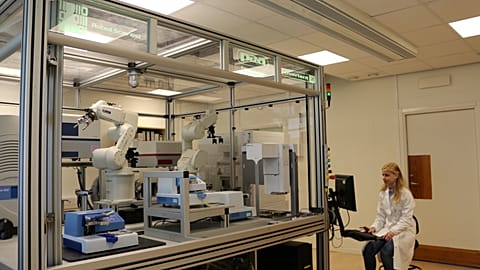






























A new AI model by Google DeepMind can decipher DNA and predict mutations, opening new doors for disease research.
Our DNA is made of millions of combinations of the genomes that create the human body. Even the smallest changes in these sequences, or in how they act, can change the functioning of the whole body and cause diseases such as cancer.
 ADVERTISEMENT
ADVERTISEMENT
ADVERTISEMENT
AlphaGenome, Google’s new artificial intelligence (AI) tool, can read large stretches of DNA and predict how different sections behave and how changes could lead to diseases.
Using deep learning and inspired by how the brain processes information, it is designed to help scientists understand how DNA works.
Google’s new tool can help decode how DNA controls genes by predicting what long stretches of genetic code do.
“We believe AlphaGenome can be a valuable resource for the scientific community, helping scientists better understand genome function, disease biology, and ultimately, drive new biological discoveries and the development of new treatments,” Google DeepMind said.
How does AlphaGenome work?
The model reads up to one million DNA letters with single-letter precision – something impossible with previous tools.
DNA consists of long chains made from four basic chemical building blocks called nucleotides, each identified by a letter: A, C, G, and T. It works as an instruction manual for making and controlling every cell.
Only about two percent of human DNA directly codes for proteins, the building blocks that do most of the work in our cells.
The remaining 98 percent has long been dismissed as “junk DNA”; however, far from being useless, these sequences act like control panels regulating how the other two percent works.
They guide when, where, and how much genes turn on or off, respond to environmental signals, and influence RNA splicing, a system that joins sequences of letters and allows the same gene to produce different readings.
Many disease-linked variants hide here, affecting gene activity without altering proteins.
AlphaGenome is the first deep learning model able to target this part of DNA and predict its functioning.
The model can estimate how small genetic changes, called variants, can affect gene activity or interrupt normal processes linked to diseases such as cancer.
How does it work in practice?
As a real-life example, the researchers focused on a type of acute leukaemia, a cancer of the white blood cells, where immature T-cells, immune fighters, grow out of control.
Some leukaemia cases are caused by small changes in DNA that don’t change a protein itself, but instead change how strongly or when certain genes turn on.
The AlphaGenome model compared the normal DNA sequence with the mutated one, and predicted how likely the mutation is to increase the activity of nearby genes.
The model is currently available for scientists for free for non-commercial research; it is a research tool, not meant to be clinically used.
How can it help?
The research team sees multiple uses for the new model.
In molecular biology, it can work like a virtual lab tool, allowing scientists to test ideas by simulation before doing expensive experiments.
In biotechnology, it can help design genetic therapies or improve molecules that target specific tissues.
“DeepMind’s AlphaGenome represents a major milestone in the field of genomic AI,” said Robert Goldstone, head of genomics at the Francis Crick Institute.
He added that the level of resolution that the new model allows is a breakthrough that moves the technology from theoretical interest to practical utility, allowing scientists to programmatically study and simulate the genetic roots of complex disease.
“AlphaGenome is not a magic bullet for all biological questions, but it is a foundational, high-quality tool that turns the static code of the genome into a decipherable language for discovery,” Goldstone added.
However, scientists warn that, like all AI models, AlphaGenome is only as good as the data used to train it.
“Most existing data in biology is not very suitable for AI - the datasets are too small and not well standardised”, said Ben Lehner, head of generative and synthetic genomics at the Wellcome Sanger Institute in the United Kingdom.
According to him, the most important challenge right now is how to generate the data to train the next generation of AI models.